


Shop Talk
Capturing this week’s zeitgeist
As America continues to celebrate its 250th anniversary, Union Pacific’s Big Boy No. 4014, the world’s largest operating steam locomotive, continues its historic coast-to-coast tour, thundering across the nation as a living tribute to the engineering ingenuity that helped build and unite the country /NPR/.
Remaining public displays are scheduled /UP/ in St. Louis on July 19, Kansas City on July 21-22, and Hays, and Kansas on July 25. Come see the restored 133-foot, 1.2-million-pound marvel captivates crowds with its raw power, haunting whistle, and the sheer spectacle of steam-era might, drawing families and rail enthusiasts alike to witness a once-in-a-lifetime connection to America’s industrial heritage.
Not in America? Exponential Industry is developing a game to experience industrial heritage across the world. Stay tuned!
Heard on the floor
“It’s an AI problem. It’s not a data problem, and it’s not an energy problem,” he said. “If you’re a tier-one AI researcher, where are you going to work? I don’t think Shell’s on that list.”
Applied Computing Chief Executive Callum Adamson /TNW/

Yes, there will be winners in the robotic supply chain, but the big outsized winners will be those that build and sell the robots themselves: Tesla, Figure, 1X, Apptronik, etc.
And the biggest will have in-house data collection and in-house robotic AI models as well as significant vertical integration in motors, actuators and other key hardware.
Assembly Line
This week’s industrial breakthroughs and frontier technologies of the built world.
How China came to dominate the global EV factory boom
A New Semi Every 8 Minutes: Inside Tesla’s Truck Factory /Core Memory/
Decommissioning the original Model S & X assembly line in just 46 days /Tesla/
The landscape of automotive companies and their robotics bets /Vedant Nair/
Inside the Self-Driving Manufacturing Lab
Georgia Tech’s Advanced Manufacturing Pilot Facility is using AI, robotics and autonomous experimentation to accelerate manufacturing development. Dr. Tom Kurfess explains how the self-driving lab is helping manufacturers test and de-risk new technologies before they reach production.
The Lab Mistake That Might Revolutionize Computing
✍️ Authors: Mario Lanza, Sebastian Pazos
The brain is roughly one million times as energy efficient at many of the comparable tasks we set for AI. To try to approach these efficiencies, a radically different way of computing called neuromorphic engineering is seeking to build electronic components and circuits that act more like the brain’s neurons and the synapses that connect them.
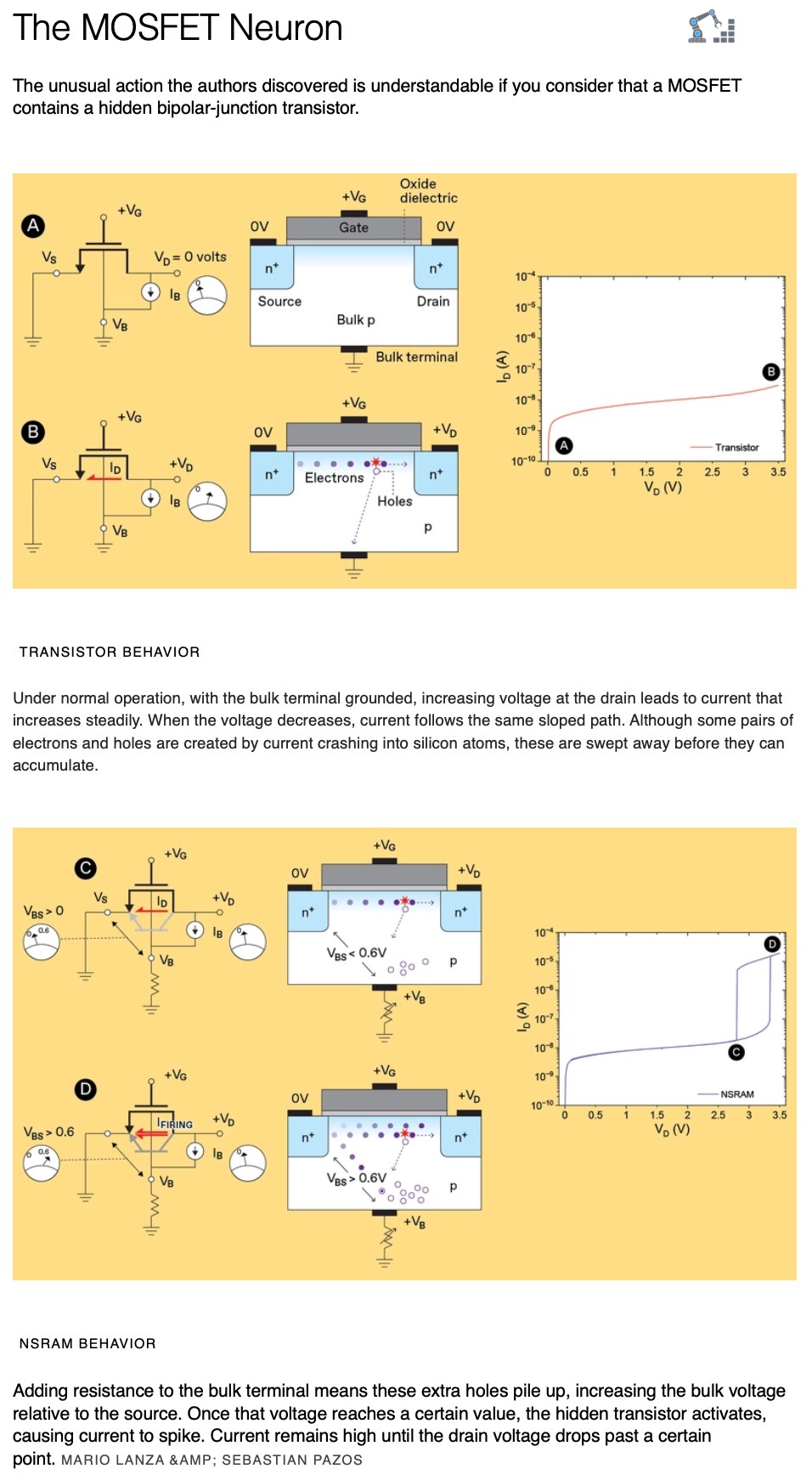
Working in our laboratory in 2024, one of my students was measuring a memory circuit that consisted of one transistor and one memristor—a type of nonvolatile memory device first fabricated in 2008. The student’s memristor circuit was built from two-dimensional material atop a silicon microchip containing MOSFETs. The MOSFETs were created in a commercial foundry using fabrication technology called the 180-nanometer node, which was cutting-edge in the year 2000.
One day the student forgot to connect the bulk terminal of the transistor. What he observed was a sudden increase in current with high nonlinearity that self-relaxed when the voltage was ramped down (a phenomenon called a hysteresis loop). This was a very promising neuronlike behavior!
Read more at IEEE Spectrum
Neuromorphic principles meet reinforcement learning for virtual robotic control /Neuromorphic Computing and Engineering/
RoboTTT: Context Scaling for Robot Policies
✍️ Authors: Yunfan Jiang, Yevgen Chebotar, Ruijie Zheng, et. al
Recent robot foundation models operate with single-step or short-history visuomotor context. We introduce Test-Time-Training Robot Policies (RoboTTT), a robot model and training recipe that scale visuomotor context to 8K timesteps, three orders of magnitude beyond state-of-the-art policies, without growing inference latency. At this context length, we unlock new robot capabilities: one-shot in-context imitation from human video demonstrations, on-the-fly policy improvement, robustness to perturbations, and stronger performance on multi-stage, long-horizon tasks.
Read more at arXiv and NVIDIA Research
WAM-TTT: Steering World-Action Models by Watching Human Play at Test Time /arXiv/
Claude plays robotics /Anthropic/

New Product Introduction
Highlighting new and innovative facilities, processes, products, and services
Kimi K3: Open Frontier Intelligence
As an early proof of concept, Kimi K3 designed a chip to serve a nano model built on its own architecture. In a single 48-hour autonomous run, K3 built, optimized, and verified the chip using open-source EDA tools on the Nangate 45nm library. Within 4 mm², the chip closes timing at 100 MHz and sustains over 8,700 tokens/s decode throughput in simulation, packing 1.46M standard cells, 0.277 MB of SRAM, and an INT4 MAC array with fused dequantization. A chip built by a model, for a model, reflects K3’s long-horizon agentic capabilities.
Read more at Kimi
Archer Announces Zee, AI Foundation Model Purpose-Built for Aviation, a Key Pillar of Its Physical AI Strategy
Archer created Zee, what it believes to be the world’s leading aviation-specific foundational model that delivers a unified aviation intelligence platform built on ADS-B, ATC communication, maps and charts, aircraft state, terrain and weather data. Zee is trained on real-world operational data, aggregated through Archer’s proprietary data pipeline and a global network of over 6,000 ADS-B receivers.
On a typical day, more than 45,000 flights move through American airspace. That flight activity generates a constant flow of data in the form of radio calls, navigation inputs and aircraft-state that pilots and air traffic controllers piece together in real time. Zee is built to understand these disparate data sources as a single system. The goal of Archer’s approach with this unified aviation intelligence platform is to deliver a lower latency, better performing model capable of running on-device requiring no connectivity, critical for use in a wide range of aviation environments from air taxis and UAVs to commercial airliners and air traffic management.
Read more at Archer
Business Transactions
This week’s top funding events, acquisitions, and partnerships across industrial value chains.
Walden Robotics Launches with $300 Million to Put General-Purpose Robots to Work Today
Walden Robotics, a full-stack Physical AI company building and deploying general-purpose robots that continuously learn and improve while performing real work, launched out of stealth with $300 million in funding. The round, which values the company at $1.1 billion, is co-led by Toyota (Toyota Motor Corp, Toyota Invention Partners, and Toyota Ventures) and Deviation Capital, with participation from NVIDIA, Boeing, AE Ventures, Samsung Ventures, Prologis Ventures, CoreWeave Ventures, and financial partners Calibrate Ventures, Colle Capital, Shine Capital, NextView Ventures, Squarepoint Capital, One Madison Group, KAS Venture Partners, and Menlo Ventures, among others.
Walden’s product builds on a decade of foundational AI and robotics research the Walden team helped pioneer, including Diffusion Policy and Large Behavior Models (LBMs), the frontier model class that powers Walden’s robots and lets them quickly learn new tasks and continuously improve through real-world practice. Walden launched out of Toyota Research Institute in January 2026 and began working with customers across multiple industries immediately. Since February, Walden’s general-purpose robots have been doing useful work in production at a Toyota plant in North America, moving from first pilot to real work in under two months.
Read more at Business Wire
LimX Dynamics Closes US$200 Million Pre-IPO Round /LimX/
microagi raises $55 million seed round to power Europe’s robotic reindustrialisation /microagi/
TerraFirma Raises $115M to Accelerate Construction on Earth and Beyond
TerraFirma, a tech-enabled, vertically integrated construction company focused on critical infrastructure, announced it has raised approximately $115 million, including a $100 million Series A led by Kleiner Perkins, with participation from Bain Capital Ventures, Glade Brook Capital Partners, BANNER VC, Saga Ventures, Trust Ventures, Definition, PEAK6, Magnetar Capital, and Ravelin Capital. Angel investors include founders, executives, and engineers from companies including SpaceX, Anduril, Base Power, Shinkei, and Hadrian.
TerraFirma is building the robotic infrastructure stack for modern construction. The company’s full-stack platform combines AI-enabled pre-construction software, a remote command-and-control center, and retrofitted semi-autonomous heavy machinery, including excavators, dozers, loaders, rollers, skid steers, and more, converted into robots that no longer require an operator in the cab. Instead, skilled operators orchestrate entire fleets from screens, using the same intuition and judgment they’ve built over years, now extended across multiple machines at once. The result is a system that can make each operator up to 300% more effective, accelerating project execution, reducing costs, and creating jobs that are safer and higher-paying than traditional equipment operation.
Read more at Business Wire
Monumental raised $32 million to put more robots to work building the world /Monumental/. They run a fleet of more than 100 robots laying real brick on job sites across Europe today.
Hyperion Robotics raises €6.4 million to bring physical AI to European infrastructure /EU Startups/ using large-scale additive manufacturing and localized robotic microfactories to replace traditional, labour-intensive concrete processes with a cleaner, faster alternative. It claims to use up to 75% less material and to reduce program times by up to 3x.
Senra Systems Announces $65 Million Series B, Plans for Third Manufacturing Facility
Senra Systems, a software-driven manufacturing company modernizing wire harness production, announced it has raised $65 million in a Series B funding round and plans to accelerate its expansion with a third factory location. The round brings the company’s total funding raised to over $112 million and was co-led by Lowercarbon Capital and Interlagos, with participation from General Catalyst, Sequoia Capital, Andreessen Horowitz, Founders Fund, Dylan Field, CIV, 8VC, The Friedkin Group, Jaws Estates Capital, Sozo Ventures and Alumni Ventures.
Senra manufactures complex wire harness systems used in aircraft, spacecraft, launch vehicles, satellites, defense systems and other advanced platforms. The company’s manufacturing model is powered by Amp, its proprietary software platform that integrates quoting, engineering, manufacturing, supply chain management and production workflows into a unified system. Unlike traditional wire harness manufacturing environments that rely heavily on fragmented manual processes, Senra’s integrated manufacturing approach enables faster onboarding, reduced production variability and accelerated delivery timelines.
Read more at PR Newswire
Bezos’ Blue Origin Said to Seek Funds at $130 Billion Valuation /Bloomberg/
Ravee Optics Secures $6 Million Seed Round as the Need to Move More Data in Space Explodes /Business Wire/
Lucid Weighs Going Private or Chapter 11 as Adviser Reports to Board
Restructuring adviser AlixPartners has been asked to deliver its findings to Lucid‘s board before its next meeting, two people familiar with the matter told EV. The strategic options under review include taking the Saudi-backed EV maker private or filing for Chapter 11 bankruptcy protection, one of the sources said.
Read more at EV
AE Industrial Establishes Specialty Materials Platform with Investment in Powder Alloy Corporation /AE Industrial Partners/
Looking for additional content? Paid subscribers get more stories delivered each week as part of Overcapacity!