


Shop Talk
Capturing this week’s zeitgeist
Exponential Industry’s mission is to be the premier source and mixed-media aggregator for the business culture of high-tech manufacturing, energy, and supply chains. We are building a thriving community of founders, engineers, operators, and capitalists who are accelerating innovation in the physical world. Our tenets:
Direct from the source - We select from primary sources across millions of company blogs, press releases, podcasts, deep-dive articles, social media posts, and videos directly from where they are originally published.
(Otherwise mishaps like the WIRED exclusive on the 1X hands launch happen)Credit and attribution - We prominently display the authors and publication to give credit where credit is due.
Straight to the point - Our excerpts seek to answer what and why. We highlight the technology, value proposition, and results so each reader is briefed on a wide range of cross-discipline topics and is encouraged to dive deeper if the content is enticing to explore further.
Private and opt-in by default - Substack is used to deliver this publication directly to your inbox.
Please spread the word of Exponential Industry by sharing the publication:
Heard on the Floor
“This country is either going to start making things again or it’s going to circle the drain.”
Mike Rowe on the Shawn Ryan Show /YouTube/
Assembly Line
This week’s industrial breakthroughs and frontier technologies of the built world.
🗜️ How to Build a Full Body Ultrasound
This project is actually crazy, combining 40 ultrasound probes into one machine, an underwater elevator to slide you through them, and the computational expertise to build an image of your insides just based on the echoes of what bounced around you.
Announcing Midjourney Medical /Midjourney/
How The World’s Best Cricket Balls Are Made in Australia /YouTube/
🛰️ Space Can Have Big Impact on the Economy
Money is flooding into the space economy, from SpaceX’s record IPO to Blue Origin’s first outside fundraising effort. But while capital is abundant, rocket launches are not. Founders Fund Partner and Varda Space Chairman Delian Asparouhov explains why access to space could become the industry’s biggest bottleneck.

🔻 The Debt-Fueled Collapse of China’s Top Machine Tool Maker
Shenyang Machine Tool (SYMT), once the world’s top machine tool maker, collapsed in 2019 due to unsustainable debt-fueled expansion and reliance on unmastered foreign technology. Following a bankruptcy reorganization, the state-owned conglomerate General Technology Group (GENERTEC) took control of the Shenyang Machine Tool Group to salvage and restructure the business.
☀️🚰 New 3D Photothermal Structure Enables Efficient Solar Desalination and Crop Irrigation
✍️ Editor: Zhang Nannan
Researchers from the Institute of Process Engineering, Chinese Academy of Sciences, and Shenzhen University have developed a new three-dimensional (3D) photothermal structure that greatly improves solar evaporation efficiency.
The researchers used Hansen solubility parameter theory to tightly combine polyethylene terephthalate (PET) chains with HoMS /Advanced Materials/. Accelerated seawater aging tests found no detectable particle detachment from the material after 30 days of continuous exposure. In addition, no active free radicals were detected when the material was exposed to light, suggesting potentially good durability and reliability during long-term use.
The new technology also shows promising economic potential. The researchers estimate that after two years of operation, the cost of water produced by this technology would be lower than that of commercial bottled water. If it proves capable of stable long-term performance, the new material may offer a practical solution for sustainable freshwater production in regions facing water shortages.
Read more at Chinese Academy of Sciences

New Product Introduction
Highlighting new and innovative facilities, processes, products, and services
⚡🛢️ Making a new gas turbine, how big should it be?
“There’s a sweet spot in the 40-50MW range where the turbine has most of the efficiency of a gigantic unit yet is also much more manufacturable and deployable. This is the sweet spot is in total cost per unit energy, inclusive of capital expenditure.
This is why Superpower sits at the ever magical 42MW.”
Read more at Blake Scholl on X
neuralCAD-Edit: An Expert Benchmark for Multimodal-Instructed 3D CAD Model Editing /GitHub/
🫲🦾🧠 NEO’s Hands: An API to the Physical World
Our NEO hand is read-write. Developed from the ground up by our world-class engineering team, it runs quasi-direct-drive tendons via the 1X Tendon Drive at low gear ratios of approximately 5:1 to 15:1. All 25 degrees of freedom (22 fully actuated DoF in the fingers and palm, plus 3 at the wrist) are natively force-controlled and fully backdrivable. Push on a finger and it yields — and reports exactly how hard you pushed. Force flows out and information flows back through the same physical path. We call this force transparency, and it’s what turns a push into a measurement.
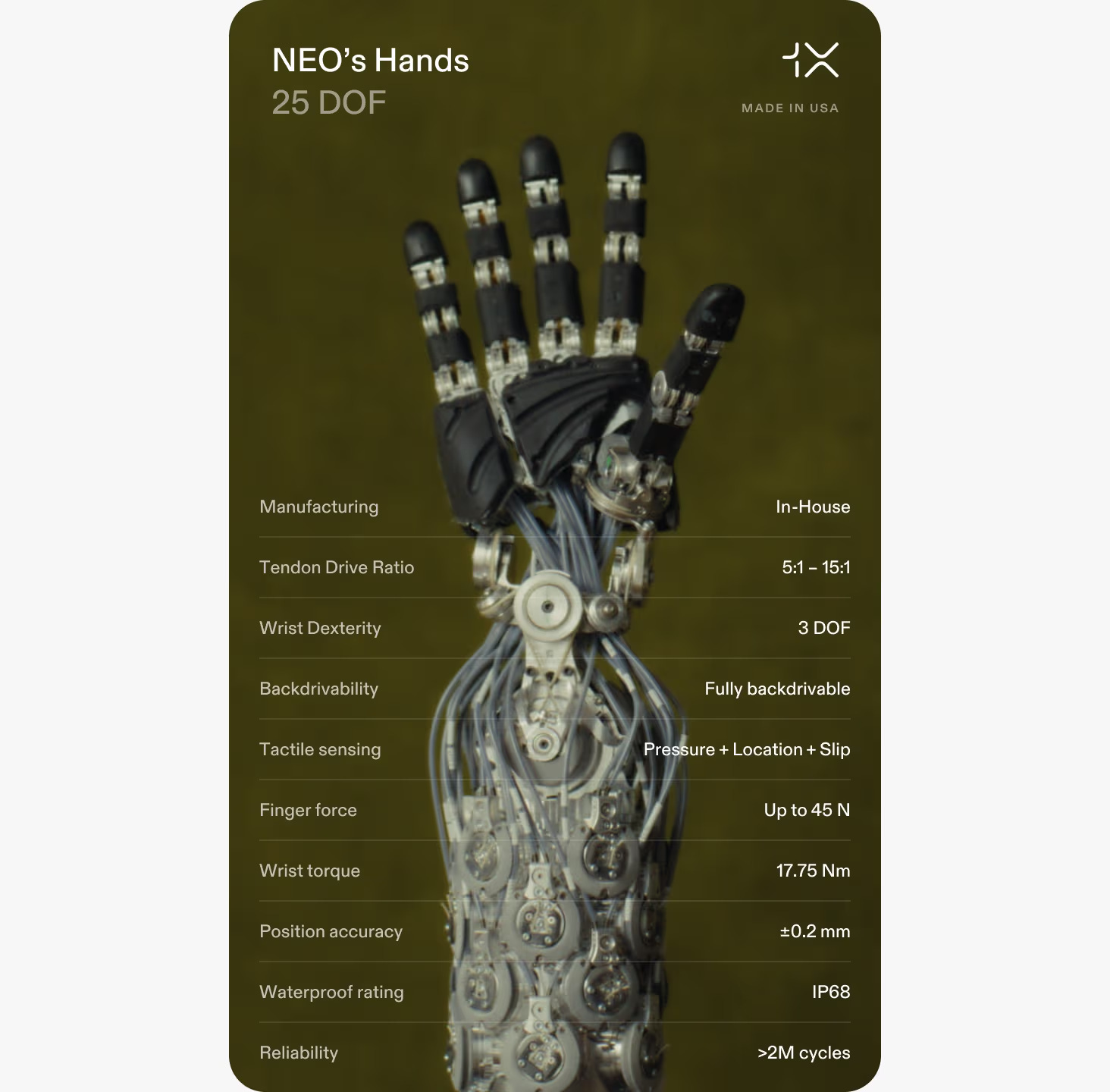
These 25-DoF hands are IP68 waterproof and food-safe, allowing NEO to wash its own hands like a human. Far from fragile, they deliver powerful, useful strength: Peak torques reach 3.5 Nm at the thumb CMC and 2.6 Nm at the finger MCP joints, with distal flexion forces up to 45N. The wrist delivers 17.75 Nm of torque. This enables strong whole-hand grasps, tool use, lifting and carrying, opening doors, pushing loaded carts, and precision pinch under load, all while retaining full dexterity. With ±0.2 mm positioning accuracy, they work (and perceive) in the small-object regime where most human labor actually happens. Those aren’t demo modes. They’re the natural output of enough independent, force-controlled DoF at human scale.
Read more at 1X.tech
AnyHand: A Large-Scale Synthetic Dataset for RGB(-D) Hand Pose Estimation /GitHub/
NVlabs/ProtoMotions is a GPU-accelerated simulation and learning framework for training physically simulated digital humans and humanoid robots /GitHub/ and transfers directly to the Unitree G1 humanoid robot zero-shot.
Robotics precision-transmission supplier Laifual Drive listed in Hong Kong /Hong Kong Exchange/
Constraint Capital #7 - Creating Valuable Humanoid Components

Agility Robotics’ recent announcement of a $2.5 billion SPAC merger with Churchill Capital Corp XI /Agility/ and Unitree Robotics’ ongoing push toward a Shanghai STAR Market IPO /ACN Newswire/ mark notable milestones in the humanoid robotics sector’s evolution toward commercial maturity.
Business Transactions
This week’s top funding events, acquisitions, and partnerships across industrial value chains.
🇺🇸♨️ Quaise Energy Raises $134 Million in Initial Close of Series B to Build World’s First Superhot Geothermal Power Plant
Quaise Energy, a leading developer of utility-scale superhot geothermal energy, announced the first close of its Series B financing, raising $134 million with additional equity and debt capital expected to close imminently. The round was led by Prelude Ventures, with strategic investments from JERA and Idemitsu, two of Japan’s largest energy companies. Nearly all existing investors, including Safar Partners, participated in the round.
The proceeds from Series B will fund Project Obsidian, the world’s first commercial superhot geothermal power plant, and the continued development and commercialization of Quaise’s millimeter wave drilling system towards depths in excess of 5 km. Project-level equity and debt financing is concurrently being raised as the company advances toward first revenues secured by yet-undisclosed commercial off-take partners.
Read more at Business Wire
🇺🇸🔋 EnergyX Secures $225 Million Strategic Investment from Eni to Advance the Black Giant™ Lithium Project in Chile /PR Newswire/
🇺🇸♨️ Hephae Energy Technology Raises $17.8 Million for Commercial Deployment of Superhot Drilling Tech to Advance Geothermal /EINPresswire/
🇧🇪🥔 Polysense raises $10.7M to shape the food factory of the future
Polysense has built AI-native quality control and process optimization technology for food manufacturers. The $10.7M round was led by Felix Capital, with participation from Fortino Ventures, Syndicate One and angel investors including 100IN. This funding goes toward expanding to more production lines worldwide, growing our team, and making deployment faster.
🇺🇸📸 Oxipital AI Closes Series A Following Major Commercial Expansion and Rapid Adoption of its V-CORTX AI Vision Platform /PR Newswire/
🇬🇧🎛️🧠 Luffy AI raises £8.1M to put self-tuning AI inside the world’s electric motors
Luffy AI, an Abingdon startup building what it calls neuroplastic AI for the real-time control of physical machines, has raised £8.1m in a Series A round. The round was led by BGF, which bills itself as the most active equity investor in the UK and Ireland, and the money is earmarked for turning pilots into commercial deployments. It is a large ambition for a modest round, and one that rests on whether a self-tuning motor can prove itself on a real factory floor rather than in simulation.
Read more at TNW
🇬🇧📺🏭 Pixel-Flo Raises £5.25 Million Seed Round to Unlock MicroLED Displays for the Mass Market
Pixel-Flo, a University of Sheffield spin-out addressing a critical bottleneck in MicroLED display manufacturing with its proprietary Continuous-Flo™ Mass Transfer technology, has raised £5.25 million in Seed funding. The round was led by Northern Gritstone with additional investment from SCVC, the Parkwalk Northern Universities Venture Fund, and German investment firm, HTGF.
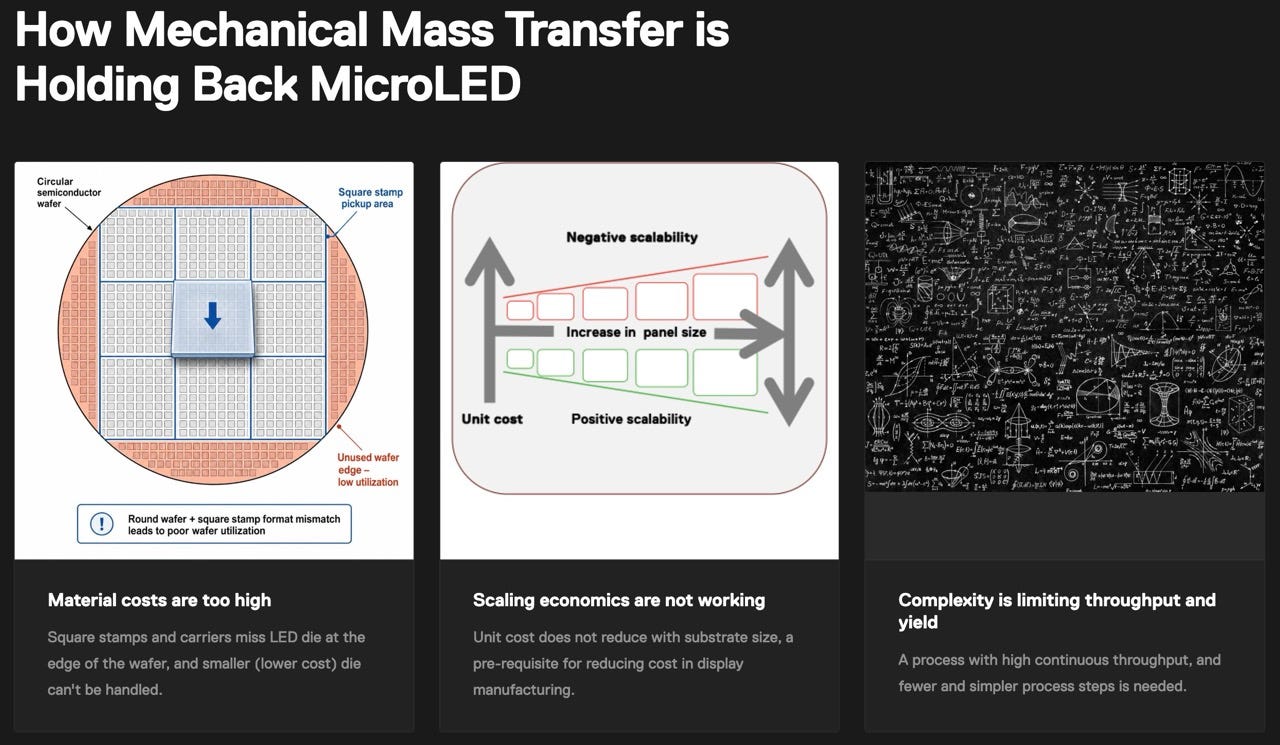
Pixel-Flo is developing the cost reduction breakthrough critically needed for MicroLED display manufacturing, through its highly scalable, cost-efficient approach. MicroLED is the next wave of display technology, offering 2–5x higher brightness and 2–4x greater efficiency than traditional displays. However, volume adoption of microLED is currently limited by the fundamental scalability challenges of mechanical mass transfer techniques. By comparison, Pixel-Flo’s proprietary fluidic self-assembly technology offers extremely high continuous throughput, delivering the high-performance of MicroLED at radically reduced processing and material cost. This will allow MicroLED enabled products from smartwatches to TVs to be made available at mass market price points.
Read more at Pixel-Flo
Looking for additional content? Paid subscribers get more stories delivered each week as part of Overcapacity!