


Shop Talk
Capturing this week’s zeitgeist
In 1956, the GM Tech Center was hailed as an “Industrial Versailles” /JSTOR/ a sprawling monument to the belief that the future could be manufactured through sheer precision and architectural grandness. But as we’ve learned over the last 70 years /Assembly/, the most iconic leaps often happen in the frantic, unpolished spaces between the prototype and the finish line.
In this week’s issue, we look at the man on the moon mindset that bridges Detroit’s mid-century dominance with today’s silicon-and-intelligence frontiers. Apple’s own “man on the moon” project the high-stakes was a six-month sprint to replace the iPhone’s plastic screen with glass just weeks before launch.
Flash forward to today, and the legacy of these high-pressure tech centers is alive and well this morning. The four-person crew of Artemis 2 streaks past the halfway point between Earth and the Moon, we see the ultimate result of turning impossible prototypes into operational reality which is what Exponential Industry is all about.
Quote of the Week
And what confirms that the site is very competitive is that in the current market environment and all the headwinds we are facing from what’s happening in the Middle East, still, after a smooth startup of our plants, the plants are running at a very high utilization rate, while our competitors, many of them had to reduce their run rate, some even had to declare force majeure. Given that we are having very good cost positions and we are having a mixed-feed cracker that allows us to shift feedstocks between naphtha and butanes, we can run full.
Stephan Kothrade, CTO BASF /Yicai/
Failed AI tractor company, Monarch Tractor, lays off all employees, abandons Bay Area headquarters /SFGATE/
New in 2026: We are gifting a 1-year paid subscription to the first person to identify the content link AND cultural reference to the title/subject line of this week’s digest. Comment on this post with your guess before next week’s digest is released to be eligible!
Last week’s answer: Agency to Build Thinking Factories
Assembly Line
This week’s Industry 5.0 breakthroughs and frontier technologies of the built world.
🚀 Artemis II Launches Astronauts to the Moon
Artemis II’s SLS (Space Launch System) rocket lifted off from Launch Pad 39B at NASA’s Kennedy Space Center in Florida, at 6:35 p.m. EDT (2235 UTC) on April 1, 2026, sending NASA astronauts Reid Wiseman, Victor Glover, Christina Koch, and CSA (Canadian Space Agency) astronaut Jeremy Hansen on an approximately 10-day test flight around the Moon and back aboard their Orion spacecraft.
🚀 Liftoff! NASA Launches Astronauts on Historic Artemis Moon Mission /NASA/
🚀💰 SpaceX Has Filed Confidentially for IPO Ahead of AI Rivals /Bloomberg/ seeking a valuation in the IPO of more than $1.75 trillion while raising as much as $75 billion.
🚗 Reimagine marketing at Volkswagen Group with generative AI
✍️ Author: Liam Byrne, Kim Robins, Philipp Hinderberger, Sebastian Angersbach, Philip Trempler, and Weiran Zhang
The first step in Volkswagen’s generative AI journey was deceptively simple: could foundation models (FMs) generate photorealistic images of their vehicles? Initial experiments with base diffusion models revealed two critical gaps. First, while these models could produce impressive automotive imagery, they lacked decades of Volkswagen design language. The tiniest features matter: the exact texture of a grille mesh, the precise geometry of headlight housings, the specific wheel spoke patterns for each model line. The models would generate a Volkswagen, but with generic wheels and grille patterns that didn’t match an actual model year. Second, base models had no knowledge of unreleased vehicles. They couldn’t generate images of next year’s models still under development, severely limiting their utility for forward-looking marketing campaigns.
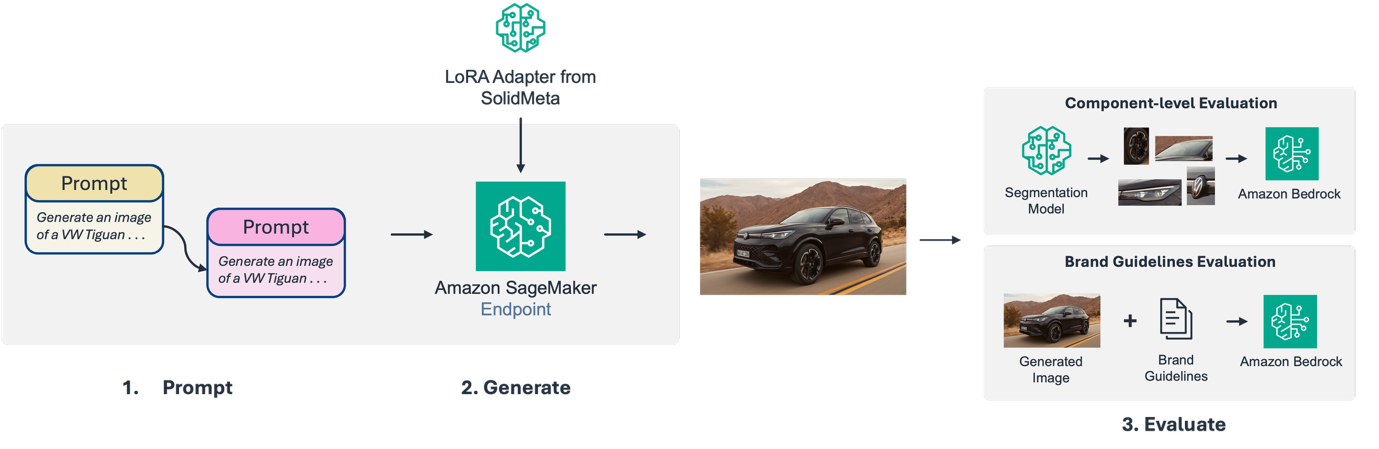
The solution required fine-tuning foundation models on Volkswagen’s proprietary visual assets. Working with SolidMeta, the team used DreamBooth fine-tuning techniques with training data collected from digital twins in NVIDIA Omniverse. The following diagram illustrates this process for the Volkswagen Tiguan. DreamBooth training works in two parts: first, the model learns from VW Tiguan images paired with a unique identifier token ‘VW Tiguan’ that teaches it this specific vehicle. Second, the model trains on generic car images to preserve its general capabilities and help prevent overfitting to the training set.
Read more at AWS Blogs
Autonomous CNC Programming
Tanmay Aggarwal, CEO of Lambda Function, in a deep conversation about autonomous CNC programming, real-time shop floor integration, and why memory and causal inference matter for the next wave of physical AI.
🎨🦾 A New Way to Spray Paint Color
✍️ Author: Sandesh Manik, a mechatronics engineer and the founder of a stealth startup focused on 3D modeling for hardware.
I wanted my solution to be inexpensive and simple enough to build as a DIY project and functional enough for an artist to use, without breaking their flow. So I began prototyping a system that combines base colors while they are still in pressurized form from off-the-shelf cans.
Even though the system worked, the solenoid valves I used constantly clogged up. Designed for water purifiers, the valves didn’t prevent paint from entering the mechanism, where the paint would harden. Moreover, when the valves were turned off, they could stop backflow only if the inlet remained pressurized. So disconnecting a paint can from the system would cause instant leaking. Other off-the-shelf valves I tried couldn’t cycle fast enough and were too expensive.
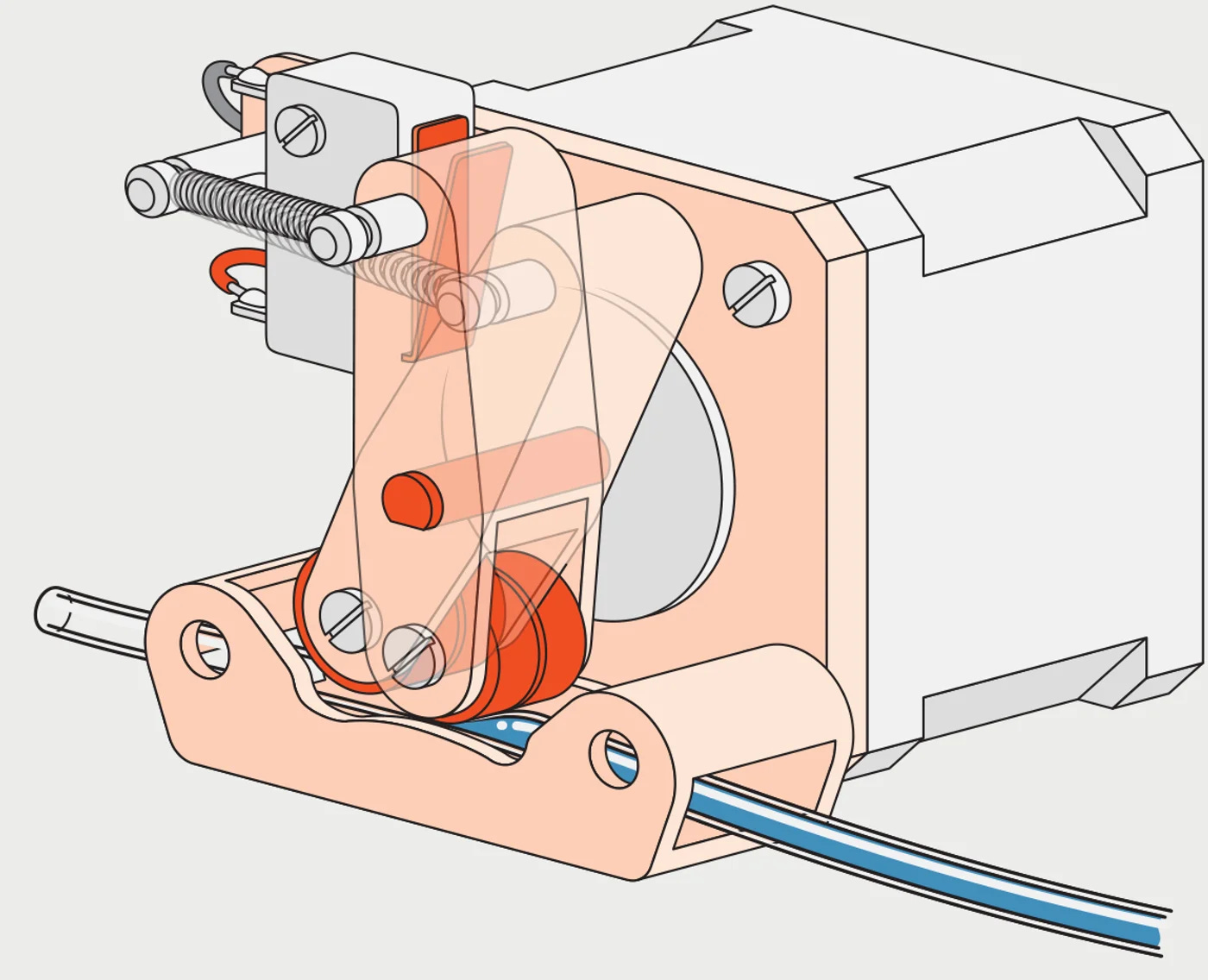
So I created my own mechanism: a high-speed, electronically controlled, rotary pinch valve. It has a stepper motor that rotates a lever with a rolling bearing to constrict fluid flow inside a flexible tube. This concept isn’t new—there’s something like them in every peristaltic pump. But I added a spring to firmly hold the lever in the closed position against any back pressure when the motor isn’t powered, making it a normally closed valve that isolates the attached can. Additionally, the valve is fast enough to be open for as little as 30 milliseconds.
Read more at IEEE Spectrum
🪨🧠 AI for American-Produced Cement and Concrete /Meta/. BOxCrete: Bayesian Optimization for Sustainable Concrete Mix Design /GitHub/
🚗🧠🔧 Can AI Predict Loose Bolts in Automotive Assemblies?
Standardized test methods, such as DIN 65151 and DIN 25201, are effective in terms of performance evaluation for single bolt and nut types. However, the rigid conditions in those tests are not necessarily applicable to bolted joints in automobile chassis. The conditions are different, and the external loads acting on the joints have variable frequency.
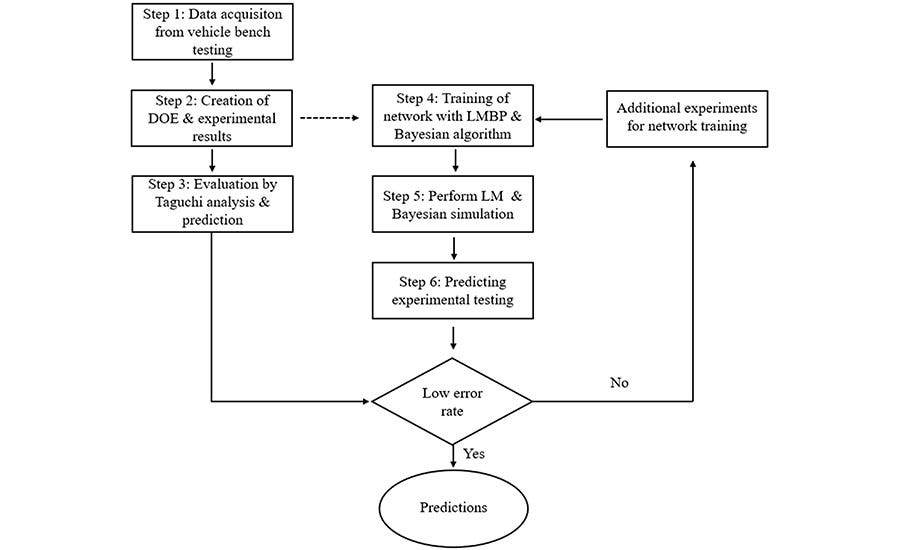
Our approach consisted of three steps. In the first step, we collected external loading values from mechanical testing of engine suspension joints. In the second step, we performed Taguchi method experiments with actual joint conditions to obtain training and test data for the neural network. In the third step, we created a neural network with the Levenberg-Marquardt (LM) and Bayesian Regularization (BR) algorithms to create a relationship between the controlled factors and the loosening rate. We then collected the mean squared error (MSE) values to evaluate the prediction errors of the neural network.
Read more at Assembly and Machines
What Could Bezos Buy?

Back on February 27th, the Financial Times broke the news on Jeff Bezos’ Project Prometheus /FT/ and its associated $30 $100 billion /WSJ/ "manufacturing transformation vehicle." It appears Jeff Bezos and Vikram Bajaj are targeting a specific profile of business that blends traditional heavy industry with high-complexity engineering.
New Product Introduction
Highlighting new and innovative facilities, processes, products, and services
🏭📊🧠 HighByte Brings AI to Industrial Data Pipelines with Version 4.4: Federated Namespaces and AI-Driven Pipelines
✍️ Author: Jeffrey Schroeder

HighByte Intelligence Hub version 4.4 is built for exactly that environment. This release introduces Central Data for composing federated namespaces and pipelines with remote data sources, new connectivity options including native Databricks Zerobus support and the CESMII i3X Server interface, and a Pipeline AI Agent that makes pipeline configuration more accessible across teams and skill levels. Taken together, they extend what Industrial DataOps teams can do and who can do it.
Read more at Business Wire and HighByte
🏭📊 Unified Namespace, Revisited: Toward a Composable Industrial Architecture /Solace/
🏭📊🧠 HP Indigo boosts manufacturing yield (from 60% to 92%) and traceability with Databricks and Unity Catalog /Databricks/
📶📐🧠 Introducing Atlas RF Studio: Toward a Foundation Model for Electromagnetics
✍️ Author: Christopher Bryant, Tommaso Dreossi, Hao Liu, Nathan Mirman, Noah Kessler, Usman Farman, Daniel Pedraza, Trevor Beaton, Akshay Kumar, Ben Gelb, Mike Frei, Arun Natarajan, Harish Krishnaswamy
Atlas RF Studio is powered by two models that mirror the two fundamental problems of electromagnetic engineering. Both develop an understanding of how geometry and electromagnetic behavior relate, but they apply this understanding in opposite directions.
We call the forward model Heaviside-0, after Oliver Heaviside, who reformulated Maxwell’s equations into the compact vector form that made modern electromagnetic analysis possible. Heaviside was the great characterizer. He gave engineers the mathematical language to describe what fields do. Our forward model carries that legacy. Given a circuit layout, it predicts S-parameters in milliseconds rather than the significant compute time required by a numerical solver. This is what makes rapid design iteration possible.
We call the inverse model Marconi-0, after Guglielmo Marconi, who invented and built the first practical radio systems through relentless experimentation, turning desired wireless behavior into physical reality. Our inverse model does the same thing. Given a target S-parameter response, it generates a physical geometry that produces it. This is the creative half, the one that proposes designs a human might never think to try.
These two models work in tandem. Marconi-0 proposes a collection of designs that it thinks will produce your target behavior, and Heaviside-0 quickly checks whether the proposed designs exhibit that behavior. Based on that feedback, Marconi-0 can then iteratively propose new designs that are more likely to produce the desired behavior, and Heaviside-0 can then characterize them again to see if they are any better.
Read more at Arena Physica
📳🧠 A foundation model for non-destructive defect identification from vibrational spectra /Matter/. The model measures defects that can be leveraged to improve materials’ mechanical strength, heat transfer, and energy-conversion efficiency /MIT News/.
🇺🇸⚗️ Via Separations Raises $36 Million to Deploy Commercial Projects, Expand into Refining and Chemicals Markets /Business Wire/
Business Transactions
This week’s top funding events, acquisitions, and partnerships across industrial value chains.
🇺🇸 Saronic Closes $1.75B Series D at $9.25B Valuation to Accelerate a New Era of Maritime Autonomy
Saronic Technologies announced it has closed $1.75 billion in Series D funding to advance its mission of ensuring maritime superiority for the U.S. and its allies by delivering autonomous platforms at scale across defense and commercial sectors. The round was led by Kleiner Perkins and values the company at $9.25 billion.
An important component to Saronic’s efforts is the development of Port Alpha — its next generation shipyard — alongside the rapid expansion of its existing production facilities in Louisiana and Texas. This capital will allow Saronic to accelerate the growth and maturation of its shipbuilding enterprise, one that is defined by innovation, scalability, and strategic impact.
Read more at PR Newswire
🇺🇸 iBase-t Announces Strategic Growth Investment from TA to Accelerate AI-Powered Digital Manufacturing and MRO Transformation in Aerospace & Defense /Business Wire/
🇺🇸🛰️ Starcloud Raises $170M Series A at $1.1bn Valuation Led by Benchmark and EQT Ventures
Starcloud, the company building data centers in space, announced it has raised a $170 million Series A, at a $1.1 billion valuation. Achieving unicorn status just 17 months after its Y Combinator demo day, Starcloud is now the fastest unicorn in Y Combinator history. The round is also more than double the size of the next largest YC Series A, and brings the company’s total capital raised to $200 million.
Starcloud has demonstrated a pace of execution previously unseen in the aerospace or tech industries. With just $3 million in pre-seed funding, the company designed, built, and launched its first satellite, Starcloud-1, in a record 21 months. Launched in November 2025, the mission achieved several historic industry firsts:
First NVIDIA H100 in orbit: Successfully deployed the most powerful GPU in space, delivering a 100x increase in AI compute.
First orbital AI training: Successfully trained an AI model in space.
First orbital inference on Gemini: Successfully ran a version of Gemini in orbit.
First orbital fine-tuning: Demonstrated high-powered inference and model fine-tuning in space.
Read more at Business Wire
🇪🇺⚡🛰️ TerraSpark advances space-based solar power with €5M funding /Tech.eu/. TerraSpark is developing space-based solar power to deliver continuous energy independent of weather or time of day, starting with wireless transmission on Earth before scaling to orbital systems.
Founders Factory & Rio Tinto invest in reduced-impact mining through AI & Breakthrough Technologies
The six investments are:
Durin, automated drilling rigs to accelerate mineral discovery and reduce exploration costs (Los Angeles, US)
Rock Zero, zero-waste, cost-efficient process to extract lithium from hard rock deposits (Cambridge, US)
Terra AI, AI for mineral exploration to reduce drilling costs and improve accuracy (Palo Alto, US)
Ekion, electrokinetic in-situ recovery (EK-ISR) technology to extract metals from stranded deposits with minimal waste and emissions (Perth, Australia)
Rainstick, agriculture & nature restoration using electrical fields to mimic the natural effects of lightning, boosting seed yields faster and more sustainably (Cairns, Australia)
Thunderstone, reduced-impact mining using underground electric stimulation to extract critical metals with minimal waste and cost (US)
Read more at Founders Factory
🇬🇧 Three Glasgow ‘deeptech’ companies complete £772,000 investment round /FS/. Quantcore Technologies, Vuabl and Airspection were part of Scotland’s industry-led technology accelerator STAC’s second fundraising round after completing a 18-month accelerator programme.
Chang Robotics Fund Doubles Portfolio with Five New Investments /GlobeNewswire/ in Blue Vigil, Hibiscus Health, REA Resource Recovery Systems, Suture Shield, and Anatar.
Looking for additional content? Paid subscribers get more stories delivered each week as part of Overcapacity!