


Shop Talk
Capturing this week’s zeitgeist
Heard on the Floor
After we invested in Waymo, the next question was obvious: where does autonomy go off-road?
/Talia Goldberg of BVP on X/
Please spread the word of Exponential Industry by sharing the publication
Assembly Line
Thought provoking stories across the industrial world.
Tesla Cybercab Deep Dive: Inside the Engineering with Lars Moravy and Team
Key points on the Tesla Cybercab from Munro’s production line walkthrough /X/
I Fact-Checked Every Stunt in the Tesla Roadster Reveal /Engineering Explained/
The Race for Autonomous Ride-Sharing /Wendover/


Full Teardown of Zmotor’s Linear Actuator for Humanoid Robots
In this teardown, we will take one apart piece by piece and explains how each part works. It’s all packed into a body just 32 mm in diameter. You’ll see: Stator: the fixed copper windings that create the magnetic field Rotor: spins inside the stator and drives the screw IPRS (Inverted Planetary Roller Screw): turns rotation into strong, precise linear motion
Mishin designed and built a 3D printed robotic arm forearm using three custom gearbox designs: a three-ring cycloidal drive, an angular gearbox, and a wave drive with rolling elements. /YouTube/
Using codex to reverse engineer this oven’s RS232 protocol in 30 min is legitimately sick. /Daniel on X/
Introducing Silica. We make actuators 50x more sensitive at an affordable price, so that robots can feel the world around them. /Enrico Milletti on X/
How solar power is quietly becoming bigger than nuclear
✍️ Author: Jocelyn Timperley
Solar has become the fastest-growing source of new electricity in history /Ember Energy/, and by far the largest source of new electricity globally. In 2025, it met three-quarters of the growth in the world’s demand for electricity, overtaking wind power generation (wind power is also growing, just a little more slowly).
Solar is also rapidly providing new electricity where fossil-based grids can’t keep up with demand. Pakistan, for example, has become a surprising poster child for the solar revolution due to its extraordinarily rapid rise in installations. In 2019, solar provided less than 2% of its electricity; now it’s 24%, driven by costly, unreliable grid electricity combined and cheap solar imports from China.
“What’s really incredible in Pakistan is… generally most of the solar boom has been out of people’s pockets,” says Jones. “People can afford it, without needing to take out loans.”
Read more at BBC Future
Pacific Fusion has raised over $1B to make nuclear fusion mass-manufacturable. Sachin and Adam spent a day at their San Leandro HQ with co-founders Carrie von Muench and Keith LeChien to understand how and why they’re building cheap, clean energy for all. /YouTube/
Enphase Energy Successfully Demonstrates IQ Solid-State Transformer Technology Converting 13.8 kV AC to 800 VDC /Enphase/
California solar panels tower over canals in Turlock, proving to save water, produce clean energy and improve local water quality /KQED/
3D-printed, alcohol-powered, Einstein-Szilard absorption refrigerator
Mechanical drawings and test data for a tabletop ES refrigerator design. 60W input from an alcohol burner. /GitHub/
Looking for your next opportunity or investment? Exponential Industry Scholar has identified firm alumni of 30 hubs which have a 10× to 49× higher statistical probability of building a $1B+ unicorn. Joining an engineering team in this network dramatically increases the mathematical odds of generational wealth.
New Product Introduction
New and innovative facilities, processes, products, and services
Anduril and Qualcomm Plan Rugged Laptop With US Supply Chain
Defense tech startup Anduril is joining forces with chipmaker Qualcomm to build a new American-made laptop, called BlueChip. BlueChip laptops will be manufactured in the US, with circuit board assembly planned for Anduril’s sprawling Arsenal-1 defense manufacturing facility in Ohio. Qualcomm will supply the laptop’s general-purpose processing, graphics and on-device artificial intelligence produced in Arizona by TSMC.
Anduril has produced functional prototypes of the BlueChip laptop where 90% of components come from suppliers in the US or allied countries. The final piece in the supply chain that the BlueChip initiative needs to crack is its display, Luckey said. The US doesn’t make the display panels used in laptops and other devices. Those LCD and OLED displays are made mainly in South Korea, Taiwan and China.
Read more at Bloomberg
Computer Chips Are the Most Magnificent Things Humanity Has Ever Made /The New Yorker/
Unveiling The Grid: PCBs made in America, twice as fast as Shenzhen
The Grid takes a different approach. Instead of a fixed line that has to be reconfigured for each product, it is one large robot. Levitating movers carry each board and its parts between machines that print solder paste, place parts, reflow, solder and inspect. Learned models, AI agents and classic optimizers schedule all of it.
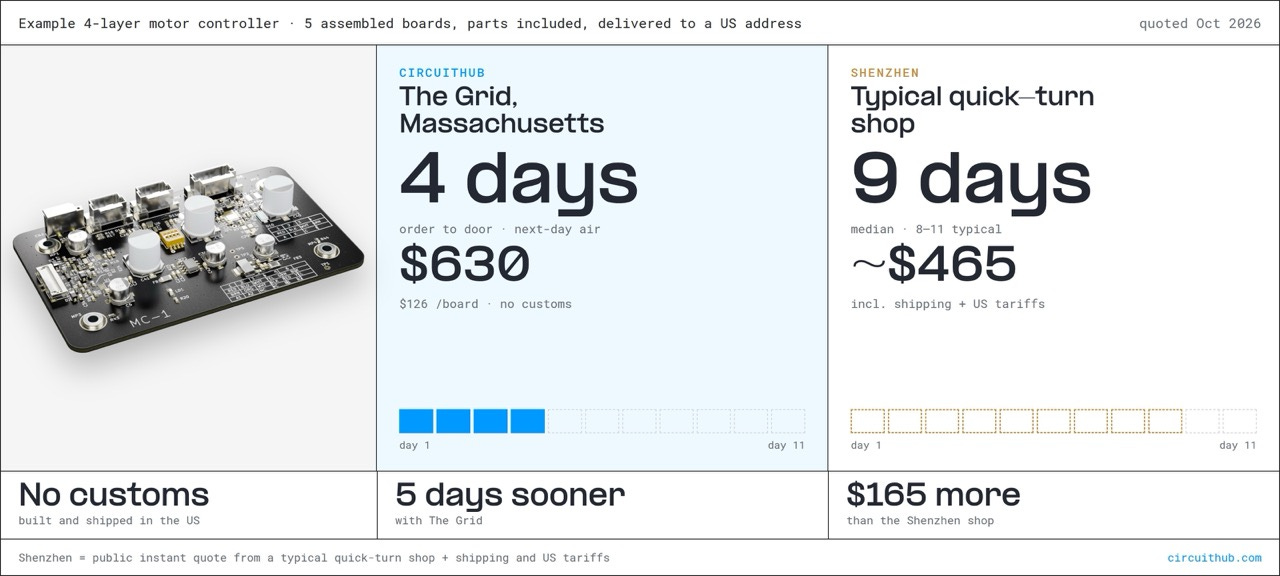
Every board takes its own route through the factory. There are no changeovers and no per-design setup, so one unit of 100 different designs runs as easily as 100 units of one. Prototypes and production batches run on the same machines.
Read more at CircuitHub and discuss on Hacker News
tscircuit (the company) has submitted 50 unique PCB designs to order over 2.5yrs, with a median cost of around $220 per order Evaluating AI designs is expensive, it often takes hours of debugging to discover how the ai made a mistake (when it does). We encode new rules to make sure that future designs don’t have the mistake /Seve on X/

Business Transactions
Top funding events, acquisitions, and partnerships across industrial value chains.
What it will take to win in robotics /Siddharth on X/
Re:Build Announces $2.1 Billion to Accelerate America’s Reindustrialization
Re:Build, the advanced manufacturing company accelerating American industrial innovation, announced it has secured $2.1 billion in new funding to ensure the most innovative products can be made in America for generations to come. This significant investment, led by General Catalyst and JPMorganChase’s Strategic Investment Group, will expand Re:Build’s capacity to manufacture hard tech products and launch new industrial startups, yielding a surge of high-quality, U.S.-based manufacturing jobs.
With this new round of funding, Re:Build ensures it has sufficient capital in its long-term holding company to support ambitious growth plans across several industries, including aerospace and defense; electrification; medical; energy and environment; and robotics and automation.
Re:Build, founded in 2020, works directly with industrial companies and innovators to turn manufactured product ideas into reality. Re:Build’s involvement begins at the earliest stages of product design. By employing Re:Build’s proprietary Manufacturing Constrained Design (MCD) process, industrial innovators achieve large-scale production at a faster pace and lower cost compared to traditional methods.
Read more at GlobeNewswire
American Advanced Materials Raises $12.5 Million to Make Globally-Competitive Titanium Sponge in America and Announces Signed Letters of Intent with Industry Buyers Worth Over $1 Billion /PR Newswire/
Bedrock Robotics Raises $600 Million Series C to Scale Autonomous Construction Equipment Across U.S. Sites
Bedrock Robotics announced a $600 million Series C financing at a $4.1 billion post-money valuation, co-led by CapitalG and Emergence Capital. The round included new investors US Innovative Technology Fund (USIT), Bessemer Venture Partners, and Temasek, alongside existing investors 8VC, Georgian, Valor Equity Partners, Xora, Eclipse, Perry Creek Capital, NVIDIA, and others. This brings Bedrock’s total funding to nearly $1 billion and will accelerate the volume of Bedrock-equipped machines across commercial construction sites in the U.S., helping contractors put existing heavy equipment to work more safely, predictably, and at greater capacity.
Agile Robots and Audi to transform automotive logistics with mobile humanoids, supported by Dassault Systèmes and NVIDIA /Agile Robots/
Foundry Robotics Raises $100 Million Series A to Build America’s First Autonomous Factory for Assembly
Foundry Robotics announced its oversubscribed $100 million Series A funding round led by Marlinspike Partners. Participating in the round are early backers Khosla Ventures and Red Glass Ventures, and new investors SE Ventures, Wing VC, and Axiom Ventures, as well as existing investors Hanabi and Zero Shot Fund.
Foundry builds and operates autonomous factories for complex assembly, combining AI-powered robotic cells with experienced manufacturing experts. With the new funding, Foundry will build out its Emeryville facility, accelerate deployment of AI models into real-world manufacturing, and grow its robotics research, engineering, and factory operations teams.
Through its manufacturing-as-a-service model, Foundry owns and operates the factory, taking customers from design to production in weeks without new production line investments or expensive retooling. Foundry trains AI models on the building blocks of assembly and deploys these models in a grid of robotic “cells” with manufacturing-grade precision. FoundryOS serves as a single agentic system linking the robots, the factory floor and the cloud. Every production run feeds back into the models, so the same cell that assembles a drone today can learn to build a satellite component tomorrow, and gets better at both with every run.
Read more at Business Wire
Lumaril Wants to Make Factories the Best Version of Themselves /WSJ/ raising $66 million at a $400 million valuation
Neuron Industries Raises an Oversubscribed $10 Million Seed Round to Cut Industrial Automation Development From Months to Days
Neuron Industries, an industrial hardware and software company building an AI-native industrial controller, announced a $10 million seed round following its public launch in August. The round was co-led by FCVC and Obvious Ventures, with participation from Y Combinator, Thin Line Capital, Zee Prime Capital, and Founder Factor.
Neuron is rebuilding the industrial control stack to help engineers develop, test, and deploy automation for new machines, production lines, and factories. Its Cortex AI Industrial Controller and Synapse development environment let engineers describe machine behavior and build user interfaces in plain English, generate readable control code, and test it before deployment. Neuron is focused on companies that are building new production plants, factories, and machines, helping teams establish their controls platform from the earliest stages of design.
Read more at GlobeNewswire
PreScalar Raises $7M to Build the Software Layer for the Modern Factory /PR Newswire/