


Shop Talk
Capturing this week’s zeitgeist

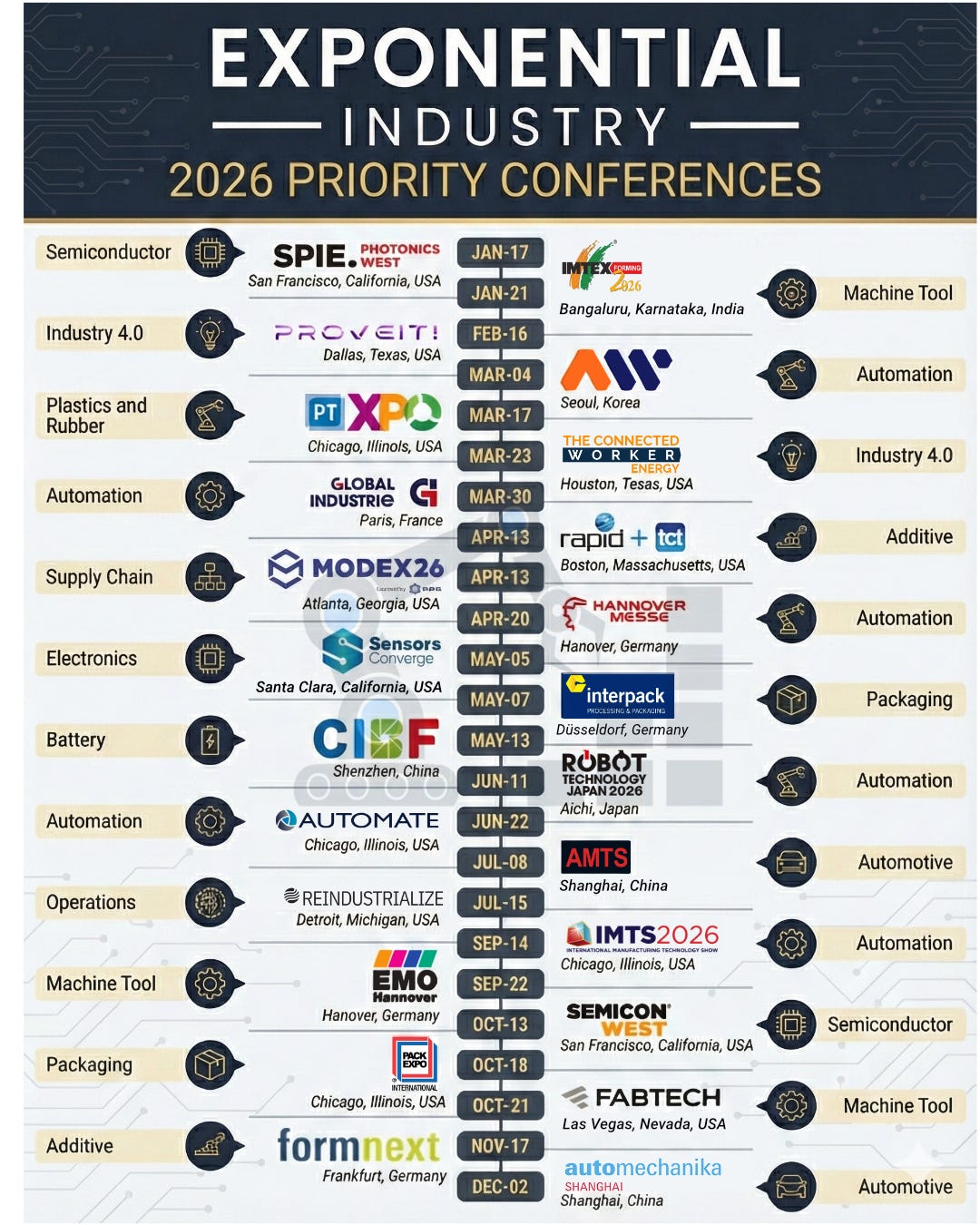
According to Elon, to unlock double-digit growth over the next year, we must accelerate applied intelligence. With 2026 on the horizon, I have curated a list of 24 essential events across the industrial tech landscape. The selection focuses heavily on next-gen manufacturing and high-tech components across AI Factories, Energy Systems, the Physical Capital Stack, and Embodied AI.
Assembly Line
This week’s Industry 5.0 breakthroughs and frontier technologies of the built world.
Mass-production of low-cost humanoid robots begins at Zerith Robotics
✍️ Author: Kaif Shaikh
A newly released footage of Zerith Robotics shows an army of its H1 service humanoids. This is at a time when the company is moving rapidly from development into large-scale commercial deployment.
The Zerith H1 is not designed as a general-purpose biped but as a wheeled humanoid optimized for indoor service and housekeeping tasks. The robot features a height-adjustable upper body mounted on an omnidirectional wheeled base, allowing it to operate across multiple vertical levels while navigating narrow corridors and crowded interiors. This design prioritizes stability, reach, and maneuverability over humanlike walking.
Read more at Interesting Engineering
Build a multimodal generative AI assistant for root cause diagnosis in predictive maintenance using Amazon Bedrock
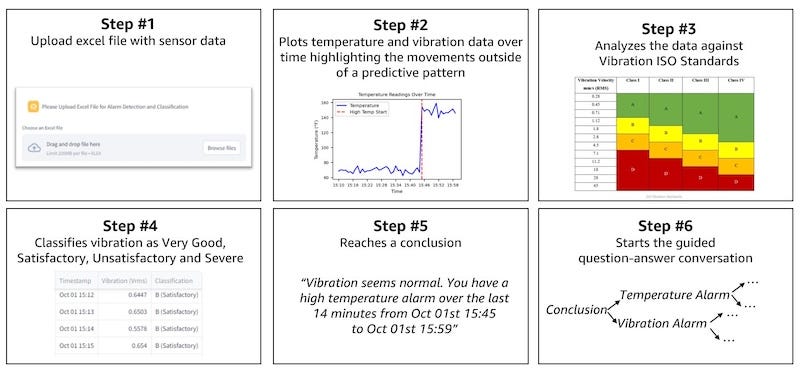
The architecture leverages Amazon Bedrock to deploy a multimodal generative AI assistant for root cause diagnosis within predictive maintenance frameworks. By integrating Retrieval-Augmented Generation with Amazon Bedrock Agents, the system fuses unstructured data like thermal imagery and technical manuals with structured time-series telemetry. This approach facilitates automated inference aligned with ISO 13374 standards for condition monitoring and diagnostics. Unlike traditional vibration analysis or standalone rule-based prognostic systems, this multimodal implementation enables the identification of latent failure modes through cross-referencing visual anomalies with semantic search results from vector databases. By automating the synthesis of disparate diagnostic inputs, the framework addresses the limitations of siloed monitoring tools and provides a scalable alternative to manual expert analysis in complex industrial environments.
Read more at AWS Blogs
How is Taiwan beating everyone at plastics recycling?
FIH ROBOTICS AI Recycling Robot, co-developed by FIH Mobile (FIH) and Da Fon Environmental Technology, helps to transform and upgrade the traditionally labor-intensive recycling industry /FIH/ with the help of ROVOX (owned by Foxconn) /ROVOX/
Supporting a circular economy: Insights from Taiwan’s plastic waste sector and lessons for developing countries /Sustainable Production and Consumption/
We Saw Lucid’s Turnaround Plan And The Stakes Are Huge
Despite industry-leading range, cutting-edge technology and luxury finishes, the Lucid Air has fallen short of sales expectations. The company says the worst is behind it, even as it pushes into robotaxis through a partnership with Uber and autonomous tech startup Nuro, a deal that brought a $300 million investment and a commitment to buy 20,000 Gravity vehicles.
Ford CEO: Europe is risking the future of its auto industry /Financial Times/ by setting unrealistic EV regulations only to adjust them when consumers do not show up
Detroit’s New Car Companies are Coming for Tesla /YouTube/ with cars designed as an open-source platform with mechanical electrical API, so you can change it into what you want it to be over time.
New Agentic AI platform, MetaChat, Accelerates Advanced Optics Design
✍️ Authors: Robert Lupoiu, Yixuan Shao, Tianxiang Dai, et. al
Stanford engineers launched MetaChat, an AI framework that accelerates the design of advanced photonic devices like metasurfaces, enabling real-time collaboration using self-reflective AI agents and fast simulations.
First, they built the engine powering the new framework: a deep-learning neural network that solves Maxwell’s equations, which govern electric and magnetic fields. The new solver, named Feature-wise Linear Modulation (FiLM) WaveY-Net, can run a simulation more than a thousand times faster than conventional methods, solving equations in just milliseconds.
Then, the team built AI agents that play the roles of optics designers and materials experts. By prompting large language models, they outlined each agent’s job and workflow. While existing AI-based designers follow a pre-determined flowchart-like process, that can sometimes lead to dead ends or poor results. To improve decision-making, the team used prompts to give the AIs agency, including the ability to self-reflect. “In one round of design, it can go back to itself and think about what it did,” said Lupoiu. “Then it can make the next best decision without a predefined template of what it must do.”
Read more at Stanford Report and Science Advances
Graph-based multi-scale fusion learning for STEP-NC machining feature recognition /Robotics and Computer-Integrated Manufacturing/
Benjie Holson proposed a set of “Robot Olympics” challenge tasks with seemingly simple everyday behaviors like spreading peanut butter, washing a greasy pan, putting a key in a lock, and turning socks inside-out. These challenge tasks might not seem as cognitively demanding as math olympiad problems, but robotics experts believe they present exceptional challenges for autonomous robots. See how many of these tasks Physical intelligence’s robots could tackle!

New Product Introduction
Highlighting new and innovative facilities, processes, products, and services
Comau Expands its Collaborative Robotics Portfolio with the Myco Cobot Family /PR Newswire/
ROBOT New Technology: Open Platforms & Physical AI /FANUC/ with source code of the FANUC ROS 2 Driver project /GitHub/
CATL Unveils the World’s Only “Ship-Shore-Cloud” Zero-Carbon Shipping and Smart Port and Shipping Integrated Solution
Contemporary Amperex Electric Vessel Co., Ltd. launched a ship-shore-cloud solution to decarbonize maritime transport. The system combines on-board power, shore-based battery-swapping, and cloud management platforms. This model addresses high upfront costs and infrastructure gaps through a separation of ship and battery approach, lowering capital requirements compared to traditional purchase methods. The process replaces fragmented supplier models with a unified service network to improve reliability over thirty-year vessel lifecycles. CATL has secured certifications from five major ship classification societies, including the China Classification Society. Su Yiyi, General Manager of CATL Electric Vessel Department, noted the solution makes green shipping as easy and efficient as driving an electric car. Having equipped nearly 900 vessels, the company aims to move electric shipping beyond land-based technology adaptations to meet maritime power requirements.
Read more at CATL
TE Connectivity launches 3D industrial application tool
TE Connectivity launched an interactive 3D Industrial Applications Tool to simplify component selection and integration across nine sectors including robotics and electric vehicle charging. This digital service replaces standard selection guides with a spatial environment featuring 53 applications and over 120 product cards. This transition to digital design navigation aims to reduce development timelines and improve accuracy in complex systems like semiconductor manufacturing equipment. The tool emphasizes performance in harsh environments where reliable connectivity is necessary for industrial automation and data-intensive applications.
Read more at The Robot Report
What is the connection between manufacturing capabilities and online customization offerings? /Twikit/
Bringing Configure-Price-Quote Into the Industrial Equipment Product Lifecycle /Dassault/
[Revisit] DigiKey Debuts Industry-First Power Supply Configuration Tool /DigiKey/
Business Transactions
This week’s top funding events, acquisitions, and partnerships across industrial value chains.
NIST commits $20M to strengthen AI in manufacturing /Manufacturing Dive/
Tulip Announces Investment and Strategic Alliance Agreement from Mitsubishi Electric /Tulip/
Galbot Secures Over $300 Million in New Funding, Breaking Records with $3 Billion Valuation in China’s Humanoid Robot Sector
Galbot has successfully completed a new funding round exceeding $300 million, bringing the company’s total funding to $800 million. This round once again sets new records for both the largest single-round financing and cumulative financing in the embodied AI sector, further cementing Galbot’s leadership in the rapidly evolving field of embodied AI and humanoid robotics. Galbot has already achieved remarkable success in deploying humanoid robots at scale across various industries:
Industrial Manufacturing: Galbot has partnered with leading companies such as CATL, Bosch, Toyota, and Hyundai, becoming the first company globally to deploy humanoid robots for real autonomous operations on manufacturing floors. With these advancements, Galbot has secured orders for thousands of units, demonstrating the scalability and reliability of its humanoid robots in real-world industrial applications.
Warehouse Logistics: Galbot’s autonomous warehouse solutions are deployed in multiple locations, demonstrating stable and continuous 24/7 operations for over a year. These solutions are addressing critical operational challenges, enhancing efficiency and meeting the growing demands of the retail logistics industry.
With this new investment, Galbot is positioned to accelerate its technology development, scale its deployments, and expand its global reach. The company remains committed to advancing embodied AI technology, bringing innovation to new sectors, and strengthening its position as a leader in the global robotics market.
Read more at PR Newswire
Kargo.ai Raises $42M Series B to Scale Global Warehouse Deployment with Enterprise Clients
Kargo, a leader in industrial artificial intelligence (AI) technology for supply chain and logistics, announced the closing of a $42 million Series B funding round. The round was led by Avenir, with participation from Linse Capital, Hearst Ventures and Lightbank, and previous investors Matter Venture Partners and Sozo Ventures. The new capital will be used to accelerate Kargo’s mission to transform real-time inventory data infrastructure across warehousing and logistics globally.
Kargo turns the loading dock into a source of accurate, actionable data for warehouses and logistics centers. With physical Kargo towers and lifts at docks and gateways, hardware sensors seamlessly connect to the Kargo platform to automate all shipping and receiving operations without scanning, manual intervention or change management. The system automatically inspects arriving freight for damage, verifies shipments against Bill of Lading (BOL), and pushes inventory data directly to customers’ systems for real-time status and compliance. Issues are flagged instantly and documented with irrefutable visual evidence, enabling teams to resolve freight claims efficiently while managing customer relationships. The platform also consolidates scheduling, driver check-in, and dock door allocation into a single seamless workflow that automatically adapts to real-world conditions, such as inclement weather, allowing teams to make informed decisions about labor allocation, Overages, Shortages & Damages (OS&D) drivers and operational best practices.
Read more at Business Wire
Howmet Aerospace to Acquire Consolidated Aerospace Manufacturing from Stanley Black & Decker for approximately $1.8 Billion
Howmet Aerospace Inc. (NYSE: HWM) announced it has entered into a definitive agreement to acquire Consolidated Aerospace Manufacturing, LLC (CAM), a leading global designer and manufacturer of precision fasteners, fluid fittings, and other complex, highly engineered products for demanding aerospace and defense applications, from Stanley Black & Decker, Inc. (NYSE: SWK) for an all-cash purchase price of approximately $1.8 billion. The transaction will receive favorable treatment for federal tax purposes, which will result in a significant tax benefit for Howmet.
Read more at PR Newswire
Alphabet Announces Agreement to Acquire Intersect for $4.75 billion in cash, plus the assumption of debt to Advance U.S. Energy Innovation /Alphabet/
Want more? Check out the bonus reads below 👇