


Shop Talk
Capturing this week’s zeitgeist
The holidays are behind us, and we’re officially in 2026! Our gift guide standout, Stickerbox, was a hit with the kids this year. We also love seeing 3D printing in the wild: Formlabs printers were used to bring the Stranger Things Demogorgon to life, and Snapmaker’s Artisan Premium kept the elves busy to crafting elegant music boxes.
We will continue to share fun ideas like these periodically in our newly launched lifestyle micro blog moving forward. Also, check out a short teaser for CES 2026 which kicks on Monday featuring the Advanced Manufacturing Showcase for the first time!
New in 2026: We are gifting a1-year paid subscription to the first person to identify the content link AND cultural reference to the title/subject line of this week’s digest. Restack this post with a note containing your entry before next week’s digest to be eligible!
Assembly Line
This week’s Industry 5.0 breakthroughs and frontier technologies of the built world.
How AI is Changing Manufacturing
Spending 4 days in West Michigan factories to see what modern manufacturing looks like /Zach Glabman on X/ making yachts, drones, pickleball paddles, hydraulics and pneumatic systems and industrial recyclers pumping out metal. Some lessons observed:
Innovation happens on shop floors, as much if not more than in design. When you make something, you learn how to make it better. That knowledge doesn’t travel well across oceans.
When you have deep industrial capacity and talent in your backyard, iteration cycles are measured in hours, not weeks. It all comes back to the people who make it happen
Advanced tech hides in “old” industries. CNC precision to human hair tolerances. 3D printed aerospace structures. X-ray sortation at industrial scale. Mechanical automation from custom machine tools.
There are billions of ways to build an engine. Here’s how they found the best one.
“We were really trying to reimagine, from the ground up, what a hydrogen engine could be,” said Neil Terwilliger, HySIITE principal investigator and technical fellow for Advanced Concepts at Pratt & Whitney, an RTX business. To help answer that question, the team tapped into the broad realm of artificial intelligence, using a in house program called DISCOVER, to quickly analyze design options and suggest promising new architectures.
The DISCOVER team calculated the number of possible ways they could arrange the engine’s roughly 70 components. The result: There were about a quattuorvigintillion possibilities. Then, they gave DISCOVER lists of the engine’s components and how they work together along with a set of design rules. From there, 4,202 combinations emerged as possible winners.
The team’s work resulted in the design of an engine known as HySIITE, which could improve performance by 35% while eliminating nearly all nitrogen oxide emissions. They demonstrated their design on rig tests at the RTX Technology Research Center in East Hartford, Connecticut, supported by the U.S. Department of Energy’s ARPA-E program. The engine’s efficiency hinges on its ability to capture water from the exhaust – one gallon every three seconds – and use it to control how the liquid hydrogen burns.
Read more at RTX
The Ridiculous Engineering Of The World’s Most Important Machine
Intel installs industry’s first commercial High-NA EUV lithography tool — ASML Twinscan EXE:5200B sets the stage for 14A /Tom’s Hardware/
Inside Texas Instruments’ New 300mm Fab in Sherman, Texas
Texas Instruments has officially commenced production at SM1, the first of four planned 300mm semiconductor wafer fabs at its new multi-billion-dollar site in Sherman, Texas. This facility represents a cornerstone of TI’s broader $60 billion investment strategy to modernize its manufacturing footprint and reach a goal of 95% internal production by 2030.
Mohammad Yunus, senior vice president for technology and manufacturing at TI, talks about the operational transition as it sunsets its older 6-inch wafer manufacturing in Sherman, and transitioning to state-of-the-art 300mm (12-inch) technology, including retraining the existing local workforce and moving talent from across North Texas to support the new facility. Also discussed is how the new fab will focus on leading-edge analog processes to produce power management ICs and signal chain chips, plus the role of data and AI, noting that the factory generates terabytes of data hourly, which TI uses to optimize yields, quality, and long-term cost efficiency.
We Went To Intel’s Arizona Chip Fab To See If It Can Regain Its Edge /CNBC on YouTube/
Even the Companies Making Humanoid Robots Think They’re Overhyped
Current humanoid robots remain largely restricted to performing simple, repetitive tasks such as moving boxes because they are currently too unreliable to perform complex tasks. A primary technical hurdle is a lack of training data, which makes it difficult for machines to transition from single-function actions, like folding laundry, to multi-purpose utility.
The human form itself also introduces physical engineering weaknesses: robots that look like us are prone to tipping over, and engineers struggle to create a mechanical version of the human hand. Unlike humans, who rely on sensations from our skin to know how much pressure to apply, robot builders currently struggle to replicate tactile feedback. Furthermore, the technology is limited by safety concerns; for every $100 spent on deployment, $80 must go toward systems designed to protect humans from injury. Consequently, sticking to the humanoid form too much may continue to be less efficient than building specialized robots with suction grippers or multiple sets of arms.
Read more at WSJ
RealMan Robotics open-sources its RealSource robot dataset /The Robot Report/
Teleoperation-as-a-Service (TaaS): Your First Home Robot May not Be Autonomous /Haoru Xu/
Learning From Planned Data to Improve Robotic Pick-and-Place Planning Efficiency
This work proposes a learning method to accelerate robotic pick-and-place planning by predicting shared grasps. Shared grasps are defined as grasp poses feasible to both the initial and goal object configurations in a pick-and-place task. Traditional analytical methods for solving shared grasps evaluate grasp candidates separately, leading to substantial computational overhead as the candidate set grows. To overcome the limitation, we introduce an Energy-Based Model (EBM) that predicts shared grasps by combining the energies of feasible grasps at both object poses. The formulation enables early identification of promising candidates and significantly reduces the search space. Experiments show that our method improves grasp selection performance, offers higher data efficiency, and generalizes well to varying grasps and table heights, given that variations fall within the learned distributions.
Read more at IEEE Robotics and Automation Letters
New Product Introduction
Highlighting new and innovative facilities, processes, products, and services
Spark X: The Journey to Ready-to-Use 3D Creation
SPARKX is a new 3D printing brand born from Creality’s technical legacy, but engineered for a new generation. Moving beyond intimidating, overly technical machines to create a product you can unbox and start using right away.
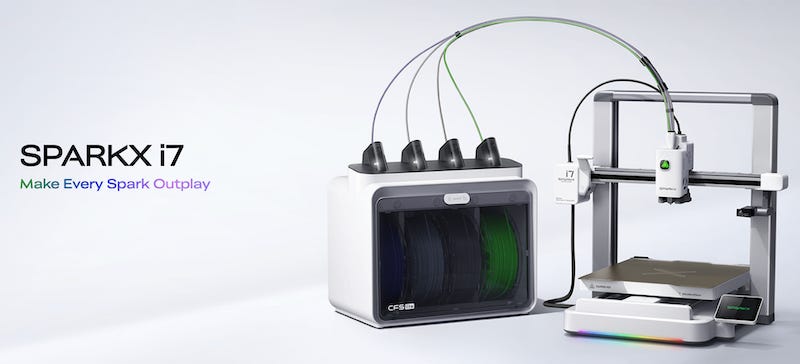
Spark X was shaped not only by frustrations, but by a few moments that made us feel what a truly effortless 3D printing experience could be. One of the earliest and clearest moments came from the quick-swap hotend. The first time we removed the entire nozzle module in just a few seconds during an internal demo, the room went completely still before anyone reacted. The operation was so simple, so unexpectedly natural, that even our own engineers were momentarily confused, “Wait… It’s already done?” That brief silence told us something important: when a task that used to be intimidating finishes in a snap, creativity becomes possible for far more people. It was the first time we felt how deeply meaningful “effortless” could be.
Read more at PR Newswire
Creality Unveils Scan-to-CAD Workflow Through New QUICKSURFACE Partnership /PR Newswire/ offering up to 0.02 mm accuracy, high-speed capture, and multi-mode scanning, enabling users to digitize complex parts with precision.
Automated multi-loop printing for Bambu Lab printers /GitHub/ allowing you to print many copies of the same model automatically by looping the print and pushing finished parts off the build plate.
ESAB Expands Automation Portfolio: TracFinder & Robbi Cobot Launch
To help metal fabricators improve productivity, quality and workforce needs, ESAB has launched its new Tracfinder Rail and Tracfinder Wheel series of battery-powered welding tractors and unveiled its newly branded ROBBI™ Mobile cobot welding system. ROBBI is now available with the Aristo Edge 500R power source and RoboFeed Edge robotic wire feeder, which offer next-generation capabilities. Compared to manual welding, these automation solutions can typically increase output per operator by 70 to 100%.
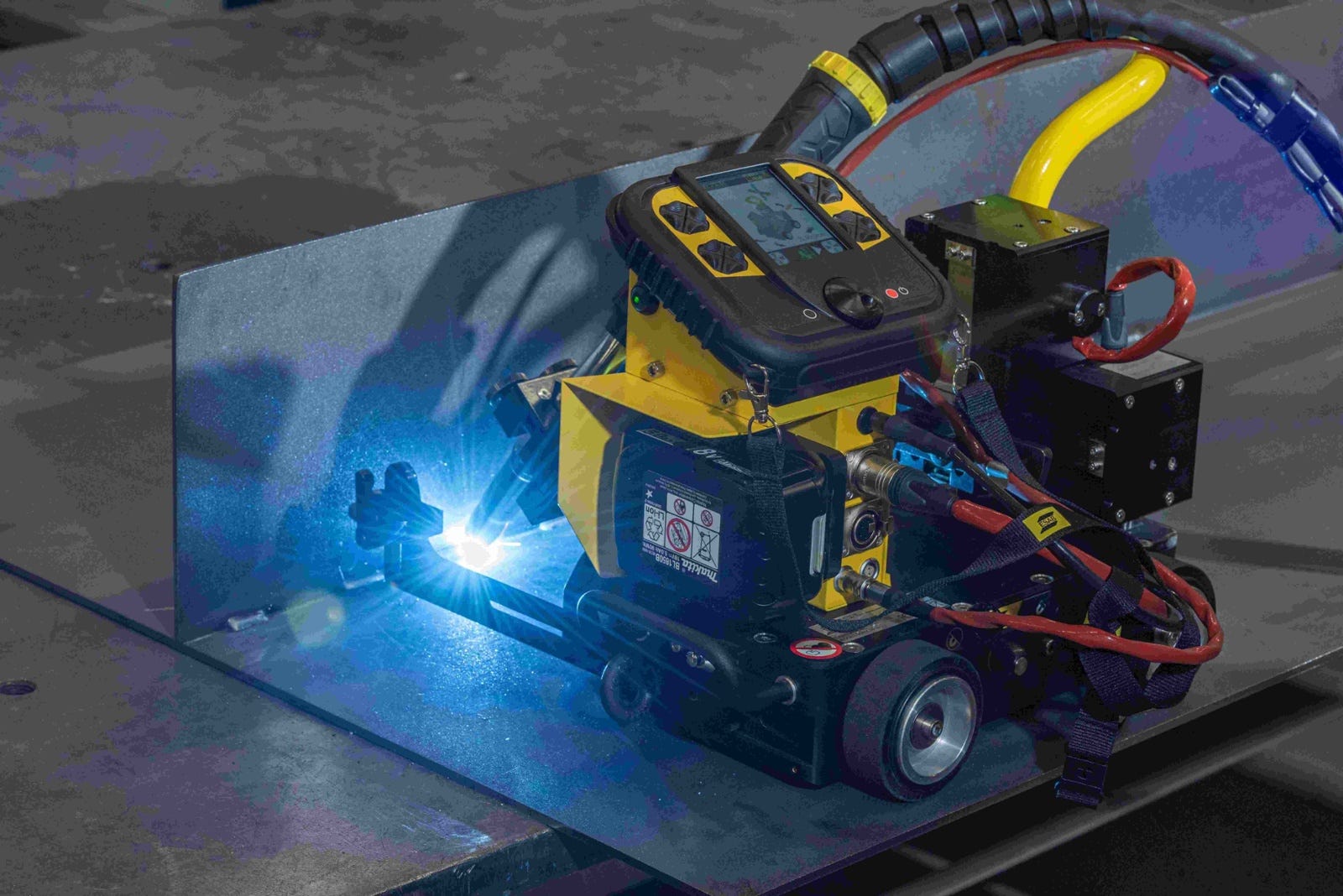
ROBBI Mobile welding cobots feature a Universal Robots’ UR10e or UR 20e industrial robot arm and a Siegmund 32- x 48-in. or 5- x 10-ft. table. The ESAB Teach Tool uses a ‘no code’ or plain language program so users can effortlessly incorporate a multitude of functions that enhance performance and productivity.
Read more at ESAB
Business Transactions
This week’s top funding events, acquisitions, and partnerships across industrial value chains.
Groq and Nvidia Enter Non-Exclusive Inference Technology Licensing Agreement to Accelerate AI Inference at Global Scale
Groq announced that it has entered into a non-exclusive licensing agreement with Nvidia for Groq’s inference technology. The agreement reflects a shared focus on expanding access to high-performance, low cost inference. As part of this agreement, Jonathan Ross, Groq’s Founder, Sunny Madra, Groq’s President, and other members of the Groq team will join Nvidia to help advance and scale the licensed technology.
Read more at CNBC
Groq: Nvidia’s $20 Billion Bet on AI Inference /EETimes/
Octopus Energy to spin off $8.65bn tech arm Kraken
✍️ Author: Archie Mitchell
Octopus Energy is set to spin off its Kraken Technologies arm as a standalone company after a deal to sell a stake in the platform valued it at $8.65bn (£6.4bn). The energy giant, Britain’s biggest gas and electricity supplier, has sold a $1bn stake in the AI-based division to a group of investors led by New York-based D1 Capital Partners. The majority of the $1bn investment will go to Octopus to fund its expansion, with Kraken receiving the rest. Octopus founder and chief executive Greg Jackson said Kraken will be operating completely independently of Octopus “within a few months”. The move paves the way for Kraken to be demerged from Octopus, and for a potential stock market flotation for the business in the future.
Kraken uses AI to automate customer service and billing for energy companies and can manage when customers use energy, rewarding them for reducing consumption at peak times. It was initially built for use by Octopus but has since picked up a raft of other utilities clients, including EDF, E.On Next, TalkTalk and National Grid US. It now serves 70 million household and business accounts around the world.
Read more at BBC
Motive Files Registration Statement for Proposed Initial Public Offering
Motive Technologies, Inc., the AI platform for physical operations, announced that it has filed a registration statement on Form S-1 with the U.S. Securities and Exchange Commission (“SEC”) relating to the proposed initial public offering of its Class A common stock. Motive has applied to list its Class A common stock on the New York Stock Exchange under the symbol “MTVE.”
Founded in 2013 by Shoaib Makani, Ryan Johns, & Obaid Khan, the company has grown from an electronic logging device (ELD) compliance tool into a comprehensive physical operations platform serving nearly 100,000 customers across trucking, construction, oil & gas, & manufacturing. Motive’s platform has since expanded beyond compliance to combine AI-powered dashcams for driver safety, GPS tracking for real-time visibility, & spend management cards to control costs. This suite acts as a central operating system for physical economy businesses, unifying data from vehicles, drivers, & equipment into a single interface.
Read more at Motive and Tomasz Tunguz
Want more? Check out the bonus reads below 👇