


Shop Talk
Capturing this week’s zeitgeist
Heard on the Floor
When we go from bits to atoms. Naturally, you have to get into manufacturing. There’s just no way around it, which is why so many of the startups that we’re seeing right now are in the robotics space, they’re in the machinery manufacturing space. They have to be. But you cannot go and manufacture something like a thousand or ten thousand miles away when you’re first getting going. When you’re first getting going, that manufacturing space needs to be right next to HQ. Because everyday the guys who are designing the product and the guys designing the manufacturing line that makes the product, they have to be fused and have to be like mind-melded. And so this is why it’s kind of crazy. You’re like, wow, there’s all these manufacturing sites going up in San Francisco. How the h*#l is that a thing?
...
But, you can’t iterate the way you need to iterate to win in this market. And so it’s almost like the natural thing is that manufacturing gets localized.
...
It’s a beautiful thing and it’s fun and it’s really interesting to go from like that super digital world to the physical one where things where you can feel it and like the problems are way more textured and interesting.
Travis Kalanick on AI and Jobs at the TomorrowX Summit /YouTube/
Thank you for your patronage of Exponential Industry. For a limited time this holiday season, lock in 25% off an annual membership. In 2026, paid subscribers gained full access to Constraint Capital and the Scholar industrial career engine. Your support directly funds what comes next: in 2027, your patronage will help us build and launch Shift, Sourcebook, and Fuel. Upgrade today to secure our lowest annual rate and back independent, first-principles coverage of enduring frontier industrial technology.
Assembly Line
Thought provoking stories across the industrial world.
Why Skydio Built a Lopsided Drone
✍️ Authors: Evan Ackerman
There’s a short rabbit hole you can go down if you start looking for other examples of asymmetrical aircraft. In the 1990s, legendary aircraft designer Burt Rutan and his company Scaled Composites built some decidedly odd airplanes, including the Model 202 Boomerang. But perhaps the most famous asymmetrical aircraft was the Blohm & Voss BV 141, a World War II-era reconnaissance plane that featured an engine in the middle alongside a crew compartment alarmingly offset out onto the right wing. The unique design was intended to give the crew the best possible view for reconnaissance missions, because in a typical single-engine aircraft, the crew sits right behind the engine, limiting forward visibility.
Samsung, SK hynix, Micron Move to Set Robot Charging Standard
✍️ Authors: Kim Tae-ho and Lee Seok-jin
Samsung Electronics, SK hynix, and Micron are setting a charging standard for robots used in semiconductor fabrication plants. The project aims to unify battery specifications and charging station operating methods that until now have differed from vendor to vendor. With chipmakers moving to automate their factories, the effort is seen as groundwork for managing robots from different makers more easily and, further out, for making robots compatible with manufacturing operations systems.
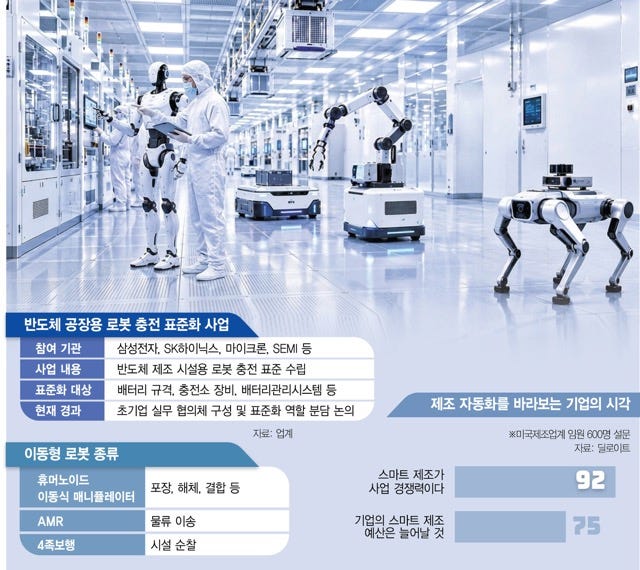
Items under consideration for standardization include battery specifications for various mobile robots, communications and equipment for robot charging stations, charger connection parts and battery management systems. As they seek to automate older plants, chipmakers are reviewing the adoption of humanoid robots, autonomous mobile robots and mobile manipulators. These robots are not fixed in place but move freely to carry out tasks. In exchange, they carry batteries in their bodies and must be recharged at separate charging stations. The goal of the standardization project is to set common guidelines on charging components, equipment, communications and system interfaces, limited to mobile robots to be deployed in chip plants.
Read more at The Seoul Economic Daily
96,000 wafers per hour: NAED Energy Holding’s new vertical line targets double solar cell output /IE/
China’s big bet on Mexico’s border region tech industry
Mexico Risks Missing Out on AI Data Center Boom as Energy Crunch Bites /Bloomberg/
Beijing has rolled out programs to shift Chinese factories toward a greener future. One tactic is called the zero-carbon industrial park, an effort to run manufacturing hubs on renewable power. Can the world’s largest exporter move to a greener era of mass production? /YouTube/
Heavy Metal Acrobatics: Learning Dynamic Control for Skid-Steer Loaders
✍️ Authors: Pierre-Jean Lorentz, Pascal Egli, Edo Jelavic, et. al
Automation of heavy machinery offers the opportunity to improve productivity in mechanized industries such as construction, mining, and material handling. Yet, automation of such machines is challenged by their complex dynamics, in part because of hydraulic actuation that involves fluids, flexible elements, and nonlinear delays. A concomitant challenge is the size and weight of these machines, which can make experiments on the physical systems exceedingly dangerous.
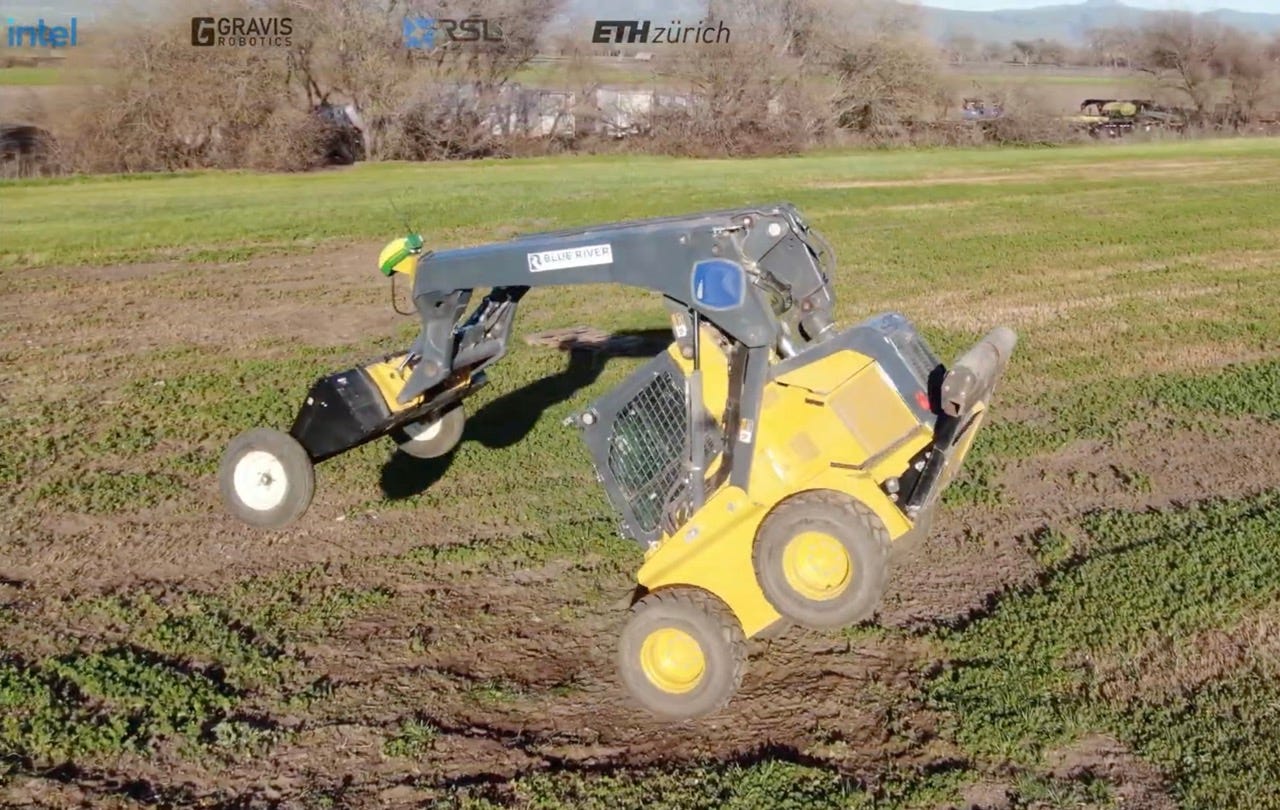
Here, we show that Reinforcement Learning (RL) in simulation, followed by transfer of the learned policies from simulation to reality, can successfully automate acrobatic maneuvers that push a heavy construction machine to the limits of its actuation and have only previously been accomplished by a small number of elite human operators in official world-record performances. We trained policies that perform autonomous acrobatic maneuvers on a John Deere 332G, an operational 5-tonne skid-steer loader. The policies can autonomously swing the machine up onto two wheels and, while balancing on two wheels, drive over rough terrain, trace out specified trajectories, spin around, and swing the bucket back and forth before landing it safely back onto four wheels. This work demonstrates that RL and sim-to-real transfer enable dynamic autonomous control of heavy machinery, directly contributing to greater automation in heavy equipment sectors.
Read more at arXiv and Science Robotics
Directly editing π0.5 and openpi by Physical Intelligence VLA’s weights improved its performance, with no fine-tuning /Abdul Rahim Mirani/
New Product Introduction
New and innovative facilities, processes, products, and services
6 Weeks, 1.9 Million Downloads: Why the Free AI-Built CAD “SolidCraft” Took Off
In October 2026, a single developer in Michigan, USA, released SolidCraft, an open-source 3D CAD application /GitHub/. About six weeks after release, it had been downloaded roughly 1.9 million times from GitHub. Much of the development was done together with AI.
Read more at FabScene
Introducing FieldCraft /GitHub/ a free, open-source project from Tangency Labs, spun out of SolidCraft: one modeler for structures, heat and fluids, in pure Rust. Parametric part in, verified results out. /Brennen Herbruck on X/
Machina Launches Rebellis™ to Bring Automotive Personalization to Scale
Machina Rebellis combines AI, robotics and digital manufacturing to form complex, production-grade metal structures without conventional geometry-specific dies or tooling. Traditional automotive body manufacturing relies heavily on stamping dies and dedicated tooling that are highly efficient when producing large numbers of identical components but make low- to mid-volume variants and design changes costly and time consuming.
Machina’s technology enables vehicle manufacturers and aftermarket companies to move more rapidly from digital design to physical assemblies, supporting low- to mid-volume production vehicles, special editions and vehicle customizations at scale without the time and expense associated with conventional tooling.
Read more at Machina Labs
Business Transactions
Top funding events, acquisitions, and partnerships across industrial value chains.
General Flash Announces $128 Million in Funding to Scale U.S. Production of Critical Metals
General Flash, which has developed a fundamentally new way to make critical metals, announced it has raised $128 million in equity capital across its Seed and Series A rounds to scale domestic production of metals essential to national security and American manufacturing. Investors include Lux Capital, Construct Capital, Overmatch Ventures, GreatPoint Ventures, Pillar VC, Lowercarbon Capital, Ensemble VC, Ravelin and leading angel investors.
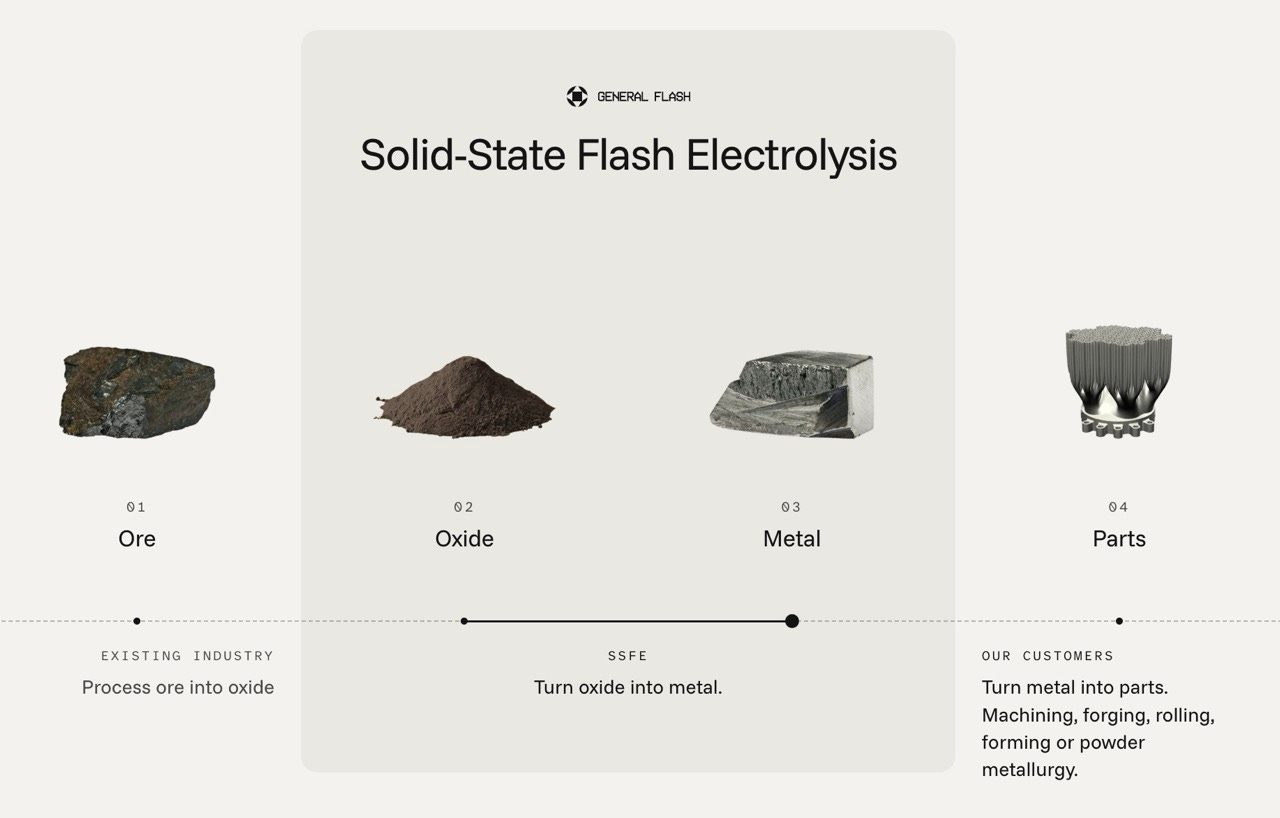
General Flash’s process converts metal oxides directly into high-purity, semiconductor-grade metal, with no emissions. It is faster and lower cost than conventional refining and gives the U.S. a way to build cost-effective refining capacity at home instead of relying on foreign supply. The company’s Solid-State Flash Electrolysis (SSFE) process is metal-agnostic and can be used to refine materials like tungsten, tantalum, titanium, hafnium, zirconium, germanium, yttrium, niobium, molybdenum, and rare earth elements. The funding will support commercial-scale production by summer 2027, in what will be one of the largest and most advanced critical materials production plants in the world.
Read more at PR Newswire
ROTOBOOST Secures Strategic Investment from Aramco Ventures to Accelerate Global Deployment of Methane Pyrolysis Technology for Low-Carbon Hydrogen and Advanced Carbon Materials /PR Newswire/
Nodal Networks Raises $11.3 Million to Tackle Global Shipping Bottlenecks with AI-Powered Decision Intelligence
Nodal Networks, which builds AI decision intelligence for the world’s container terminals, announced $11.3 million in seed funding to help port and rail hubs reduce congestion, move more cargo using their existing infrastructure and keep global freight moving. The financing brings the company’s total funding to $14.5 million. The round was led by Eniac Ventures, with participation from new investor NewRoad Capital Partners and returning investors Riot Ventures, Trail Mix Ventures and Liquid 2 Ventures.
Paul Albert-Lebrun, Nodal’s co-founder and CEO, worked in satellite operations and later led product at Kepler Communications, a space telecom company. Nic Westgate, Nodal’s chief commercial officer, is a mining engineer. The two approached the global freight coordination problem from opposite ends. The founders’ combined expertise led to Malcom, Nodal’s AI-powered platform for improving terminal operations. The platform is named after Malcom McLean, the inventor of the modern shipping container. Malcom combines AI agents with specialized forecasting models to help operators predict congestion, understand lost productivity and make better-informed decisions about container placement, equipment allocation and loading operations. The platform is already deployed at terminals across three continents.
Read more at Business Wire
Modern Industrials Raises $6M to Deploy Custom AI Solutions to Manufacturers and Distributors
Modern Industrials, the AI solutions platform reshaping how manufacturers and distributors work, announced $6 million in seed funding led by Glasswing Ventures, co-led by TMV, and joined by a16z speedrun and others. Already working with prominent manufacturers and distributors, Modern Industrials is bringing custom AI systems to a $9T+ industry long constrained by fragmented workflows and legacy software.
Modern Industrials works closely with customers to build custom AI agents around their unique operations, integrating seamlessly with existing systems and workflows. From quoting and order entry to demand planning, vendor management, and customer support, these agents automate complex processes and equip teams with intelligence to make better decisions. Every deployment is designed around a single goal: make the company easier to do business with through faster execution, greater reliability, lower costs, and exceptional service, all without disrupting existing operations.
Read more at GlobeNewswire
Pedestal AI Emerges From Stealth to Bring AI Agents Into Real-World Supply Chain and Logistics Operations /PR Newswire/