


Shop Talk
Capturing this week’s zeitgeist
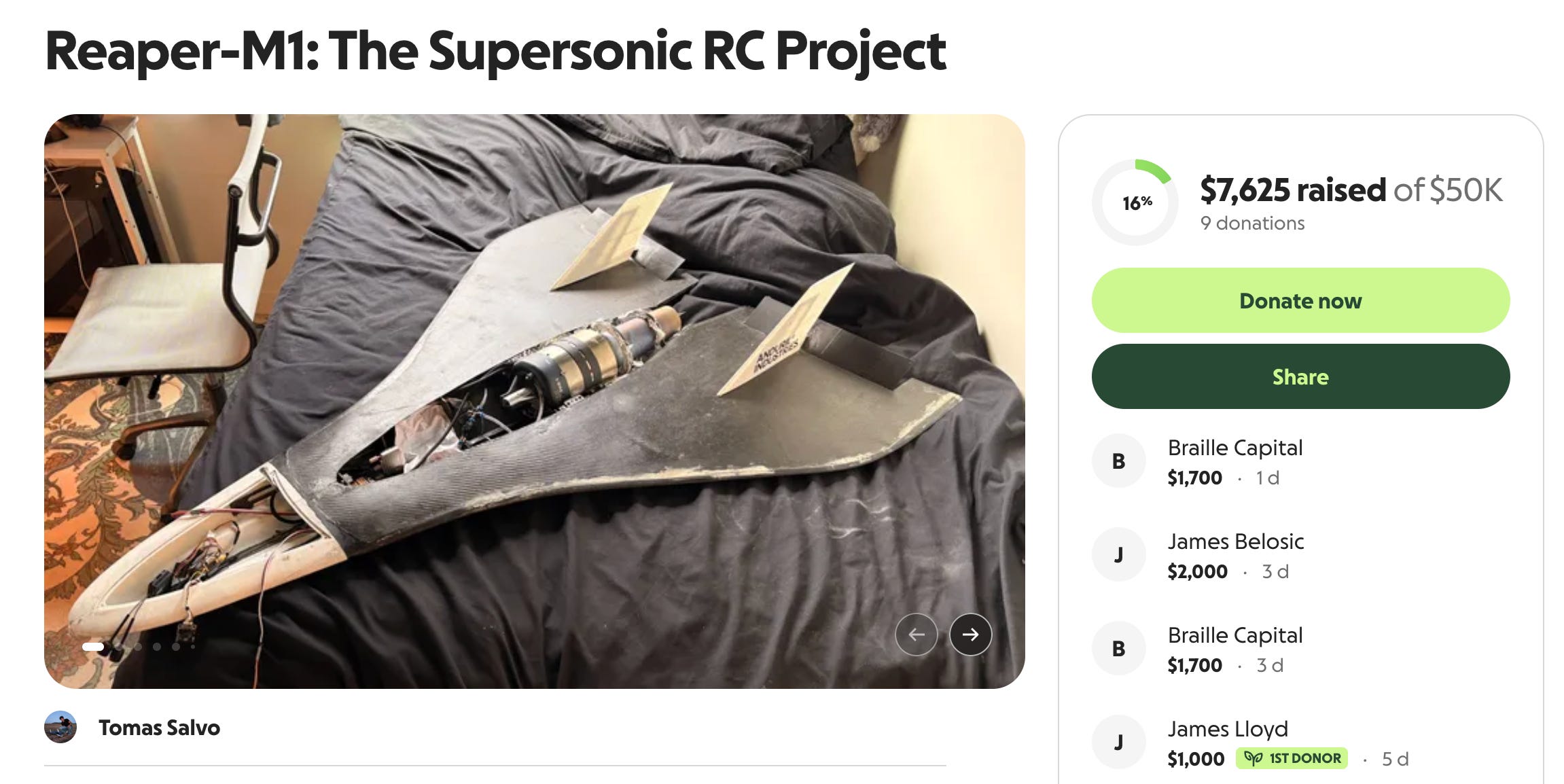
I’m building a supersonic RC aircraft.
After my Reaper project went viral, @bscholl put up an $800k prize for the first supersonic RC drone and I’m going for it.
>Assembling a small team of Georgia Tech students
>Aircraft/propulsion solution outlined and already in motion
>Target: first flight by December
I’ve already raised ~$20k. Crowdfunding the remaining $50k, with a full cost breakdown on GoFundMe.
Heard on the Floor
CAD-as-code has been a long-standing promise of our industry, but it has never really become a mainstream method for 3D modeling. This comes down to a few different reasons, and it feels like with the rise of LLMs (which excel at coding), that might change.
István Csanády: Geometry Kernels, Implicit Representations and CAD /emm0sh on X/. István Csanády breaks down the geometry kernels that power modern CAD and explains why boundary representations remain both indispensable and notoriously difficult to build.
HuggingAI4Engineering/CADGenBench /HuggingFace/. CADGenBench evaluates AI-driven CAD generation: how well a model can turn a description of a mechanical part into a valid, geometrically correct 3D model.
markov-ai/cad-1000-hours /HuggingFace/. CAD 1000 Hours is a computer-use dataset containing 1,021.64 hours of recorded work across 597 workflows and 10 CAD, BIM, structural-analysis, and visualization applications. The tables below summarize its software coverage.
GPT + Autodesk Fusion MCP: The AI That Can Build and Edit Real CAD Models /@irinatoxi on X/ Through an agentic environment such as Codex connected to Fusion MCP, GPT is no longer sitting outside the software explaining which buttons you should press. It can participate directly in parts of the CAD workflow.
Assembly Line
This week’s industrial breakthroughs and frontier technologies of the built world.
What’s Wrong With Germany?
Even Mercedes Can’t Stop the Decline of German Cars in China /Bloomberg/
GM Sets Up $4.5 Billion Plan to Ensure Supply of Critical Parts /Bloomberg/ to safeguard the company from supply shocks caused by such events as extreme weather, natural disasters and cyberattacks. The automaker reached a deal with Procura Auto Parts LLC, which will buy parts inventory from key suppliers and front the cash.
AI Buildout Stretches Deeper Into Manufacturing Supply Chain
✍️ Author: Brooke Sutherland
The rapid data center buildout across the US is starting to manifest more broadly across the industrial ecosystem, including at companies that wouldn’t have been considered obvious data center suppliers even just a few months ago.
Paintmakers Sherwin-Williams Co., PPG Industries Inc. and Akzo Nobel NV are touting a mix of specialized anti-static and fire-protection coatings for things like transformers, power generation equipment and switchgear, as well as moisture mitigating flooring for server halls. Parker-Hannifin Corp. is seeing growing sales of hoses, couplings, manifolds and fittings to data center customers, while Ingersoll Rand Inc. is a major provider of odorizing systems for natural gas — the power source of choice for many data centers — and also sells compressors used for electricity infrastructure.
Fortive Corp. has found a new source of demand for its power quality and fiber testing products, while Axon Enterprise Inc. sees an opportunity to sell drone defenses to data centers. Pool-pump maker Pentair Plc late last week announced it would spend $1.4 billion to bolster its exposure to the data center and heating and cooling markets through the acquisition of Taco Group Holdings, which makes water circulators, heat exchangers and valves.
Siemens announces over $200 million in U.S. manufacturing investments and 1,500 new jobs to expand electrical infrastructure production /Siemens/
Molex Invests in CAEPlus to Advance Thermal Management with Active Liquid Cooling Solutions for AI Data Centers /PR Newswire/
Xylem to Acquire Cornell Pump and Roper Pump, Strengthening Industrial Presence in High Growth Sectors /Xylem/
Unitree Sees Robots Reaching ‘Mass Market’ Within Decade
The market will take off once robots can handle 80% of tasks given to them via voice instructions in unfamiliar surroundings, Wang Xingxing said in a speech at the World Robot Conference in Beijing on Thursday. That will take two to 10 years, he said.
JPMorgan forecasts global humanoid robot shipments will rise to 60,000 this year and 1.75 million units by 2030, compared with 18,000 units in 2025. The bank sees China accounting for more than half of global demand.
Read more at Bloomberg
Peppy Secures Pre-Seed Funding to Build the Coding Platform for Humanoid Robotics, Democratizing Physical AI /EIN Presswire/
The HydroGym reinforcement learning platform for fluid dynamics
Christian Lagemann, Sajeda Mokbel, Miro Gondrum
Effective control of fluid flows is critical across transportation, energy and medicine, where it can increase lift, reduce drag, enhance mixing and attenuate noise. Yet fluids are notoriously difficult to control because they involve high-dimensional, nonlinear and multiscale dynamics that resist conventional approaches. Reinforcement learning has driven remarkable progress in fields such as protein folding and complex games, which have shared benchmarks and standardized environments. Fluid dynamics has lacked such infrastructure, so each controller is typically tuned to a single geometry and operating condition, making progress difficult to accumulate, transfer and compare. Here we introduce HydroGym /GitHub/, a solver-independent reinforcement learning platform providing more than 60 validated, openly available flow control environments spanning from canonical laminar flows to complex turbulent flows, with systematic progression in the Reynolds number up to Re = 4 x 10^5, and Mach number variations in two and three dimensions. Across these environments, agents repeatedly discover robust control principles, including boundary layer manipulation, disruption of acoustic feedback and reorganization of turbulent wakes. Critically, we demonstrate a proof of concept for zero-shot transfer, in which agents that are trained exclusively in inexpensive surrogate environments are deployed to challenging real-world scenarios such as a three-dimensional wing section. We achieve a 38% reduction in local skin friction while reducing exploration costs by four orders of magnitude compared with direct on-wing optimization. As this transfer exploits shared near-wall physics, the breadth of generalization remains open, suggesting a new pathway for research toward policy generalization across computationally prohibitive simulation environments. By offering a common, extensible foundation for reproducible research, HydroGym moves flow control from isolated case studies toward a cohesive community effort.
Read more at Nature and discuss on X
Hidden Factory
Unseen patterns in emerging industrial technology
New Product Introduction
Highlighting new and innovative facilities, processes, products, and services
Introducing GEN-1.5 by Generalist AI
Humans have a remarkable ability to perform new physical skills from only one or a few examples. Our latest robot foundation model, GEN-1.5, exhibits the beginnings of that same ability: it can learn a new task in seconds, from a single example, without gradient updates or fine-tuning. It displays broad capabilities across one-shot and few-shot learning from demonstration, as well as zero-shot physical generalization. Although the tasks are simple and short-horizon, this is the first model we know for which one-shot and few-shot learning of physical skills have emerged at scale. We view these results as a significant step towards our mission of building general intelligence for the physical world.
Read more at Generalist and discuss on X
Robotics’ Model T moment /Robo/. The case for a robot affordable enough to build economies around.
Heart Aerospace - X1 First Flight
On August 12, 2026, Heart Aerospace’s X1 demonstrator aircraft completed its first flight at Plattsburgh International Airport in upstate New York, becoming the largest battery-electric aircraft ever flown. With a 106-foot wingspan and takeoff weight over 25,000 pounds, X1 completed a 27-minute piloted mission comprising taxi, takeoff, climb, maneuvering and landing, of which 8 minutes were airborne.
Powered entirely by batteries, X1 used approximately $5 worth of electricity during the flight, highlighting electric aviation’s potential to deliver structurally lower commercial aircraft operating costs. The flight demonstrated electric aviation at the scale of a commercial airliner, marking a major step toward bringing electric aircraft into everyday airline service. The milestone advances the development of Heart’s ES-30, a 30-seat hybrid-electric regional airliner targeted to enter commercial service in 2031.
Flying-taxi maker Vertical Aerospace secures £74m /UKTN/
Ampaire Closes $19 Million Series B to Advance Hybrid-Electric Aviation Commercialization and Increase Scalability /EIN Presswire/

Via Morgan Stanley gas turbine tracker: 38GW of Gas turbine orders in calendar 2Q26 is a new quarterly record, and 1H26 orders are now annualizing at 134GW for 2026 (+34% YOY) /Ben Bajarin on X/
Business Transactions
This week’s top funding events, acquisitions, and partnerships across industrial value chains.
Gravis Robotics Raises $200M for Construction Autonomy
SoftBank is investing $200 million in Gravis Robotics. As the largest Series A in construction robotics history, this funding accelerates Gravis’s mission in physical AI – scaling autonomous heavy machinery across jobsites globally. This investment powers a global rollout, bringing physical AI directly to construction sites and embedding our autonomous systems into heavy machinery fleets across a trillion-dollar market bottlenecked by labor shortages.
Acting as an operating system for mixed fleets, Gravis’ software runs on the Gravis Rack – their autonomous control kit – which has been installed across an unmatched range of machinery brands including Caterpillar, Case, Develon, John Deere, JCB, Hitachi, Sumitomo, Yanmar, Volvo, and more. Because their learning-based models excel at adapting to the nuances of machines, the same core software can drive a compact excavator or a machine five times its size without custom reprogramming.
Read more at Gravis Robotics
Mafix Raises $5.4 Million to Commercialize Silicon Fertilizers that Remove CO2
Mafix, an industrial technology startup that turns abundant rocks into agronomically advantageous carbon-negative silicon fertilizers and other mineral products, announced it raised $5.4M in pre-seed funding, led by Azolla Ventures with support from Counteract VC, Astera Institute, Plug and Play Ventures, Impact Science Ventures and a Dutch family office. With this funding, Mafix will commercially demonstrate its proprietary technology to produce 1,000 tons of its fertilizer that restores soil health, boosts crop yields and resilience, and reduces the need for traditional fertilizers. In the U.S., there is demand for silicon fertilizers, but producers cannot reliably obtain high-quality supply at relevant price. Mafix, with its permanent carbon sequestration fertilizer that has multiple value props for farmers, is meeting that demand.
Read more at GlobeNewswire
Rivian Spins out Micromobility Business into New Startup—Also, Inc.
Rivian (NASDAQ: RIVN) announced it has spun out its micromobility business into a new company: Also, Inc. Also will focus on small, lightweight vehicles that are designed to meet the global mobility transportation challenges of today and tomorrow. Rivian retains a substantial minority ownership stake in Also and expects opportunities for future collaboration, which may include selectively using some of Rivian’s retail footprint. In connection with the spin-off, Also secured a $105 million investment from the venture capital fund, Eclipse Ventures, which will support Also’s next phase of growth. Rivian Founder and CEO RJ Scaringe will serve on Also’s Board of Directors as its Chairman.
Read more at Business Wire