


Shop Talk
Capturing this week’s zeitgeist


Detroit grew into a major industrial powerhouse in the early 20th century primarily because of the explosive rise of the automobile industry, which was enabled by abundant open land for massive factories, access to Great Lakes shipping for raw materials like iron ore and coal, a surging labor force from The Great Migration, and pre-existing mechanical expertise in carriage-making and metalworking that innovators like Henry Ford adapted into revolutionary assembly-line mass production.
Will the rise of AI Factories bring the same prosperity? /Bloomberg/
Quote of the Week
At first they didn’t want to sell it to me. They’re like, “All right, let’s talk about your sheet metal shop. Why are you upgrading to a laser?” And I was like, “Well, I don’t really have a sheet metal shop. I’m just starting one.”
They had sent out a salesman. He’s like, “You are a moron. You’re a software guy with soft hands. You don’t know what you’re doing.”
“But I like you, and I’m going to vouch for you. If this thing all blows up, I don’t give a shit. I’m going to come pick up the machine. It’s 50,000 pounds. You can’t move it. I’ll come get it if you don’t make your payments.”
And I was like, “This sounds like an awesome deal.” So we were able to bootstrap because of debt. And that’s really how we run.
Jim Belosic, Co-founder and CEO of SendCutSend /Turner Novak on X and Spotify/
Assembly Line
This week’s industrial breakthroughs and frontier technologies of the built world.
The Manufacturing Startup That’s Outcompeting China | Jim Belosic, SendCutSend | Round II
Why SCS raised $110M, finding buildings with enough power and great capital partners, and plenty more!
I finally raised some money. Here’s why I waited so long. /Jim Belosic on X/
AI in machine building 2026: Adoption, barriers, use cases, and leading sub-industries
✍️ Author: Raghav Kadian
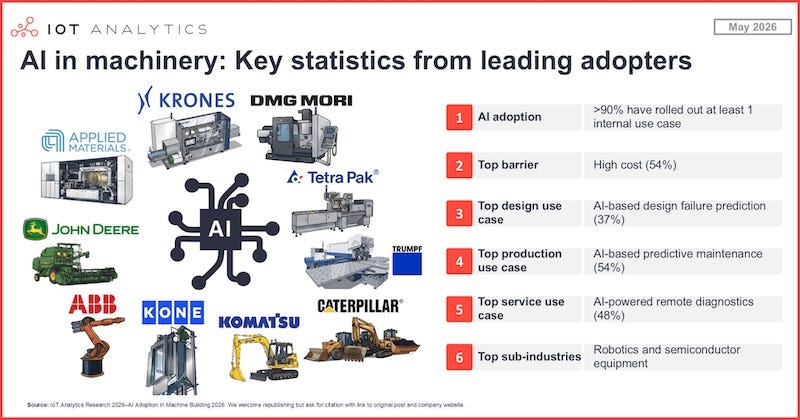
AI use in the machinery industry is becoming widespread. 96% of machine builders have started to deploy AI in internal operations, and many have started to bring AI features into machine software and into the machines themselves, according to IoT Analytics. The research, which surveyed 120 decision-makers directly involved in machine building across 22 machinery sub-industries, found that machine builders vary widely in their AI motivations and use cases, and that adoption rates vary widely by subindustry.
Read more at IoT Analytics
Real-time inference for robots at Physical Intelligence
For standard local inference, Pi models are trained in the cloud then downloaded locally to run using on-board GPUs attached to each robotic system. This provides a reliable system with good performance and straightforward debugging, but requires a GPU on each robot. Off-board remote inference provided a more lightweight solution for robots without an onboard GPU.
Because Pi’s robots sit inside a continuous control loop, even small amounts of jitter or head-of-line blocking can degrade behavior, which means the nature of TCP was not necessarily the right architectural choice for the setup. To match Tunnels-like performance gains without introducing the potential for request-response stalls in the control loop, Pi worked with Modal to build a more specialized transport: a QUIC-based portal running over UDP with automatic NAT traversal. This system establishes a persistent, bidirectional channel between the robot runtime and the Modal GPU container. Instead of issuing independent TCP requests, the robot connects once and streams observations while receiving action outputs over the same channel.
On Modal, PI can allocate larger, data-center-class GPUs per deployment and run GPU-intensive experiments immediately. This lets the team experiment with larger models that couldn’t even fit on the on-board GPUs, so engineers can test ambitious architectures first and optimize later, if needed.
Read more at Modal
I Gave My OpenClaw Agent a Physical Body /Ken Goldberg on X/
Inside the YASA YM360: Axial Flux Motor Engineering Explained
In this teardown, we take a closer look at the YASA YM360 axial flux motor and the engineering decisions driving its impressive performance. We analyze the motor’s compact architecture, rotor and stator design, cooling strategy, material selection, and power density advantages while comparing it to conventional radial flux motors.
Unitree GO-M8018-6 Motor Reverse Engineering /Hackaday/

New Product Introduction
Highlighting new and innovative facilities, processes, products, and services
LeRobot Humanoid: An Open, Low-Cost, 3D-Printed Humanoid for Robot Learning
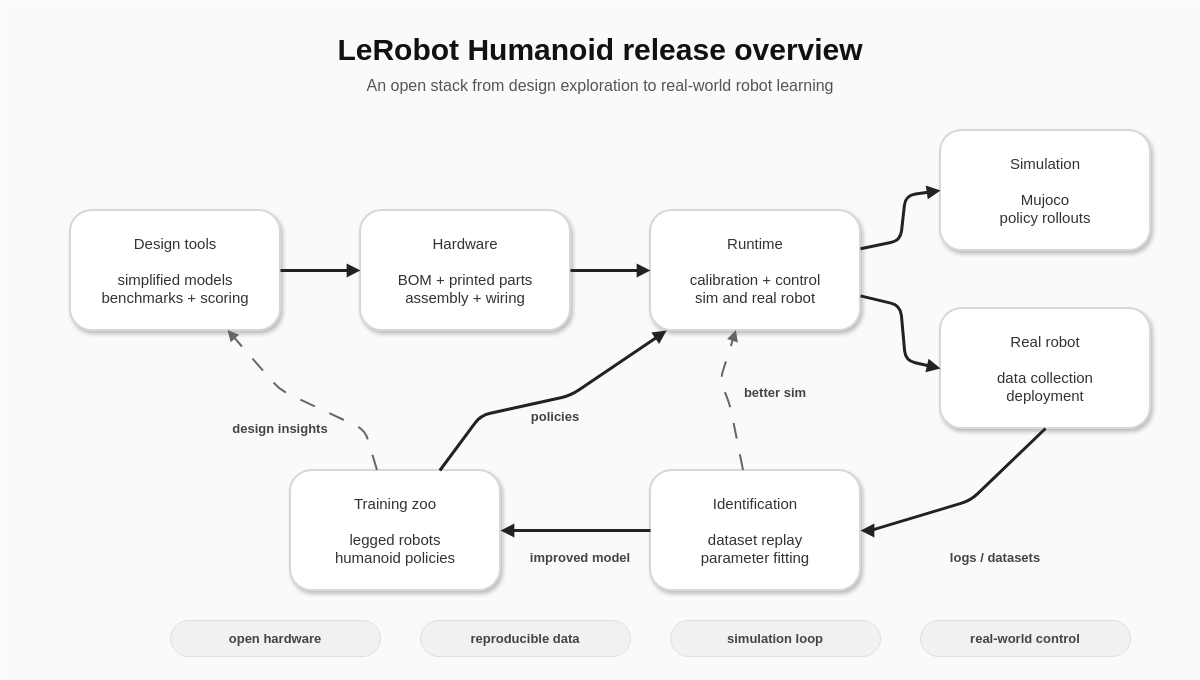
LeRobot Humanoid is designed for a specific niche: an open humanoid platform that is affordable enough to reproduce, simple enough to modify, and complete enough to support real robot-learning experiments.
If you are looking for the most advanced humanoid robot, this is not it.
If you are looking for a humanoid you can build, understand, repair, instrument, simulate, and use for learning experiments, this is the robot we are trying to make.
This is why the release includes more than a robot model or a controller. It includes hardware files, assembly documentation, simulation assets, runtime tools, identification pipelines, and training environments. The goal is to make the full humanoid learning loop accessible, from mechanical design to real-world control.
Read more at HuggingFace
Asimov DIY Kit /Asimov/ Asimov 1, Here Be Dragons Edition, is for those who want to build a humanoid robot from scratch /eWeek/
Hyundai expands US robotics strategy with 25,000 Atlas humanoid deployment update /IE/
In Q1 2026, Lightwheel closed approximately $100 million in orders across Physical AI infrastructure, including simulation, data generation, evaluation, and deployment-oriented systems. /Lightwheel/
Dassault Systèmes became a test case in the repricing of industrial software
Investors are no longer asking only whether a software company is sticky. They want to know where it fits in the AI value chain. Does it generate direct financial gains from AI adoption? Does it control unique data that AI relies on? Or does it operate at the application level, vulnerable to automation, pricing pressures, and valuation compression?
The new test is harder. What does the platform control that AI cannot easily bypass? Where does the real product value reside? Where is engineering authority preserved? Where is lifecycle accountability maintained when decisions are made more rapidly and with increased automation? If industrial software vendors respond with generic AI feature talk, they will continue to be squeezed. “We also have copilots” is not a strong investment case. It is a defensive slogan.
Read more at Engineering.com
Business Transactions
This week’s top funding events, acquisitions, and partnerships across industrial value chains.
🇨🇦 Inside ventureLAB’s bid to bring AI to Ontario’s critical industries /BetaKit/
💰🇺🇸 IXSAR Capital Launches Focused Venture Platform Backing the Future of Space Technology, Autonomy, and Robotics /PR Newswire/. IXSAR is particularly focused on companies where engineering depth creates durable advantages and where execution requires navigating complex markets, supply chains, and regulatory environments.
💰🇨🇳 BAI Capital Announces First Close of New US$800 Million Fund, Continues to Back Asia Growth and Globalization Opportunities /PR Newswire/. BAI Capital has been deeply rooted in China’s technology and industrial ecosystem, while continuously expanding its global perspective and cross-regional capabilities.
🇺🇸💿 Plural backs CircuitHub with $28M to use robots that manufacture electronics in days
CircuitHub has announced new funding to accelerate a new era of electronics production. The company’s latest funding injection stands as a $28 million Series A round. The investment was spearheaded by Plural, an operator-led venture capital firm founded by an experienced team of European tech heavyweights, including Taavet Hinrikus, Sten Tamkivi, Ian Hogarth, and Khaled Helioui.
Today they operate what they believe is the world’s most advanced PCBA factory /CircuitHub/. Their Grid system is a factory-scale robot that looks more like a semiconductor fab than a contract manufacturer. As a matter of routine they ship 1-off prototype PCBAs in 2 to 3 days without charging white-glove prices. 2M+ boards shipped, 133M+ parts placed, 20,000 engineers served so far. In time, prototyping electronics should look a lot more like 3D printing, and they plan on keep driving lead times and prices down until it does.
Read more at TFN
💿 Project Speedrun: The First Computer Designed by AI /Quilter/
🇦🇹🛣️⚡ REPS gets $23.6M to turn road traffic into clean electricity at scale
REPS was built to recover wasted mechanical energy and convert it into clean electricity at scale, using infrastructure that already exists. REPS has announced a $23.6M equity financing round to scale its Road Energy Production System, a patented “road power plant” that converts vehicle traffic into electrical energy.
REPS stands for Road Energy Production System. Its core product is a patented road power plant that installs directly into existing road infrastructure and harvests energy from trucks and cars driving over it, without disrupting traffic flow or logistics operations. The technology is particularly effective where vehicles naturally slow down or brake, or where slopes create additional force. REPS is initially targeting ports, logistics hubs, cities, industrial sites, and other high-traffic infrastructure operators that want to reduce energy costs while improving sustainability.
Read more at GlobeNewswire
🇨🇭🛠️ AVIAN raises $2.6M to scale AI thermal monitoring for the world’s most fire-prone industrial sites
Industrial operators across Europe and North America are facing a problem they can’t inspect their way out of. Fine dust, friction, electrical faults, and aging equipment are pushing fire and downtime risk into territory that insurers will no longer underwrite at viable premiums. Sites that were insurable five years ago are being deemed too risky today. Against that backdrop, AVIAN – the Zurich-based industrial AI company building 24/7 thermal monitoring for the world’s most fire-prone facilities announced it has raised a $2.6M pre-seed round, led by Founderful.
Read more at GlobeNewswire
🛠️ Novity, a Leading Provider of Predictive Maintenance for Process Industries, Announces Strategic Investment from Acario Innovation /PR Newswire/
🛠️ UpKeep Announces Strategic Growth Investment from Accel-KKR /AKKR/
Looking for additional content? Paid subscribers get more stories delivered each week as part of Overcapacity!