


Shop Talk
Capturing this week’s zeitgeist
The relocation of the 1937 Westinghouse Atom Smasher from Forest Hills to Cranberry Township ends a decade of decay for the world’s first industrial Van de Graaff particle accelerator. Early researchers at this site studied fundamental particle behaviors, laying technical groundwork for practical nuclear power, medical X-rays, and radar systems. Saving these physical remnants keeps historical engineering achievements visible to young inventors who are building new hardware. Seeing physical machinery from past technological leaps helps current developers solve the todays complex manufacturing challenges.
Try GeoSourced inside the Exponential Industry Arcade to trace historical discoveries, supply chains, and industrial culture. Can you pin global trade flows and locate significant technological heritage sites worldwide? 👇
Assembly Line
This week’s industrial breakthroughs and frontier technologies of the built world.
The $1/Hour Robot Is Coming: Industry Leaders from ANYbotics, NEO, Boston Dynamics, & Agility Robotics Explain What’s Next
Almost $1 Billion Later, the US Still Can’t Make a Medical Glove
Establishing domestic nitrile glove production requires rebuilding a dead chemical process from the ground up. Workers must synthesize nitrile butadiene rubber by heating and cooling butadiene and acrylonitrile inside massive specialized reactors to strip out impurities. America abandoned this complex polymer refining thirty years ago. Restarting the industry means constructing multi-story chemical plants with five-hundred-thousand-dollar pressure vessels before a single glove rolls off an assembly line. Because domestic plants lack these facilities, local factories buy foreign raw latex from China, South Korea, and Italy to stay open.
Read more at Bloomberg
Flashback to July 2023, “Why America’s Largest Tool Company Couldn’t Make a Wrench in America“ /WSJ/
Applied Intuition: A Billion Intelligent Machines
The simplest way to understand Applied Intuition is that it builds the brains for machines, and the tools other companies use to build those brains. If a manufacturer wants its tractor, truck, or mining vehicle to drive itself, it can buy the intelligence from Applied Intuition or use its platform to develop its own.
The discussion centers on why the most important companies of the next 25 years will all be physical AI companies, Dana, their new agentic platform for developing and deploying these systems, and how the company raised a billion dollars without spending any of it.
We led Standard Bots’ $200 million Series C because we believe it’s the company built to reinvent the robot arm for physical AI and to bring the industry back to America.
In this public thesis we will dive into:
The birth of the robot
A typical robot arm’s hardware and software architecture
The technical limitations that hold back today’s arms
How Standard Bots is reinventing the arm from first principles
Read more from RoboStrategy on X
New Product Introduction
Highlighting new and innovative facilities, processes, products, and services
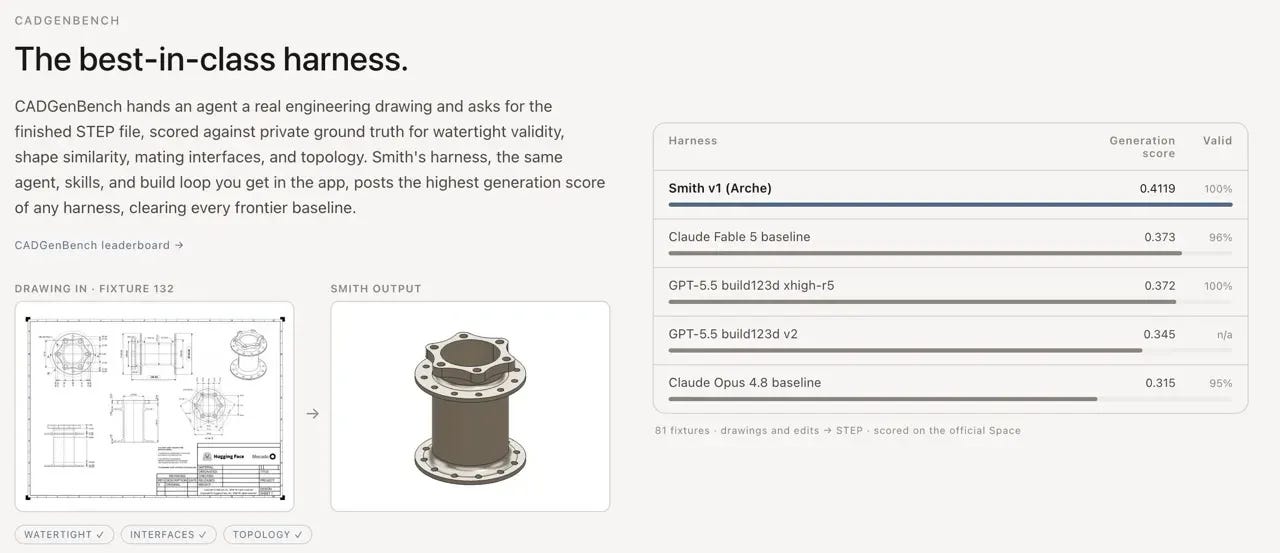
Agentic Engineering Harness: Arche Smith
Design for Manufacturability is what really matters in the end, so Arche integrated hundreds of real catalog STEP parts directly into its Smith’s model reasoning. Design with real parts!
Read more from Arche on X
Applied Electrodynamics’ WaveSight Brings Radio Frequencies into Human Perception
What would the world look like if we could see beyond visible light, across the entire electromagnetic spectrum?
Read more from Founder & CEO Bilgehan Avser on X
Business Transactions
This week’s top funding events, acquisitions, and partnerships across industrial value chains.
🇺🇸☢️ Commonwealth Fusion Systems Raises Another $1 Billion
This capital raise is the single largest funding round among fusion energy companies worldwide since CFS announced its $1.8 billion Series B round in 2021. With this capital, and the $863 million the company raised last year, CFS has now raised a total of $4 billion. This $4 billion represents about 30 percent of the total capital raised by the fusion industry to-date, reinforcing CFS’ position as the world’s largest and leading fusion company.
CFS will use the funds raised to further accelerate its progress to commercialization. In parallel to completing the assembly of its SPARC fusion demonstration machine, CFS continues to move forward with development of the world’s first grid-scale fusion power plant, called ARC, at the company’s Fall Line Fusion Power Station in Chesterfield County, Virginia.
Read more at PR Newswire
🇺🇸🔋 Antora Closes $550 Million in Series C Funding to Meet Surging Energy Demand and Reindustrialize America /Business Wire/. The announcement comes on the heels of the company’s deployment of one of the largest battery storage projects in the world, a 5 gigawatt-hour system in South Dakota that advanced from initial construction to delivering energy in under 12 months. Antora is now scaling that proven approach, with a growing pipeline of signed agreements with hyperscalers and industrial leaders.
🇺🇸☢️ Antares Raises $470M Series C to Deploy Nuclear Microreactors for Critical Missions /Business Wire/ comes weeks after Antares took its Mark-0 reactor critical at Idaho National Laboratory. It was the first privately developed non-light-water reactor to achieve criticality in the United States in more than four decades.
🇬🇧☢️ Nuclear Turbines raises £15M for compact reactors it says could undercut fossil fuels /TNW/. The technical idea is a substitution. Nuclear Turbines replaces the steam turbine systems at the heart of a conventional plant with high-temperature turbine technology borrowed from jet engines and gas-fired power stations.
🇺🇸🛰️ K2 Space Raises $500M Series D at $6.8B Valuation to Scale Large, High-Power Satellites
K2 Space, the leading manufacturer of big, high-power satellites, announced a $500 million Series D funding round at a $6.8 billion valuation. Kleiner Perkins and ICONIQ led the round, with participation from CapitalG, Lightspeed, Altimeter, Spark Capital, Sands Capital, ARK Invest, T. Rowe Price Associates, and other existing investors.
“In addition to expanding our factory footprint and growing our accomplished workforce, we’ll also be scaling up the satellite itself,” said Neel Kunjur, K2 Space Co-Founder and CTO. “We’ll be introducing our 100kW Giga-class satellite in the second half of 2028, which will be the foundational platform for deploying massive amounts of compute on orbit.” In addition to building and deploying the Giga satellite, K2 will focus on delivering large constellation orders on schedule for its customers’ ambitious programs over the next 24 to 48 months. K2 Space’s next mission, Trinity, will launch multiple satellites in Q2 2027.
Read more at PR Newswire
🇺🇸💿📐🧠 ChipAgents Expands Series A Funding to $134 Million as Demand Grows for Agentic AI in Semiconductor Design
ChipAgents, the category leader in agentic AI platforms for semiconductor design, announced an additional $60 million in Series A2 financing, bringing the expanded round to $134 million just six months after its initial Series A close. The financing reflects continued investor confidence in the company’s commercial momentum, with new investor B Capital joining Bessemer Venture Partners, Micron, MediaTek, Ericsson, ScOp, and other existing investors.
The funding will support ChipAgents’ next phase of expansion as the company scales customer deployments, grows its engineering and go-to-market teams, and accelerates development of its AI-native semiconductor design platform. Since its founding in 2024, the company has raised more than $134 million.
Read more at Business Wire
💿📐🧠🤝 Synopsys Advances Agentic AI Chip Design with AMD and Microsoft /PR Newswire/. This milestone builds on the existing collaboration and previously announced agentic specification to RTL workflow, marking the first EDA applications available for evaluation on Microsoft Discovery. Customers can request evaluation access through Synopsys. AMD is actively evaluating the application of autonomous workflows to accelerate the development of their next-generation products.
💿📐🧠 Kimi K3: Open Frontier Intelligence /arXiv and HuggingFace/. The RTL code is available on GitHub.
🇺🇸📐🧠 Engineering AI startup, P-1 AI, Announces Its Series A Financing Led by NEA, Adding Jeff Immelt to the Company’s Board
P-1 AI, Inc., the company building Archie, an AI mechanical and electrical engineer for industrial teams, announced the initial closing of its Series A financing round led by New Enterprise Associates (NEA). The Series A, on the heels of the company’s $23 million seed round led by Radical Ventures in 2025, reflects strong product execution and commercial traction. “Interest in Archie from major industrial firms—employers of most of the world’s engineers—has been extraordinary and emphasizes the need to scale our product and deployment teams,” said Paul Eremenko, the company’s co-founder and CEO. “This capital will enable us to grow the team and 10X the compute for training custom models to meet customer needs.”
P-1 AI built Archie to maximize anthropomorphism so that it fits seamlessly into existing engineering teams and workflows. Archie today is at the level of a junior mechanical and electrical engineer, with quantitative intuition over the product design space and the ability to use complex engineering tools—the same tools his human teammates use. “Paul’s approach is distinctive: bringing advanced AI capability into the workflow of engineering and industrial teams in an engineer-native form factor. That matters,” said Immelt. “By fitting naturally into how engineers collaborate, P-1 AI can shorten cycle times, improve competitiveness, and deliver measurable results in mission-critical environments.”
Read more at GlobeNewswire
🇬🇧🤖🧠 Kinematic Trees raises £585,000 to scale robotics intelligence using principles of brain evolution /Kinematic Tree/. Funds will be used to build Kinematic Trees’ commercial, robotics and software engineering teams across London, Nottinghamshire and Sheffield in the UK, in line with product development, international deployment and major advancements in the robotics industry.
See the unseen connections driving industrial tech. Paid subscribers get Overcapacity exclusive industrial ecosystem ontologies that map how people, capital, and technology connect. Turn raw news into actionable strategic context.