


“Highly automated shops with 10-19 employees that employ technologies & systems built around the decades of human knowledge, will be able to ship 3x-5x what they do now.”
Much respect and I love the dialogue, but I’m skeptical that there’s a 3x to 5x capacity unlock with the same headcount. Shop owners aren’t dumb. 5x revenue without having to hire would be like crack. They’d have done it in a heartbeat if there were a clear path.
/OSH Cut CEO Caleb Chamberlain on X/
OK, here’s the future of manufacturing in the US. This is how we will Reindustrialize... /Caleb Chamberlain on X/
Buying Your Next Machine? Make the Automation Math Work /Making Chips Podcast/
Please spread the word of Exponential Industry by sharing the publication
Assembly Line
This week’s industrial breakthroughs and frontier technologies of the built world.
Factory Walkthrough of NOX METALS
Zane and Paige Finn Doherty walk us through the Nox Metals factory floor and talk about what we do here all day. In the video they cover how the material comes in and gets cut, how our nesting system (we call it Factos) figures out how to get the most out of every piece, and how you can get a price online in seconds without waiting on anyone to email you back.
The American Baijiu Dinner
If you’ve ever worked with a Chinese supplier, you’ve probably been to a baijiu dinner: round table, lazy susan, a bottle of Moutai, and continuous toasting until somebody can’t stand anymore.
You could be buying 100 parts from them, and they’re taking you to a disproportionately intimate setting, singing sweet nothings at karaoke and naming their firstborn after you.
...
The best suppliers in the world play a long game, because they know that something is going to break, and when it does, they want to be the first call.
Read more from Zach Glabman on X
Pat Gelsinger on Why This is the Best Time to Build Hardware
a16z’s Raghu Raghuram and Guido Appenzeller sit down with Playground Global General Partner and former Intel CEO Pat Gelsinger to discuss the next wave of semiconductor innovation and the physical constraints shaping the AI buildout.
Factory Visit
An Encouraging Signal from NADCA: Factories Are Coming Back to Life
Field report by IndustrialMind.ai Co-Founder and CEO Manufacturing AI Steven
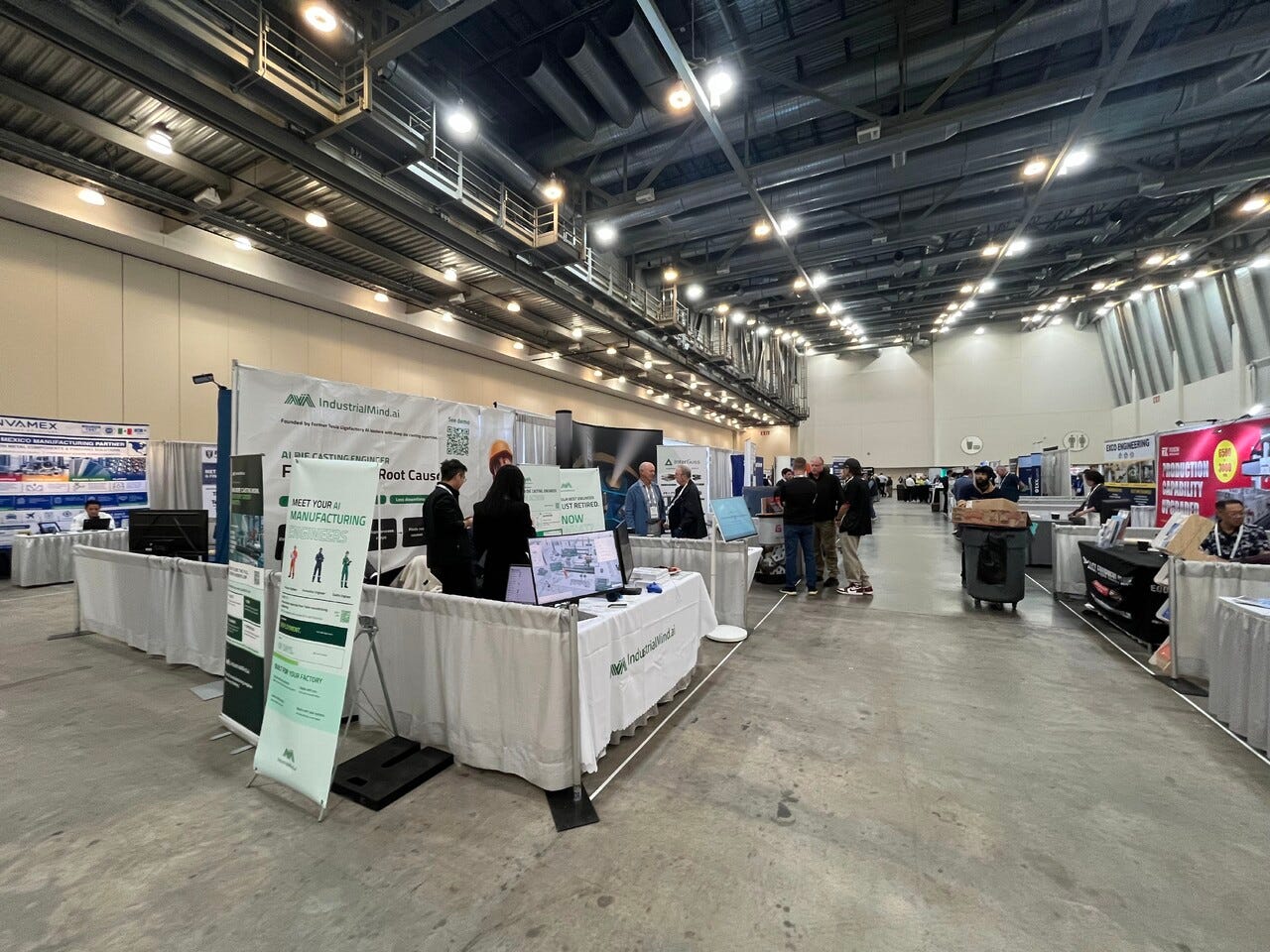
We came away from NADCA with a sense of optimism about traditional manufacturing. Among the conversations we had, one theme stood out: we heard about several factories restarting operations.
These were individual stories, and we would not treat them as proof of an industry-wide recovery. Still, hearing them across different conversations made an impression. At a time when so much attention goes to new technologies and entirely new industries, it was encouraging to hear about renewed activity in the factories and businesses that form the foundation of manufacturing.
A factory coming back to life can mean much more than production resuming. It can bring new opportunities for workers, renewed business for suppliers, and a reason for a local manufacturing community to look ahead with greater confidence.
For us, that was an important takeaway from NADCA. The future of industry will be shaped both by new capabilities and by the renewal of existing ones. Established factories, experienced teams, and accumulated manufacturing knowledge all have a role to play.
It is too early to know how broad this momentum will become. But the stories we heard were encouraging—and they gave us a reason to pay closer attention to the revival of traditional industry.
Observing something in the field you’d like to share with the community?
New Product Introduction
Highlighting new and innovative facilities, processes, products, and services
Introducing AWS Physical AI Toolchain
The Physical AI Toolchain on AWS is a publicly available collection of reference architectures, Infrastructure as Code, and deployment automation purpose-built for the Physical AI development lifecycle on AWS. It integrates the NVIDIA robotics software stack: GR00T for vision-language-action training, Isaac Sim for physics simulation, Isaac Lab for reinforcement learning at scale, Cosmos for synthetic data generation, and OSMO for workflow orchestration into a single, reproducible pipeline that deploys on AWS managed services. The toolchain does not abstract away Physical AI complexity. It gives teams a repeatable way to move data, models, simulation jobs, and deployment artifacts across stages without reinventing the infrastructure at each handoff.
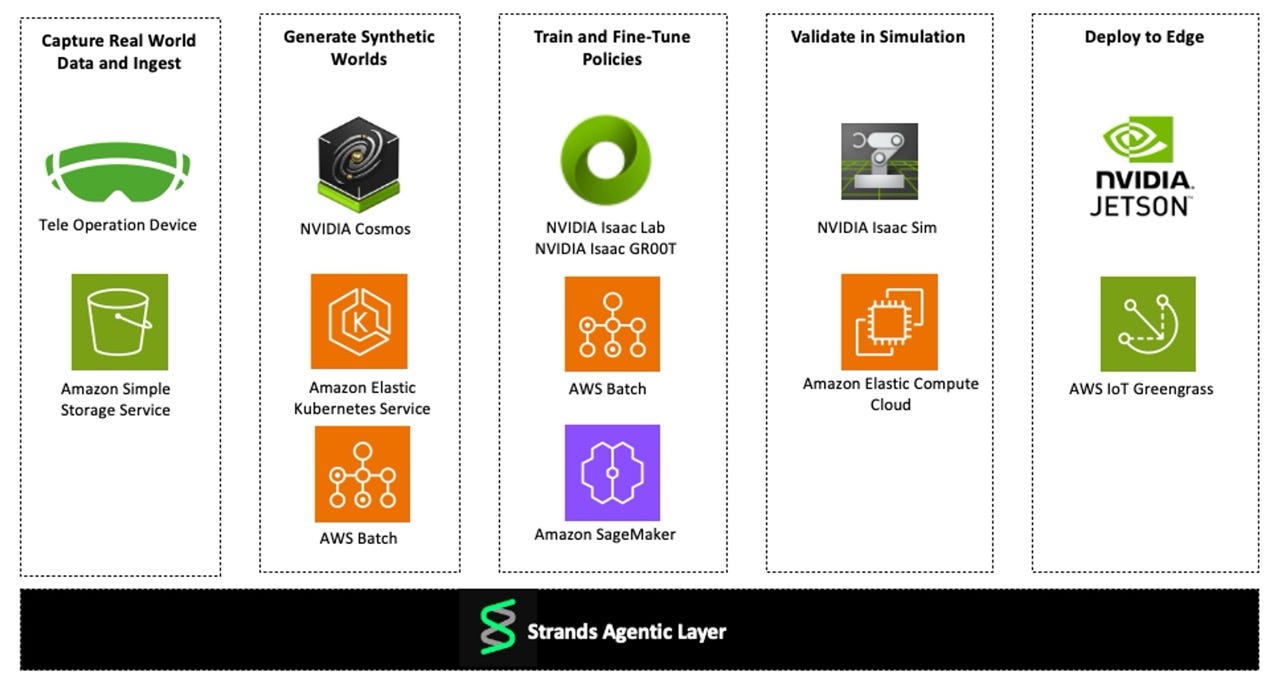
A free workshop walks through each stage with working examples that can be run against any robot data. For detailed setup instructions, see the README guide in the repository /GitHub/.
Read more at AWS
Doosan Enerbility ships 1st gas turbine to US for SpaceXAI
Doosan Enerbility said it has shipped a gas turbine to Space XAI for the U.S.-based artificial intelligence (AI) company’s energy infrastructure project. The South Korean power plant builder said the DGT6-300H gas turbine was manufactured at its facility in the southeastern city of Changwon, marking the company’s first gas turbine shipment to the United States. The turbine will be deployed as part of a U.S. energy infrastructure project by SpaceXAI, the AI arm of Elon Musk’s SpaceX, according to the Korean company.
Read more at The Korea Times
Business Transactions
This week’s top funding events, acquisitions, and partnerships across industrial value chains.
Atomic Machines emerges with $250M to build micro-machines from code
After six years in stealth, Atomic Machines is out. Our mission: on-demand, universal command of matter. First beachhead: the Matter Compiler, an AI-native manufacturing system that builds working micro-machines from code alone. No per-product tooling. No process development. Different code, different machine.
Founder & CEO /Jeff Holden on X/
The first device is PrimeSwitch PS-150, a relay that opens in 50 microseconds. The company says that is about 1,000 times faster than a conventional contactor. It carries 150 amps of continuous current. The package measures 9.5mm across and 3mm thick.
Read more at Business Wire
At Prometheus, where Bezos is a co-founder and co-CEO, he said the goal is to develop an “artificial general engineer” that helps people turn ideas into physical products. /Fox News/
Teradyne Makes Strategic Investment in Bright Machines to Advance AI Infrastructure Manufacturing /GlobeNewswire/
Ultra raises $62 million for fast-growing ‘robots as a service’ business, announces tie-up with AI research firm Physical Intelligence
Warehouse robotics startup Ultra has raised $62 million across two funding rounds: a $50 million Series A led by Framework Ventures with participation from Y Combinator, following an earlier $12 million seed round led by Y Combinator and Next View. Ultra’s rapid early traction stems largely from its “robots as a service” model, which avoids heavy upfront capital expenditures for clients. Instead, customers pay an initial integration fee for installation alongside an ongoing monthly fee covering hardware and software support. This approach has driven substantial booked revenue and strong demand, allowing the company to raise its prices as its machines pack orders across nationwide logistics hubs.
Central to Ultra’s strategy is a “body and brains” operational framework that divides physical engineering from artificial intelligence development. While Ultra handles the design, manufacturing, and on-site integration of the physical hardware, it relies on Physical Intelligence (PI) to provide the AI that enables the robots to quickly learn and adapt to each facility’s unique environment. Founded by former Google DeepMind researchers who published landmark work on robotic intelligence, PI is valued at $5.6 billion and supplies AI software to numerous robot manufacturers, benefiting from real-world operational data to further refine its models while Ultra focuses on core robotics hardware.
Read more at Fortune
Valuations for Most Robotics Startups Will Fall By 2030, Says Vinod Khosla /The Information/
Parallel Systems Closes $100M+ in New Funding to Fully Commercialize Autonomous Freight Rail System
Parallel Systems, the world’s leading battery-electric autonomous freight rail company, has closed its Series C funding round with $100 million in new capital. New investors include AVP which led the round, Hillspire, Agility Global, and Cobalt Capital, as well as participation from existing investors including Anthos Capital, Congruent Ventures, Riot Capital, and Collaborative Fund. Founded in 2020 by Matt Soule, who spent 13 years with SpaceX, the Company has assembled a team of engineers and rail operations professionals who will drive full commercialization, expansion into international markets, and scale manufacturing of Parallel’s third-generation Panther rail vehicle.
Since closing its Series B round in 2025, Parallel has successfully transitioned from initial prototyping to live commercial deployment under regulatory test approval. A number of major railroads are now under contract to deploy Parallel to transport commercial freight using the Company’s fully integrated autonomous delivery system, which seamlessly pairs its advanced hardware and software ecosystem. Parallel’s Georgia pilot is actively advancing in partnership with short-line railroad operator Genesee & Wyoming (G&W), operating under Federal Railroad Administration (FRA) supervision.
Read more at PR Newswire