


Shop Talk
Capturing this week’s zeitgeist
In the industrial technology sector, the software-driven urge to "move fast and break things" invariably collides with the rigid realities of heavy manufacturing, where displacing entrenched supply chains requires an uncompromising commitment to long-term validation. For deep-tech innovations entering highly regulated fields like aerospace, maritime, or defense, true market disruption cannot be rushed through aggressive early commercialization; instead, it hinges on spending years gathering empirical performance data, achieving stringent certifications, and systematically de-risking the hardware. Ultimately, building a groundbreaking system is only the first step, as the real triumph lies in having the operational endurance to fully master and validate your science before asking a skeptical market to change its mindset. The story of Caracol embodies this journey /Tech.eu/.
Quote of the Week
To become “the best salmon farming company in the world,” defined by the highest margins and the lowest salmon mortality rate, his son is embracing new technology. “I want us to be pioneers,” he said. “We want to take care of both people and the ocean, if you don't evolve as a company, you die.”
Norwegian Billionaire Bets Fortune on ‘World’s Best Fish Farm’ /Bloomberg/
Assembly Line
This week’s industrial breakthroughs and frontier technologies of the built world.
🗣️ The Untold Story of Koch Inc. : 130K Employees, 60 Countries, $150B Empire
Driving Sustainable Transformation: Endress+Hauser CEO Peter Selders /Spotify/
Capgemini Warns CEOs: Physical AI Can No Longer Be Ignored /Forbes/
🦾🤖🦿 Humanoid Robots Running an 8-hr shift - F.03 livestream
Per CEO Brett Adcock:
We previously showed this task running for 1 hour. Today we’re pushing for 8 hours straight. High odds something breaks
The use case is small package sorting. F.03 must detect the barcode, pick up the package, and reorient it barcode face-down onto the conveyor. The robots have to reason purely from camera pixels
Humans average ~3 seconds per package. F.03 is now around human parity
The robots are fully autonomous running Helix-02, our in-house neural network running entirely onboard F.03 (e.g. AI inference is done on device)
Multiple humanoids are networked together and communicating with each other to maximize conveyor uptime. The system is designed to run 24/7
A robot will work until battery is low (~3-4 hours), then autonomously request another robot to swap in to minimize conveyor downtime
It’s a multi-robot coordination with autonomous failover strategy. If a robot detects an issue - it will self diagnose itself and if there’s an issue it autonomously walks to maintenance and requests a replacement from the fleet - no humans in the loop

Figure AI’s 8-Hour Gamble Becomes a Livestream Marathon: over 33,000 Packages and No “Robot Failures” /Humanoids Daily/
Silicon Valley’s latest binge-watch is a humanoid warehouse worker /Business Insider/
🛢️ Why Big Oil is opening new frontiers
🛢️ Why the oil futures curve is not a crystal ball /FT/
☢️ Making New Nuclear Fuel for an Atomic Renaissance /Bloomberg Originals on YouTube/
🏭⚗️🧠 Physics-informed neural network-based multi-horizon model predictive control of chemical plants with renewable supply
✍️ Authors: Javad Tousi, Daniel Görges


To reduce carbon footprint and production costs, the chemical industry is increasingly integrating renewable energy into plant operations. Since renewable generation depends on variable weather, incorporating power forecasts is essential for effective planning, and production schedules must be continuously updated. Model Predictive Control (MPC) can use such forecasts to optimize control inputs, but extending its prediction horizon to capture long-term variations often becomes computationally intractable. This paper proposes a novel multi-horizon MPC framework based on a Physics-Informed Neural Network (PINN) model that combines short-term control accuracy with long-term predictions while addressing uncertainty and maintaining computational efficiency. An average production goal is included to enhance flexibility and ensure that the final target is met under power constraints. Simulation results on a chemical plant demonstrate the performance of the proposed approach in both computational efficiency and energy costs reduction.
Read more at Journal of Process Control

New Product Introduction
Highlighting new and innovative facilities, processes, products, and services
⚡🧠 GridSFM: A new, small foundation model for the electric grid
Microsoft releases a lightweight foundation model that can predict AC optimal power flow in milliseconds, boosting efficiency and unlocking cost savings in grid analysis.
At a glance:
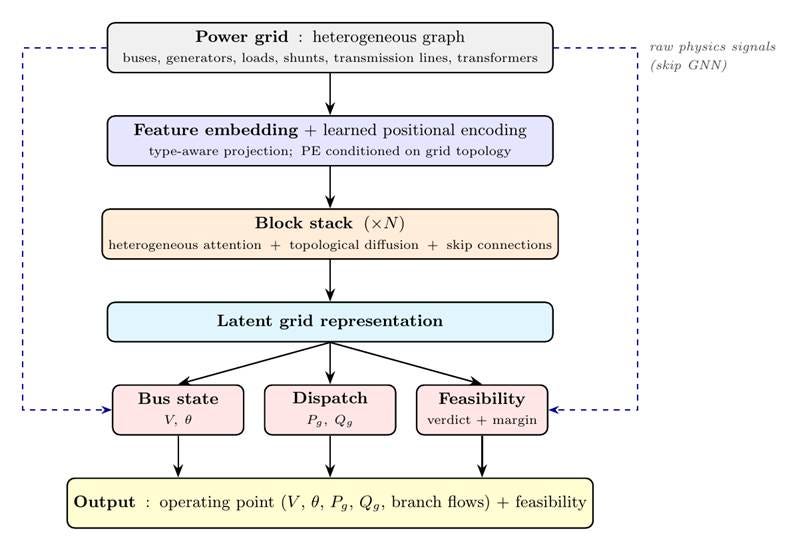
Microsoft introduces GridSFM, a small foundation model that approximates AC optimal power flow in milliseconds, unlocking decisions that can directly impact up to $20B/year in congestion losses and 3.4 TWh of renewable curtailment.
Beyond estimating generator dispatch and costs, GridSFM produces full AC system states, giving operators direct visibility into congestion, stability, and overall system health.
It provides a foundation for the community to build advanced power grid simulators and planning tools without recreating data or models from scratch.
Read more at Microsoft
Advancing AI for materials with MatterSim: experimental synthesis, faster simulation, and multi-task models /Microsoft/
🔋 Introducing Ford Energy
For the better part of a year, we have operated quietly to build a foundation for this business. We haven’t just been planning; we have been executing — securing supply chains, readying our manufacturing sites and aligning our technology with the massive demand for domestic energy storage.
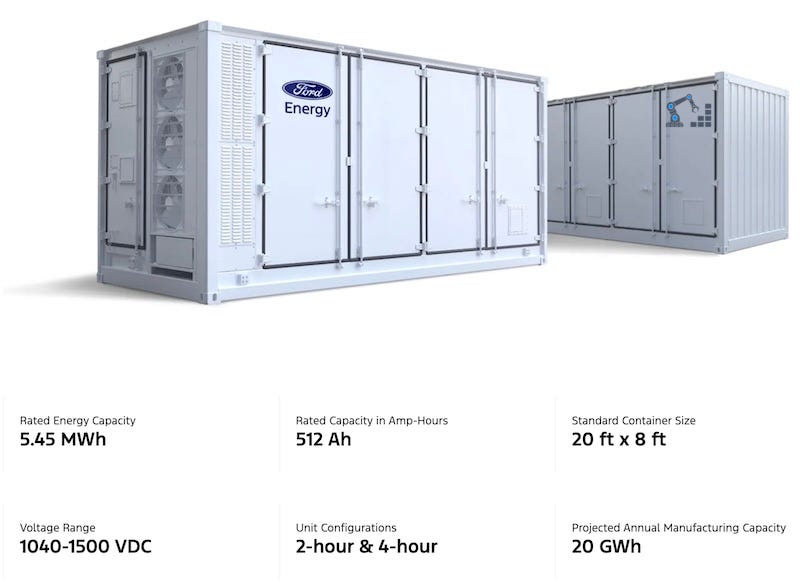
Ford Energy is a wholly owned subsidiary of Ford Motor Company. We will provide United States-assembled battery energy storage systems (BESS) for utilities, data centers and large industrial and commercial customers in the United States.
By leveraging more than a century of manufacturing expertise, Ford Energy plans to deploy at least 20 GWh annually, with first customer deliveries planned for late 2027.
Read more at Ford
Inside Ford’s EV Think Tank /Assembly/
Can a Chinese EV-maker reinvent itself as a robot firm? /The Economist/ An interview with the boss of Xpeng
Business Transactions
This week’s top funding events, acquisitions, and partnerships across industrial value chains.
🇺🇸🦾 Mind Robotics Announces $400M in New Funding to Expand Industrial Robotics Deployment
Mind Robotics announced a $400 million financing led by Kleiner Perkins, bringing total investment in Mind Robotics to more than $1 billion. This financing included participation from new investors including Meritech Capital, Redpoint Ventures, SV Angel, Incharge Capital, A-Star Capital, and Garuda Ventures as well as existing investors including Accel, Andreessen Horowitz, Eclipse, Prysm Capital, Bain Capital Ventures, and Greenoaks. This follows a seed financing of $115M in late 2025 and a Series A of $500M in March 2026.
Mind Robotics is building the world’s leading industrial robotics platform, combining foundation models, robust hardware, and deployment infrastructure to automate dexterous, reasoning-intensive manufacturing tasks at scale. The company operates with Rivian as a key partner and shareholder, providing a live, high-volume manufacturing environment for model training and deployment.
Read more at Business Wire and The Robot Report
🇨🇳🦿 Unitree Robotics founder/CEO Wang Xingxing details the first bipedal robot he developed for around ¥200 ($30) /Mike Kalil on X/
🇨🇳🦾 China’s Caifu Robot More Than Doubles World Record for Industrial Robot Payload /YiCai/
🇺🇸 🛰️🔌 Star Catcher Raises $65 Million to Build the First Power Grid in Space
Star Catcher Industries, Inc., the company building the first power grid in space, announced it has raised $65 million in an oversubscribed Series A round. The new investment — led by B Capital and co-led by Shield Capital and Cerberus Ventures, the venture arm of Cerberus Capital Management — brings Star Catcher’s total capital raised to $88 million.
Founded less than two years ago, Star Catcher is developing a space-based energy infrastructure layer that delivers electricity on demand to satellites and other spacecraft using optical power beaming. Following an industry-leading seed round and exceptional customer traction, the company set the world record for optical power beaming, completed a critical on-orbit subsystem demonstration, and validated its end-to-end system architecture. The Series A positions Star Catcher to move from validated technology to scalable infrastructure.
Read more at PR Newswire
🛰️ How to Build a Data Center in Space /Bloomberg/
🌕 NASA wants to put people on the moon. Lunar Outpost just landed $30M to send its rovers there first /TFN/
🌕 Inside NASA’s ‘very ambitious’ moon base plan /Scientific American/ NASA’s moon exploration plans call for nearly 80 launches, nearly 75 landers, 10 moon buggies and one nuclear reactor
🛰️ Cowboy Space Raises $275 Million /Bloomberg/ to use its own rockets to put data centers into orbit
🇫🇷 Mantle8 raises €31 million to fund the world’s most advanced natural hydrogen exploration and drilling campaign
Mantle8, a Grenoble, France-based natural hydrogen exploration company, has raised €31 million in Series A funding. This round brings the company’s total funding to €37 million (US$44 million). The round was led by Sandwater and includes Breakthrough Energy Ventures, Ecotechnologies 2 fund managed on behalf of the French government by Bpifrance, IP Group, Wind Capital and Calderion (an Audacia-backed investment platform).
Mantle8 claims that its technology for identifying commercially viable natural hydrogen reserves reduces exploration risk and cost, with economic models projecting production costs as low as €0.80/kg. This significantly contributes to a much lower average cost of clean hydrogen supply.
Read more at EU Startups
Looking for additional content? Paid subscribers get more stories delivered each week as part of Overcapacity!