


Shop Talk
Capturing this week’s zeitgeist
You can literally retrace all the forks in the tech tree and just look for “Here’s what we knew at the time”, and then you can insert what YOU know NOW, in 2026, and see if the other forks that weren’t pursued would bear fruit today.
You have to remember we arrived at many of those things by making decisions with incomplete information.
That’s the core thesis of Exponential Industry. By systematically retracing historical tech-tree forks and pairing them with modern materials, advanced manufacturing, and AI that augments the tacit knowledge of the original researchers and their networks, we can bypass the incremental dead-ends of today’s dominant technologies. History is littered with good ideas abandoned under incomplete information; the work of Exponential Industry is to surface the entrepreneurs and capital that can turn those abandoned industrial technology detours into high-probability exponential breakthroughs.
Assembly Line
This week’s industrial breakthroughs and frontier technologies of the built world.
You can now 3D-print the core of an MRI scanner.
A machine that hospitals pay $1.1 million to $3.4 million for has been broken open. The OSI² ONE and its educational siblings deliver real images of heads and limbs for a fraction of the cost, using a permanent-magnet Halbach array, 3D-printed structures, and fully open designs.
This is not a toy or a simulation. Working systems already produce in-vivo images in Leiden, Utrecht, Berlin, and Uganda.
The magnet alone has 396 carefully oriented neodymium cubes in a cylindrical Halbach array with costs totaling about $1,370. A complete scanner lands between $28,500 and $68,000 depending on the console and coils you choose.
Read more at Brian Roemmele on X
Why NVIDIA & BlackRock Are Betting $2.3B on This Startup
A visit to PsiQuantum’s quantum computer factory in Milpitas, California - the last production chip fab to close its doors in Silicon Valley, now ground zero for the world’s largest quantum computer.
BBC Tech Now’s Adrienne Murray has rare access to Microsoft’s Quantum Lab in Denmark to find out how the chips are being developed /YouTube/
Performant robotic manipulation with real-world reinforcement learning
✍️ Authors: Kun Lei, Huanyu Li, Dongjie Yu, et. al
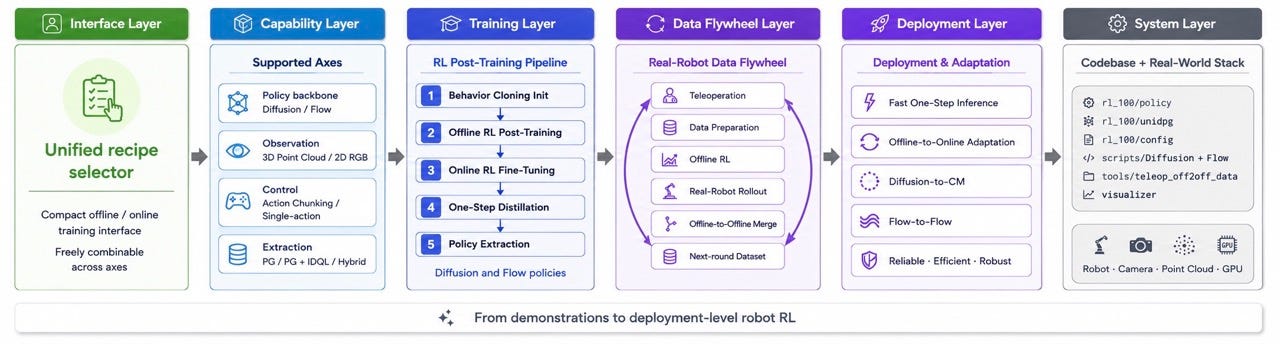
Real-world robotic manipulation in homes and factories demands reliability, efficiency, and robustness that approach or surpass skilled human operators. We present a real-world reinforcement learning (RL) framework, RL-100, for achieving complete task success under a predefined evaluation protocol built on diffusion visuomotor policies. RL-100 unifies imitation and RL under a single clipped proximal policy optimization surrogate objective applied in the denoising process, yielding conservative, stable improvements across offline and online stages. To meet deployment latency, a lightweight consistency distillation compresses multistep diffusion into a one-step controller for high-frequency control. The framework is task, embodiment, and representation agnostic and supports both single-action and action-chunking control. We evaluated RL-100 on eight diverse real-robot tasks, from pushing and bowling to pouring, cloth folding, unscrewing, multistage juicing, and long-horizon box folding. Under our predefined protocol, RL-100 achieved 100% success in the evaluated trials (1000 of 1000 episodes), including up to 250 of 250 consecutive trials on one task. It matched or surpassed expert teleoperators in time to completion. Without retraining, a single policy attained ∼90% zero-shot success under environmental and dynamics shifts, adapted in a few-shot regime to substantial task variations (86.7%), and remained robust to human perturbations (about 96%). Our juicing robot served customers continuously for about 7 hours without failure when deployed zero-shot in a shopping mall. These results suggest a potential path to deployable robot learning by starting from human priors, aligning training objectives with human-grounded metrics, and reliably extending performance beyond human demonstrations.
Read more at Science Robotics
The Hidden American Manufacturing Advantage

New Product Introduction
Highlighting new and innovative facilities, processes, products, and services
CuspAI Launches ‘AI Materials Foundry’ a Global Network to Accelerate Breakthrough Discoveries
Software-led materials discovery requires four things: high quality training data at scale, to make AI predictions reliable; compute powerful enough to screen at molecular resolution across billions of candidates; synthesis infrastructure to move from digital design to physical reality; and domain expertise to interpret what the machine finds and know what to do with it.
CuspAI’s AI Materials Foundry assembles all four, for the first time, providing the production infrastructure for industrial materials discovery. Rather than relying on the physical constraints of a single, isolated laboratory, CuspAI’s ecosystem approach creates a compounding intelligence loop: breakthroughs achieved within the network have potential to accelerate discovery timelines across the entire global value chain.
Read more at Business Wire
By uniting advanced semiconductor packaging materials with high-efficiency data center thermal management, Solstice Advanced Materials and Element Solutions seek to create a specialized end-to-end platform capturing high-margin demand across every critical hardware layer of the expanding AI supply chain /Solstice/.
RTX’s Pratt & Whitney Valox™ 1500 Engine Completes Key Design Milestone
Pratt & Whitney, an RTX business, has successfully completed a key design milestone for its Pratt & Whitney Valox™ 1500 engine, a new powerplant intended for semi-autonomous collaborative platforms. A comprehensive digital assessment confirms the design is on track to deliver an optimal mix of performance, affordability, and speed to market.
Leveraging proactive investments in digital engineering, Pratt & Whitney has significantly de-risked the development timeline and is now focused on maturing the design for follow-on ground testing. In late 2025, Pratt & Whitney received a contract award valued at more than $10 million from the U.S. Air Force to advance the engine design.
Read more at RTX
Boeing Sees ‘Volatile’ Supply Base as it Boosts Jet Output /Bloomberg/
Business Transactions
This week’s top funding events, acquisitions, and partnerships across industrial value chains.
TruArc Partners Closes on $1.2 Billion for TruArc Partners Fund V /Business Wire/ focused on middle-market investments in specialty manufacturing and business services
ATOMS is announcing a $1.7B equity investment with lead investor a16z
With the ATOMS launch a few months ago, there was a huge amount of interest after many years of ninja level stealth. My vision letter outlined Physical AI in industry, but it cruised at a fairly high altitude. I figured this moment would be a good time to connect the dots between our bold vision for the future with the actual business we are building /Travis Kalanick on X/, and bring to life what A16Z and other great investors see in it.
The impetus for this transformation is Industrial AI - Systems of software, sensors, robotics and AI used to automate the operations of entire industrial sectors. Industrial AI is getting ready to power the next Industrial Revolution. Tesla calls it Amazing Abundance. We call it the Age of Atoms.
Read more at Atoms
SoftBank Weighs Deal for Robotics Startup Gravis /Bloomberg/. A deal could ultimately value Zurich-based Gravis at more than $500 million. Founded in 2022 as a spinout from ETH Zurich university, Gravis makes hardware and software that helps earthmoving equipment operate autonomously.
Sila Secures $300 Million in Private Funding to Ramp Gigascale Anode Manufacturing and Strengthen America’s Technology Sovereignty
Sila, an advanced battery technology company, today announced it has secured $300 million in a private equity round led by Atreides Management, and Sutter Hill Ventures. The round is joined by 8VC, Bessemer Venture Partners, Matrix Partners, funds and accounts advised by T. Rowe Price Associates, Inc, and other existing and new investors. The raise will accelerate U.S. production of Sila’s silicon-carbon (Si/C) anode technology, Titan Silicon® and support a planned Phase 2 expansion at Sila’s plant in Moses Lake, Washington.
Sila’s team pioneered the modern silicon-carbon (Si/C) anode, a breakthrough technology that delivers 20-40% higher energy density than traditional graphite, enabling batteries that are smaller, lighter, and capable of ultra-fast charging. By pairing American intellectual property with gigascale manufacturing in the United States, Sila is building the blueprint for supply chain security of critical technology.
Read more at Business Wire
Sofab Inks Secures $6 Million Seed Round to Break the Reliability Barrier for Perovskite Solar /PR Newswire/
Arrakis Comes out of Stealth With $38M to Help Industrial Enterprises Compete in the AI Era
Arrakis, the AI deployment company helping industrial companies install AI agents for mission-critical operations, announced a $30 million Series A led by Blossom Capital, with participation from existing investor Accel, which also led the company’s $7.5 million seed round.
Arrakis combines elite forward-deployed AI engineers with a model-agnostic enterprise AI platform and applied AI research tuned to industrial operations, letting companies leverage their data to train, deploy, and scale custom AI agents in weeks, not quarters. The result is an AI transformation executed at warp speed, using the right model for the right task, and giving companies full control over performance, resilience and cost. Arrakis operates to the strictest data and security standards: customer data and IP remain theirs, and the company never uses them for third-party model training. Rather than replacing existing technology stacks, Arrakis deploys AI agents into existing systems, improving operational throughput without multi-year migrations. The company ties a significant proportion of its fees directly to customer outcomes, aligning its commercial model with the value delivered.
Read more at Business Wire
1872 Launches Autonomous Steel Fabrication Factory Model in Cincinnati and Closes $15 million Seed Funding Round
1872, a startup focused on AI-native manufacturing, announced its opening, introducing what will be an automated steel fabrication factory model in Cincinnati’s Camp Washington neighborhood. The company, founded by three former SpaceX engineers, is propelled by a $15 million seed funding round, one of the largest in Ohio history, made through private funds advised by The O.H.I.O. Fund, a private fund investment adviser seeking to generate strong returns for investors while creating economic growth in Ohio.
1872 introduces a unique AI-based factory automation solution to an industry that has struggled to innovate and has been unable to keep up with rising demand for steel products in the modular construction and infrastructure markets. The company’s proprietary system integrates AI software that understands the physical world with advanced automation from companies such as Ohio-based Path Robotics. This technology automates heavy fabrication tasks that have traditionally relied on manual labor, now in critically short supply. Early automations are in place at 1872, with the company expecting to achieve its full autonomous vision in 2027.
Read more at Business Wire
Looking for additional content? Paid subscribers get more stories delivered each week as part of Overcapacity!