


Shop Talk
Capturing this week’s zeitgeist
The buildout of the American railroad system in the 19th century was more than just a transportation project; it was the creation of the world’s first truly modern industrial operating system. By solving the massive logistical challenges of a continent-sized nation, railroads established the management, financial, and technical frameworks that defined the 20th-century global economy. Today, AI factories are poised to execute a parallel transformation by industrializing the production of intelligence for the 21st-century economy.


Quote of the Week
It’s one of the things that we can do that is hard for someone else to do. We’ve made enormous commitments upstream. Some of it is explicit, these commitments that you mentioned. Some of it is implicit. For example, a lot of the investments that are upstream are made by our supply chain because I said to the CEOs, “Let me tell you how big this industry is going to be, let me explain to you why, let me reason through it with you, and let me show you what I see.”
As a result of that process of informing, inspiring, and aligning with CEOs of all different industries upstream, they’re willing to make the investments. Why are they willing to make the investments for me and not someone else? The reason for that is because they know that I have the capacity to buy their supply and sell it through my downstream. The fact is that Nvidia’s downstream supply chain and our downstream demand is so large, they’re willing to make the investment upstream.
Jensen Huang, Founder and CEO, NVIDIA /Dwarkesh Podcast/
New in 2026: We are gifting a 1-year paid subscription to the first person to identify the content link AND cultural reference to the title/subject line of this week’s digest. Comment on this post with your guess before next week’s digest is released to be eligible!
Last week’s answer: Ella Langley artist of Choosin’ Texas /YouTube/ released her sophomore album, Dandelion, on April 10, 2026 while manufacturers are weighing AI’s energy demands /Manufacturing Dive/
Assembly Line
This week’s Industry 5.0 breakthroughs and frontier technologies of the built world.
🌱🧠 Inside Syngenta’s AI Driven Approach To Modern Agriculture
Syngenta is embedding AI and data analytics across four strategic pillars: research, supply chain, enterprise operations, and farmer-facing tools, to transform traditional agricultural inputs into a digitally-driven ecosystem. By leveraging interdisciplinary teams in computational agronomy and treating modern farm machinery as “data centers on wheels,” the company democratizes expert knowledge through real-time AI diagnostics and predictive disease modeling across 150 million acres. This digital transformation creates significant business value by optimizing resource allocation and increasing crop yields on existing land, positioning the firm to address global food security while paving the way for autonomous agricultural robotics.
Read more from Syngenta’s CIDO, Feroz Sheikh, at Forbes
🚛🧠 Autonomous Trucking Is Fragmenting Into Distinct Market Entry Models /Logistics Viewpoints/
🏭💿🧠 “Intel is substantially improving on its current “Intel Foundry Portal” by providing new AI enabled data metrics that go far beyond what TSMC provides customers” /@christophauto on X/. “Intel under LBT is leaning hard into Pat’s “systems foundry” differentiation while tweaking it in his own way by providing much deeper co-design and richer data services, while also addressing customer concerns regarding IP protection by creating more explicit firewalls within the company”
📸🧠 Turning Computer Vision Into Real‑World Value at Enterprise Scale
A major shift is underway as enterprises move from lab‑ready computer vision to the far more complex reality of deploying visual intelligence across messy, variable, high‑stakes physical environments. In this episode, Joseph Nelson, Co‑founder and CEO at Roboflow, examines how dependable visual data, models tuned to real operating conditions, and integration with existing production and safety systems determine whether visual AI delivers meaningful value.
⚗️🧠🔁 How Close Is the Chemical Industry to True Autonomy?
The chemical industry is transitioning toward autonomy by implementing state-based automation and digital twins that shift operators from manual routine tasks to high-level process supervision. Although AI breakthroughs like the FKDPP algorithm demonstrate rapid learning in complex operations, full adoption remains hindered by fragmented data connectivity, cybersecurity risks, and the cultural challenge of evolving workforce roles. The primary business value lies in achieving tighter closed-loop integration and safer, optimized transitions between operating modes, which drives greater plant efficiency while keeping humans in the loop to ensure system reliability.
Read more at Chemical Processing
🇺🇸⚗️ Sennos Raises $20 Million to Accelerate AI-Powered Intelligent Fermentation System, Bringing Total Funding to More Than $50 Million /PR Newswire/
🦾🧠 Robotic smelting: how automation is reshaping aluminium production /Mining Technology/.

🚢💧 World’s largest, China’s first 10,000-ton all-electric smart container vessel delivered /Global Times/. It is expected to save 580 tons of fuel a year and reduce carbon dioxide emissions by more than 1,400 tons after being put into operation, delivering genuinely zero-emission, zero-pollution voyages, Ningbo-Zhoushan Port said.
🚢🛢️ Record armada of tankers bound for U.S. Gulf to load oil /New Orleans CityBusiness/. 171 crude oil tankers are currently headed to the U.S. Gulf, compared to a typical 110 per month
New Product Introduction
Highlighting new and innovative facilities, processes, products, and services
🦾🧠🔁 Gemini Robotics-ER 1.6: Powering real-world robotics tasks through enhanced embodied reasoning
Introducing Gemini Robotics-ER 1.6, a significant upgrade to our reasoning-first model that enables robots to understand their environments with unprecedented precision. By enhancing spatial reasoning and multi-view understanding, DeepMind is bringing a new level of autonomy to the next generation of physical agents.
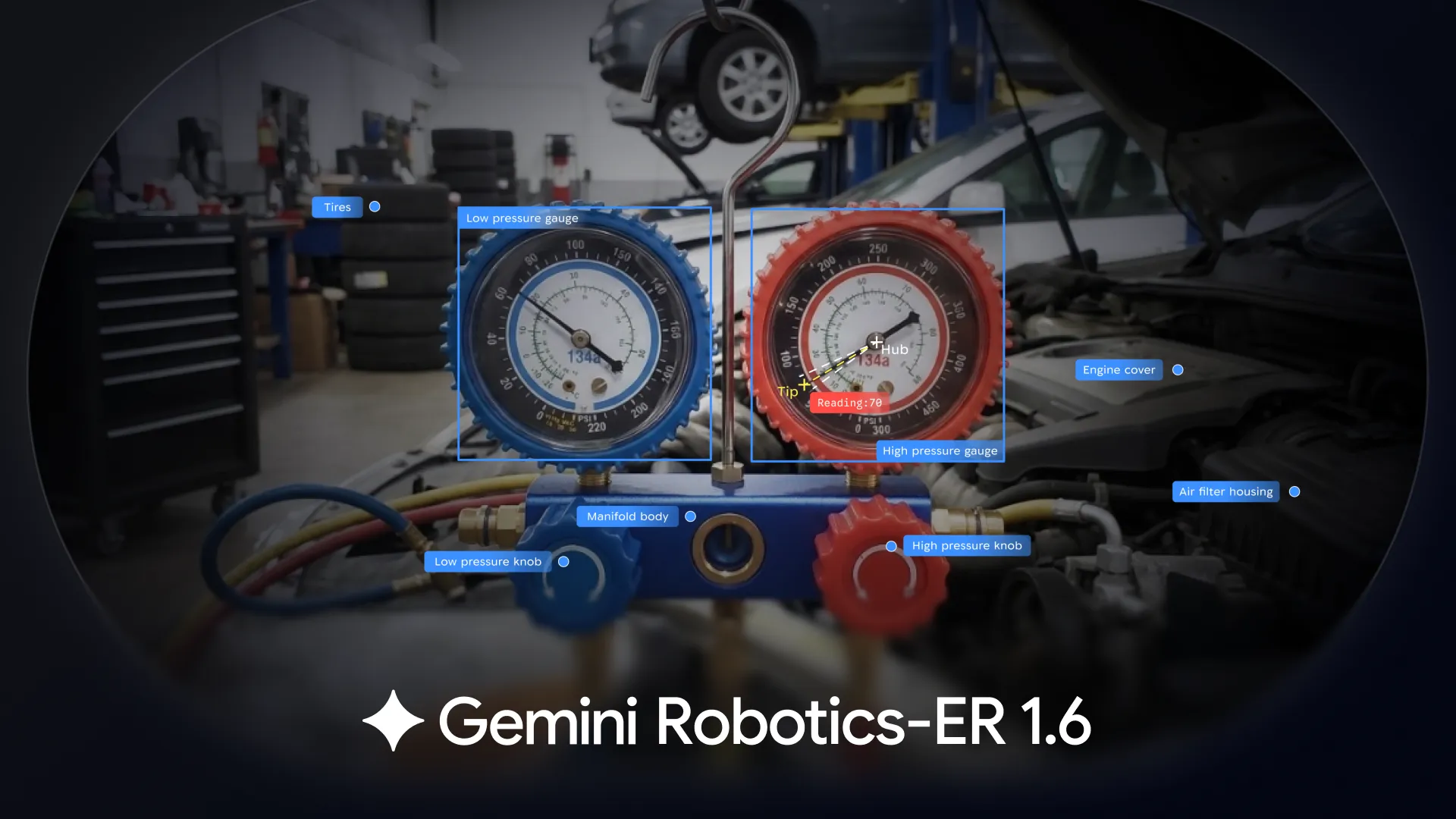
This model specializes in reasoning capabilities critical for robotics, including visual and spatial understanding, task planning and success detection. It acts as the high-level reasoning model for a robot, capable of executing tasks by natively calling tools like Google Search to find information, vision-language-action models (VLAs) or any other third-party user-defined functions.
Read more at DeepMind
🦾🧠📱 AGIBOT has deployed G2 humanoid robots into a live tablet production line with Longcheer, marking a shift to industrial embodied AI use. /IE/
🦾🧠 Path Robotics Launches Rove, Bringing Mobility to Welding Automation Powered by Physical AI /Business Wire/
How manufacturers are testing physical AI before making big investments /Manufacturing Dive/
🔋 Deep Dive: Inside the Verge TS Pro Solid-State Battery Pack
Business Transactions
This week’s top funding events, acquisitions, and partnerships across industrial value chains.
🇪🇺💰💿 How Europe Actually Finances Semiconductor Investments /EETimes/
🇺🇸🛻 Slate Raises $650 Million in Series C Round
Slate Auto possesses the operating capital to reach the next stage of development, thanks to visionary investors dedicated to developing the affordable and customizable vehicle. TWG Global continues its strong support of Slate and led the round. Slate has taken over 160,000 reservations and will deliver its first vehicles to customers in late 2026.
The Slate Truck will cost in the mid-$20,000s. Every Slate Truck will be built in the same configuration, ready for accessorization after delivery. The manufacturer’s retail price will be announced in June 2026.
Read more at PR Newswire
🇺🇸🛻 Rivian’s Illinois Factory Will Run on Recycled EV Batteries /WSJ/. Rivian and Redwood Materials Announce Energy Storage Partnership for Manufacturing /Business Wire/
🇺🇸🚙 Tesla is developing a new smaller, cheaper EV, sources say /Reuters/. A key question is whether this latest effort to develop a smaller SUV signals a strategy shift back to mass-market human-driven EVs or whether the new model would align more with Tesla’s vision for fully autonomous vehicles.
🇩🇪📐🧠 Synera Raises $40M Series B to Scale Agentic AI Engineering for Global Manufacturers
Synera, the agentic AI platform orchestrating the full industrial engineering value chain, announced a $40 million (€35M) Series B round led by Revaia, with participation from Capgemini through ISAI Cap Venture. The round also includes all existing Series A investors, including UVC Partners with a substantial commitment from its growth fund, BMW iVentures, Cherry Ventures, Venture Stars, and Spark Capital—marking a step change in Synera’s trajectory as it moves from early adoption to large‑scale industrial deployment.
Unlike solutions that require replacing existing infrastructure, Synera integrates with more than 80+ engineering tools and enterprise systems, enabling automation while keeping data and engineering intellectual property secure through on‑premises deployment. The result is a major leap in engineering productivity: faster development cycles, KPIs, reduced material usage, innovative product designs, and cost efficiencies that directly influence competitiveness and production economics.
Read more at Business Wire
🇬🇧 StirLight raises £1.25M to bring real-time quality assurance to friction stir welding at scale
StirLight has secured £1.25 million to commercialize its technology and accelerate the adoption of advanced manufacturing processes at scale by major industrial original equipment manufacturers. The company combines friction stir welding expertise with StirSense, a proprietary real-time process-monitoring and quality-assurance platform. The funding comprises over £750,000 in pre-seed investment from Haatch Ventures, The British Business Bank, D2N2 and angel investors, alongside approximately £500,000 in grant funding from Innovate UK and The Aerospace Technology Institute (‘ATI’) across two R&D projects.
Read more at Tech.eu
Looking for additional content? Paid subscribers get more stories delivered each week as part of Overcapacity!