


Shop Talk
Capturing this week’s zeitgeist
The collision between rapid industrial digitization and AI-discovered vulnerabilities reached a breaking point this week, offering a stark reminder of what happens when operational technology (OT) is unsecured.
Across Europe, coordinated cyber incidents hijacked connected commercial refrigeration systems in supermarkets and French blood banks, forcing temperatures above 50°C (122°F) and destroying millions of euros in inventory /CBS/. These attacks exploited legacy, internet-facing controllers running on unpatched firmware and default credentials. This reality check coincides with the active exploitation of CVE-2026-58115 /NIST/, a maximum-severity remote code execution flaw in Siemens SIMATIC IoT2050 industrial gateways caused by unauthenticated Node-RED web interfaces, which threat actors are actively using to drop Linux botnets and persistent backdoors.
These physical fallout events arrive right as the edge connectivity perimeter is undergoing an unprecedented expansion. According to IoT Analytics, the industrial router and access point market reached $2.86 billion in 2025 and is on track to surpass $4 billion by 2030, driven by factory automation, AGV/AMR fleets, and cellular 5G/RedCap upgrades. However, the core takeaway for industrial leaders this week is unmistakable:
How are you securing your automation and AI stack?
Heard on the Floor
a general observation having invested in deeptech for 18 years…ultimately every deeptech investor discovers some form of “VALLEY OF DEATH” in financing their companies. In many cases it leads to discovering the lender of last resort as well.
Bilal Zuberi // Red Glass Ventures /X/
If you’ve enjoyed reading Exponential Industry, please spread the word by sharing the publication
Assembly Line
Thought provoking stories across the industrial world.
Why Most Battery Breakthroughs Fail
Matt went back through the battery technology he’s covered over the last few years. One sand battery is now heating a Finnish town, but a liquid metal battery ran out of money after 15 years, and another company killed its own battery to save itself. He scored each one on the Technology Readiness Level scale, from an idea on a whiteboard to something customers already use.
New Batteries That Store Blistering Heat Are Taking Off /NYT/. To charge up, Antora draws surplus electricity from nearby wind farms that would otherwise go to waste, using it to heat carbon blocks to as much as 4,352 degrees Fahrenheit. The blocks stay hot for days, releasing heat on demand to produce steam for a nearby biofuel refinery, replacing the need to burn natural gas and coal.
LG Electronics Production Engineering Research Institute Appoints Ratel Consulting to Accelerate North American Battery Business /PR Newswire/
TerraFlow Energy Acquires FlowCellutions, Expanding Flow Battery Technology Capabilities /TerraFlow Energy/
Did you know Exponential Industry’s Hidden Factory provides a real-time assessment of emerging industrial technologies like Energy Storage Systems & Grid Battery Tech?
What Happens When Monks Combine Ancient Architecture with Modern CNC Technology?
Mastercam visited the Carmelite Monks of Wyoming, where centuries-old architectural traditions meet cutting-edge manufacturing technology. What began in 2003 as a vision shared by a handful of monks has grown into an extraordinary construction project featuring custom-cut limestone and granite, intricate Gothic stonework, and advanced CNC machining. Join Jesse as he tours the monastery and machining facility with Brother Isidor, discovering how the monks use Mastercam, 5-axis CNC machines, robotics, and custom workflows to transform massive stone blocks into breathtaking architectural elements.
Tutor Intelligence on the Compatibility of Physical AI and ROI
✍️ Author: Brian Heater
RaaS’s rising popularity helps with these calculations. Instead of factoring in huge upfront costs, companies effectively rent the systems making for a clearer one-to-one comparison at the end of the month. Boston-based Tutor takes things a step further with a unique framing.
Customers “hire” by the “robot hour.” It’s an even more straightforward way of juxtaposing automation and human labor expense. With its current structure, clients pay between $14 and $18 per robot per hour.
“We think that the closer you can get to charging per unit of work, the more aligned you are with the customer incentive,” says CEO Josh Gruenstein. “If you’re charging per month, maybe that robot is sitting down a portion of that month. As the robot vendor, we should be screaming. We should be incredibly motivated to get that fixed. If you’re a factory that sometimes runs 40 hours a week and sometimes runs 120 hours a week, your robot’s cost should be dynamic to that.”
Read more at A3
The Future of Robotics as a Service with Saman Farid of Formic /ARK Invest/
A New Way to fight ‘forever chemicals’
✍️ Author: Richard Harth
Per- and polyfluoroalkyl substances, or PFAS, gained early widespread use in products such as Teflon, a coating that resists oil, heat, stains, grease and water. Today, they are everywhere, from paints and adhesives to furniture, carpets, cosmetics, semiconductors and waterproof fabrics. Unfortunately, they are also in our water, soil, food, and even us.
Now, researchers at Arizona State University and their international colleagues are attacking the problem in a new way. Rather than filtering these harmful chemicals out of contaminated water, they have developed a technique to destroy them.
Most conventional PFAS treatments separate the chemicals from water. Activated carbon, ion exchange and membrane filtration can capture PFAS, but the contaminants remain in spent filters, brines or concentrated waste that must still be handled or disposed of. The new approach is designed to go a step further by breaking the chemicals apart rather than simply moving them somewhere else.
Read more at ASU
Catalytic reactive-hydrogen membranes for rapid capture and hydrodefluorination of six PFAS of regulatory concern /PNAS/
AltM, a Bengaluru-based startup that makes specialty chemicals from agricultural waste, has raised US$10.3 million in a series A /Tech in Asia/
After a $2.5 Trillion Wipeout, Tech Investors Brace for More Pain /NYT/, so in case you missed it Constraint Capital #10 finds out:
Who Can Survive the Buildout?

As of the past few weeks, debt markets have almost entirely shut off access to money for any company that doesn’t have substantial revenue independent of AI data centers.
New Product Introduction
New and innovative facilities, processes, products, and services
Medium voltage switchgear is one of the longest lead times in the AI infrastructure supply chain
Crusoe has vertically integrated the capability to manufacture this gear in-house through Crusoe Industries. This brings down our lead time by 40%. Crusoe is now one of only three approved manufacturers in the U.S. for this kind of ABB gas insulated switchgear.
Discuss with Co-Founder Cully Cavness on X
Eaton CEO: AC to DC migration for data centers ‘is real’ /Utility Dive/
Airplanes that Leak Your Location
This video examines the amount of location information carried by inaudible background sounds, using the Doppler effect to locate a reference recording within ~100m, and only needing (in some cases) less 1-min of audio. This video raises awareness of these capabilities and closes by discussing preventative measures one could take.
End of an Era: Jeppesen ForeFlight Bids Farewell to Paper Charts /FLYING/

Business Transactions
Top funding events, acquisitions, and partnerships across industrial value chains.
The Reindustrialization of America Is Underway /Apollo/
Agility Becomes First U.S. Publicly Listed Pure-Play Humanoid Robotics Company, Began on Nasdaq as AGLT
Agility® (Nasdaq: AGLT), a leading humanoid robotics and physical AI company, became the first U.S. publicly listed pure-play humanoid robotics company with proven, active commercial deployments. Agility’s common stock and warrants began on the Nasdaq Stock Market under the ticker symbols “AGLT” and “AGLTW,” respectively, following completion of its previously announced business combination with Churchill Capital Corp XI. The business combination and related financings represent approximately $465 million in gross capital raised before transaction expenses.
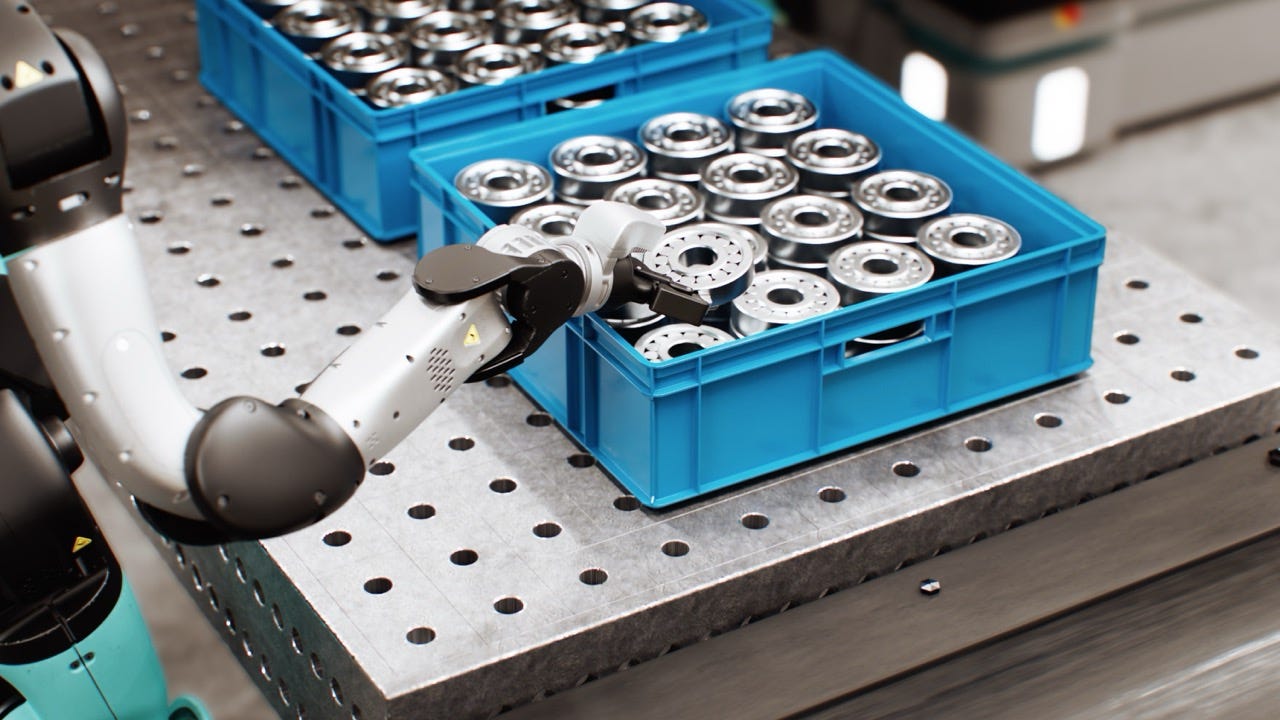
Agility enters the public markets with a differentiated foundation for commercializing humanoid robotics: nearly three years of real-world deployment experience, more than 65,000 hours of operation, committed multi-year customer orders and U.S.-based infrastructure designed to manufacture, deploy and support robots at scale. The company has secured more than $300 million in committed multi-year orders for Digit® 5, its next-generation humanoid robot, subject to contractual milestones, product features and specifications.
Read more at Globe Newswire
Josef Chen Toured Unitree’s Factory. He’s More Bullish on the West Than Ever. /X/
Harbinger Raises $240 Million Series D Funding Round, Led by Tiger Global
Harbinger, an American industrial technology platform company, announced that they have raised $240 million in Series D funding to help fuel the company’s next phase of growth. The funding round was co-led by Tiger Global, Capricorn’s Technology Impact Fund and Ridgeline. Additional investors in the round include crossover investors Fidelity Management & Research Company; Squarepoint Capital and Xantium; returning investors Maniv and Greycroft, Australian Gulf Capital, PanaceaVC, ArcTern Ventures, and Leitmotif; and strategic investors in mobility FedEx and THOR Industries through TechNexus, as well as BuildGroup in data centers; among others.
The new funding will support Harbinger’s further expansion across multiple verticals, spanning commercial vehicles, energy storage systems, power generation, autonomy software and defense applications, as well as the continued ramp up of its medium-duty platform manufacturing capacity. With the new financing, Harbinger has raised over $650 million since its founding in 2021.
Read more at PR Newswire
Humble Robotics Raises $51 Million Series A to Scale Its Unified Approach to Autonomous and Electric Freight /Business Wire/
AFORMIC raises $6.95 million seed round to automate the industries that matter /AFORMIC/
Fact Base Raises $28.8M Series D to Digitize the Factory Floor
Fact Base, Inc., which operates the drawing management system “ZUMEN”, announced that it has raised a total of approximately USD 28.8 million in their Series D funding round, consisting of a third-party allotment of new shares and the transfer of existing shares. The round was led by Insight Partners, which also participated as the lead investor in Fact Base’s Series C round, along with news investors Artemis Ventures Co., Ltd. and MPower Partners.
The funds raised will be used to further strengthen hiring and sales operations in overseas markets, as well as to advance the technical development and feature expansion of ZUMEN. In addition, the company will invest in expanding its business portfolio through new business development, and in building the management foundation needed to support global expansion, including strengthening administrative functions and establishing governance structures.
Read more at Business Wire
FluoRok raises €26.64 million to scale fluorochemical production without hazardous hydrogen fluoride
FluoRok, an Oxford-based chemical manufacturing startup that has developed a patented process to produce fluorochemicals without using highly hazardous hydrogen fluoride (HF), has secured a €26.64 million ($30 million) Series A financing round. The round was led by Orano Ventures Fund/Supernova Invest, with participation from investor Bidra Innovation Ventures. Existing backers Oxford Science Enterprises, BGF, GGF, Volta Energy Technologies, and the University of Oxford also participated in the round.
Founded in 2022, FluoRok is a University of Oxford spin-out developing a patented manufacturing platform that bypasses the conventional HF-based process used to produce fluorochemicals entirely. Conventional fluorochemical production has relied on a 250-year-old process that depends on HF, one of the most hazardous chemicals in industrial use, and high-purity fluorspar predominantly sourced from China, creating safety, supply, and cost risks.
Read more at EU Startups
Virdi raises €2.6 million to transform waste carbon dioxide into chemical products /EU Startups/