


Shop Talk
Capturing this week’s zeitgeist
When we tune into a massive sporting event, we’re usually watching the athletes, but behind the scenes, a different kind of elite performer is keeping the whole show from collapsing. YOU. This year’s modern sports spectacles are high-stakes marvels of heavy industrial engineering, where prepping a venue means pushing logistics and science to their absolute limits. Whether it’s turfgrass scientists treating the 2026 World Cup pitches like a living "layer cake" /UT/, growing stadium sod in Colorado and racing it across the country in refrigerated trucks to beat the clock /YouTube/, or structural engineers dropping a 600-ton, 92-foot-tall steel behemoth nicknamed "The Claw" directly onto the historic White House lawn for UFC Freedom 250 /ESPN/, the margin for error is zero. This week we explore the incredible technology changing agronomy, role of the robots and AI, and precision logistics. Enjoy!
Assembly Line
This week’s industrial breakthroughs and frontier technologies of the built world.
Why robotic arms are now being integrated with CNC machines
✍️ Authors: Lou Ferrell
For years, automation in CNC environments meant a dedicated unit performing one task. Modern integrations look different. A robotic arm now loads a raw blank, transfers it between machines, inspects the finished part, and routes it downstream — all without human involvement.
The infrastructure being built today by FANUC, Universal Robots, KUKA, ABB and RoboDK is already functional. What remains an open question is how much further the role of the robot expands as artificial intelligence matures. A robot that loads a part today follows fixed logic. But one that monitors spindle load, detects tool wear in real time and decides autonomously whether a part passes inspection is an entirely different kind of participant in the manufacturing process.
Read more at The Robot Report
What Can SLS 3D Printing Really Do? | The SLS Mindset
Selective laser sintering (SLS) is one of the most capable AND one of the most overlooked additive manufacturing processes for polymer parts. In this episode of the SLS Mindset series, Nate Stevens of Lifestyle Additive and Peter Zelinski explore what makes SLS different: no supports, complex geometry without compromise, assembly consolidation into single parts, and production-ready material performance.
Formlabs’ new 3D printer is poised to reshape manufacturing /Fast Company/. The Fuse X1 is designed to bring large-format SLS printing to more engineering teams and production lines. The new machine is a selective laser sintering (SLS) printer built for manufacturers, engineering teams, product developers, and 3D printing service bureaus. The printer can turn out production-quality parts in less than 24 hours. (It starts at $84,999, is available for order today, and is expected to begin shipping in the fourth quarter of 2026.)
BlueME: Robust Underwater Robot-to-Robot Communication Using Compact Magnetoelectric Antennas
✍️ Authors: Mehron Talebi, Sultan Mahmud, Adam Khalifa, Md Jahidul Islam
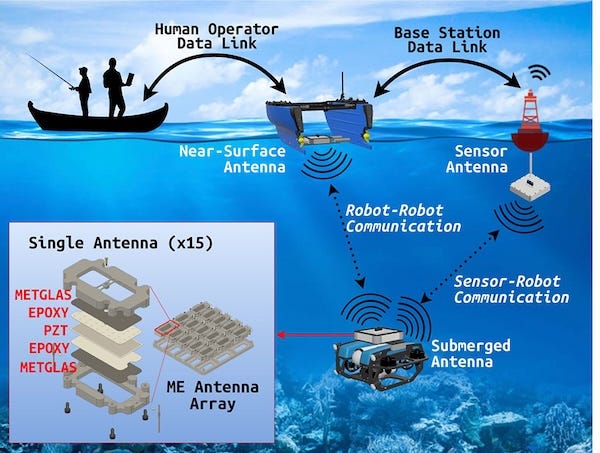
We present the design, development, and experimental validation of BlueME, a compact magnetoelectric (ME) antenna array system for underwater robot-to-robot communication. BlueME employs ME antennas operating at their natural mechanical resonance frequency to efficiently transmit and receive very-low and low-frequency (VLF/LF) electromagnetic signals underwater. We detail the system’s design, simulation, fabrication, and integration onto low-power embedded platforms, emphasizing portability and scalability. For performance evaluation, we deployed BlueME on mobile robot platforms in freshwater (lake) and saltwater (ocean) trials. Our tests demonstrate reliable signal transmission and detection using the BlueME antenna system at distances beyond 700 m while consuming less than 10 W of power. Ocean trials demonstrate that the system operates effectively under challenging conditions, such as turbidity, obstacles, and multipath interference, which are factors that typically degrade acoustic and optical methods. Our analysis also examines the impact of complete submersion on system performance and identifies key deployment considerations. This work represents the first practical underwater deployment of ME antennas outside the laboratory and implements the largest VLF/LF ME array system to date. BlueME demonstrates significant potential for marine robotics and automation in multirobot cooperative systems and remote sensor networks.
Commercializing cutting-edge machine vision is notoriously difficult. Whether it’s Maneva's Video-to-Action AI /YouTube/, Lumafield’s accessible industrial CT /Lumafield/, or Cognex’s high-speed vision systems /The Robot Report/, a brilliant product is only half the battle. Trista Li studied 40+ vision AI companies and their unique go-to-market strategies required to win in this space:

New Product Introduction
Highlighting new and innovative facilities, processes, products, and services
This Nvidia Challenger Says Its AI Chip Is 10x Faster Than A GPU
There’s a new challenger to Nvidia that says its chip can run AI inference at ten times the speed of a standalone GPU. The new chip from D-Matrix is called Corsair, and it’s now in volume production with commitments from hyperscalers, neoclouds and frontier AI labs. In an exclusive interview with CNBC, CEO Sid Shath explains how Corsair bypasses the DRAM shortage by relying on SRAM directly on the chip, and how that tight integration means Corsair can transfer data using five times less energy. It’s a novel approach to memory that’s led to huge gains for other chip startups in recent months. Cerebras’ blockbuster $95 billion IPO in May landed it among tech’s largest ever debuts, and Groq received $20 billion from Nvidia in the AI giant’s largest purchase ever in December. Now CNBC asks whether D-Matrix could be next.
Inside The Chip Factory 1,000 Times Cleaner Than An Operating Room /YouTube/
Rapidus Completes 150 Billion Yen Funding Round from Japan Government /PR Newswire/ to support its evolution from the R&D stage to full-scale 2nm logic semiconductor manufacturing by 2027.
TensorWave Raises $350 Million Series B at $1.55B Valuation to Expand Global AMD-Powered AI Infrastructure /Business Wire/
Granarium Technologies raises EUR 1 million to commercialise the world’s first renewable, affordable supercapacitors for grid stability and industrial reliability /PR Newswire/
Claude Fable 5 and Mechanical Design (V8 engine)
Claude Fable 5 and Claude Mythos 5 /Anthropic/. Fable 5 is state-of-the-art on nearly all tested benchmarks of AI capability, showing exceptional performance in software engineering, knowledge work, vision, scientific research, and many other areas.

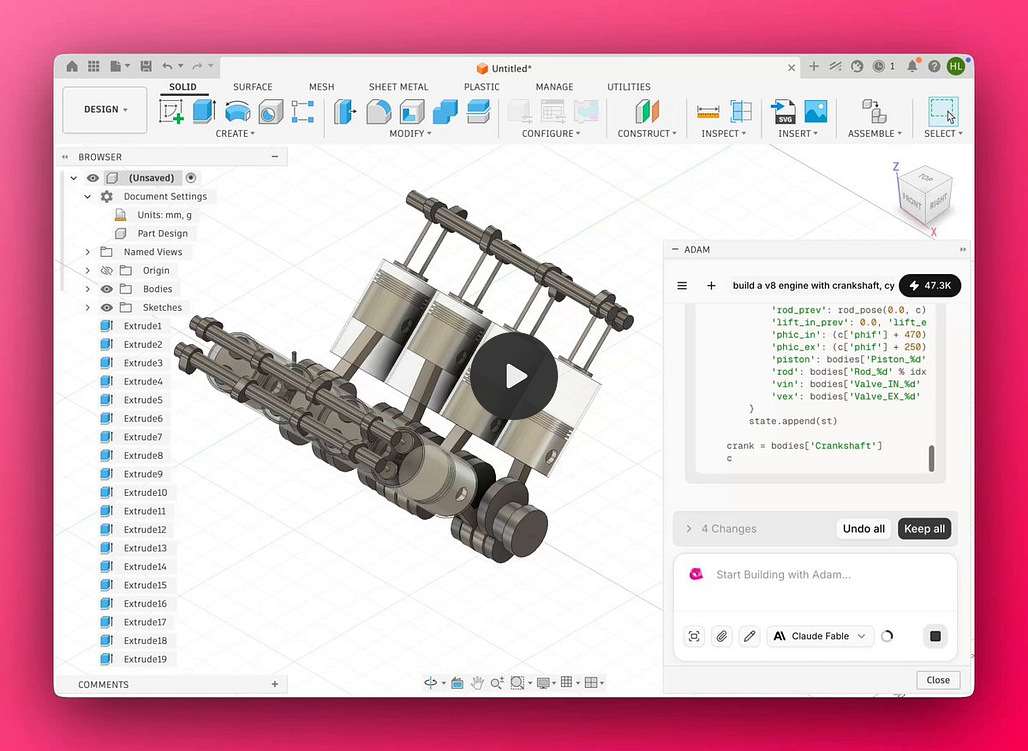
Statement on the US government directive to suspend access to Fable 5 and Mythos 5 /Anthropic/. Anthropic suspends new AI tools over US government security concerns /BBC/.
Will AI-augmented CAD make manufacturability easier to integrate into design? /Brain Ratliff on X/
Robotics will not have a clean Llama moment /The Robot Report/
We’re Raising the Curtain: Introducing Azumuta Labs
It’s a working space where we run real experiments, put prototypes in front of real operators and engineers, document what happens, and share it here before we have all the answers.
That means you’ll see results that surprised us. Approaches that didn’t work out. Ideas that are solid in a controlled environment but need more work before they’re production-ready. We’ll share all of it, including the failures, because the path to useful manufacturing AI is shorter when we stop repeating each other’s dead ends.
Read more at Azumuta
Business Transactions
This week’s top funding events, acquisitions, and partnerships across industrial value chains.
NEURA Robotics Announces Record Series C of up to $1.4 Billion to Accelerate the World’s Leading Physical AI Platform
NEURA Robotics, the pioneer in cognitive robotics and creator of the Neuraverse, announced a landmark Series C financing with a total round size of up to $1.4 billion to accelerate its mission of building the world’s leading Physical AI platform. The financing brings together global leaders across AI, robotics, compute, manufacturing and industrial infrastructure, including Tether, Qualcomm Technologies, Inc., Amazon, NVIDIA, imec.xpand, Bosch, Schaeffler, European Investment Bank, Lingotto Horizon, InterAlpen Partners and others.
NEURA is building a new category of AI infrastructure where cognitive robots continuously learn, collaborate and operate across real world environments through a shared intelligence ecosystem called the Neuraverse. Unlike traditional robotics companies focused on isolated machines or narrow industrial automation, NEURA combines robotics, AI, sensors, edge compute and large scale learning infrastructure into one unified platform architecture designed for global deployment.
Read more at Business Wire and The Robot Report
PhysicsX Announces $300M Series C to Accelerate Physics AI for Industrial Engineering
PhysicsX, the physics AI company for industrials, announced an oversubscribed $300 million Series C financing at a valuation of approximately $2.4 billion. The round is led by Temasek, with participation from new investors M&G Investments and Intrepid Growth Partners, alongside existing investors including Applied Materials, Atomico, General Catalyst, July Fund, NGP, NVIDIA, Radius, and Siemens. Temasek first invested in PhysicsX in 2025, and has played an instrumental role in supporting the company’s international expansion and growth.
This round will accelerate the company’s global growth, the expansion of its platform capabilities, and frontier research, including the development of larger, more powerful pre-trained physics AI models, known as Large Physics Models /arXiv/.
Read more at PhysicsX
Flux Raises $5M to Give Engineering Leaders Ground-Truth Visibility in the Age of AI /PR Newswire/
Standard Bots Raises $200 Million Series C At $1 Billion Valuation To Scale AI-Native American Robotics
Standard Bots, the largest U.S. manufacturer of AI-native industrial robots, announced a $200 million Series C financing led by RoboStrategy and existing investor General Catalyst, valuing the company at $1 billion.
The funding will support the expansion of the company’s manufacturing footprint in Glen Cove, New York, where Standard Bots is increasing its facility to 70,000 square feet. The company said the expanded operation will strengthen its ability to design, assemble, and deploy American-made robots at scale.
Read more at PR Newswire and The Robot Report
Mesoware Announces $1.5M to Build AI-Powered Robots for Manufacturing /Manufacturing Tomorrow/
Innovafeed raises $59m, scales production, cuts R&D headcount as insect ag hits “industrialization phase”
French insect ag firm Innovafeed has raised a €51 million ($59 million) round and unveiled plans to consolidate activities at its commercial-scale black soldier fly larvae production facility in Nesle, France.
The round, which takes its cumulative funding including grants to over $500 million, was backed by existing shareholders Creadev, QIA, Temasek, FFC, ABC Impact, and ADM along with banking partners, said Innovafeed, which was founded in 2016 by Aude Guo, Bastien Oggeri, and Clément Ray.
Read more AFN
Leaf Raises $13M Series B to bring AI to Agribusiness /PR Newswire/
SWARM Engineering Raises $10M Series A to Transform Operational Decisions with AI /Business Wire/
Maneva Raises $27M to Tackle Inefficiencies Across the $46T Manufacturing Industry
Maneva, the Video-to-Action AI company building the intelligence layer for modern manufacturing, announced $27 million in Series A funding, accelerating its mission to close the $18 trillion global manufacturing efficiency gap. The Series A round was led by U.S. Venture Partners (USVP), with participation from returning investors Bling Capital and Freestyle Capital, alongside a group of leading angel investors and funds. This fundraise brings Maneva’s total capital raised to $38.4M.
Maneva’s Video-to-Action AI turns existing factory cameras into real-time operational decisions. It begins with deep learning computer vision, giving factories the ability to see, understand, and act on what’s happening on the floor, then expands into agentic systems that connect, coordinate, and optimize the entire operation. It is the deep learning engine for modern manufacturing, and the foundation of everything Maneva builds.
Read more at Maneva
Looking for additional content? Paid subscribers get more stories delivered each week as part of Overcapacity!