


Shop Talk
Capturing this week’s zeitgeist
The rise of “Labs” is essential because large venture-scale industrial opportunities ignore traditional disciplinary boundaries and require teams to master disparate fields across thermodynamics, fluids, mechanical and electrical engineering, materials science, and semiconductor physics, often by learning them on the fly when no single set of experts exists. This model was exemplified by Elon Musk’s transition from PayPal to founding and scaling SpaceX and Tesla, and it is now enabled by applied Labs that create dedicated, low-friction environments for cross-discipline collaboration and rapid iteration, something traditional siloed organizations or pure SaaS teams cannot replicate when building full-stack physical systems. The approach continues to be validated by software-founded companies such as Boom Supersonic (led by ex-Amazon engineers now developing supersonic jets) and AI leaders like OpenAI and Anthropic that have moved into hardware (see below), where only boundary-spanning Labs deliver the enduring technical depth and commercial value that venture capital bets now require.


Assembly Line
This week’s industrial breakthroughs and frontier technologies of the built world.
Beyond the solver: How Geometric Deep Learning is reshaping CAE
A finite element mesh is an irregular graph. A point cloud from a 3D scan is an unordered set. A CAD surface is a manifold. None of these live comfortably on a regular grid. If you try to flatten them into one, as early AI-for-engineering approaches did, you lose the very geometric relationships that make the physics meaningful. You’re essentially crumpling a map to fit it into a square box, then wondering why the roads don’t connect.
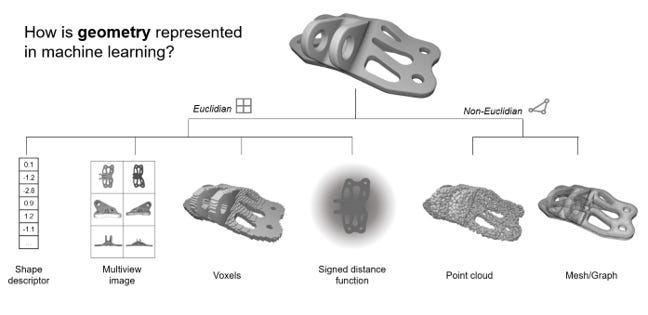
GDL extends deep learning to these non-Euclidean domains – graphs, meshes, point clouds, and manifolds – by building neural networks that respect the underlying geometric structure of the data. The theoretical backbone comes from the concept of symmetry: a well-designed geometric neural network should produce consistent predictions regardless of how you rotate, translate, or renumber the input. This property – known as equivariance – is not just mathematically beautiful but also physically essential.
Read more at Siemens
Siemens CEO on Industrial AI’s Future /YouTube/
Washington plant creates jet fuel from water, air and electricity
Alaska Airlines and Microsoft join Twelve to mark commercial operation of AirPlant One — the first plant in the United States to produce E-Jet fuel from CO2, renewable electricity, and water at scale /Twelve/. AirPlant is a eManufacturing factory that produces E-Jet® SAF and E-Naphtha with power-to-liquid technology that works like industrial photosynthesis—transforming CO2, water, and renewable electricity into hydrocarbons.
AquaPoro Raises $5M to Advance Technology that Generates Net New Water from Air /Business Wire/
ViserDex: Visual Sim-to-Real for Robust Dexterous In-hand Reorientation
Experiments show that the pose estimator trained with 3DGS data outperforms those trained using conventional rendering data in challenging visual environments. We validate the system on a physical multi-fingered hand equipped with an RGB camera, demonstrating robust reorientation of five diverse objects even under challenging lighting conditions. Our results highlight Gaussian splatting as a practical path for RGB-only dexterous manipulation.
Read more at GitHub
KinetIQ Ascend: Toward 100% Reliable Manipulation and Superhuman Speed /Humanoid/
Kyber Labs releases a capable, force-aware hand that can do useful work around people /Kyber Labs on X/
A world running foundation models on a billion robots won’t be doing it locally. /Gianluca on X/

What Makes a Robotics Business Economically Viable /JacklouisP on X/
New Product Introduction
Highlighting new and innovative facilities, processes, products, and services
OpenAI and Broadcom unveil LLM-optimized inference chip
OpenAI and Broadcom (NASDAQ: AVGO) unveiled Jalapeño, OpenAI’s first Intelligence Processor: an accelerator architected around OpenAI’s vision for the future of LLM inference, and the first AI accelerator in a multi-generation compute platform the companies are building together to make advanced AI faster, more reliable, and more accessible to more people.
Jalapeño was co-developed from initial design to manufacturing tape-out in just nine months, and the custom AI accelerator program represents what we believe to be the fastest ASIC development cycle ever achieved in high-performance advanced semiconductors. That speed reflects deep software-hardware co-development with OpenAI’s engineering teams, Broadcom’s silicon implementation expertise, and the use of OpenAI models to accelerate parts of the design and optimization process.
Read more at OpenAI
“When it comes to co-design of chips, he thinks the real value of companies like $AVGO, Mediatek, and $MRVL lies in their $TSM allocation and memory allocation, which they got sooner than everyone else” /Richard Jarc on X/
Micron and Anthropic Announce Strategic Agreement to Scale Next-Generation AI Infrastructure /Micron/. Micron and Anthropic will analyze how memory and storage subsystems perform across various workloads and interact across the full infrastructure stack. This effort is expected to drive advances in memory and storage performance, energy efficiency and enhanced token economics in Anthropic’s AI infrastructure.
IBM Debuts World’s First Sub-1 Nanometer Chip Technology
IBM’s new sub-1 nm chip packs nearly 100 billion transistors onto a chip the size of a fingernail, nearly twice the density of IBM’s 2 nm chip, unveiled in 2021. Enabled by a series of structural and material innovations, including IBM’s groundbreaking three-dimensional nanostack architecture, the technology demonstrates how continued gains in performance and efficiency remain possible even as chip features approach atomic dimensions.
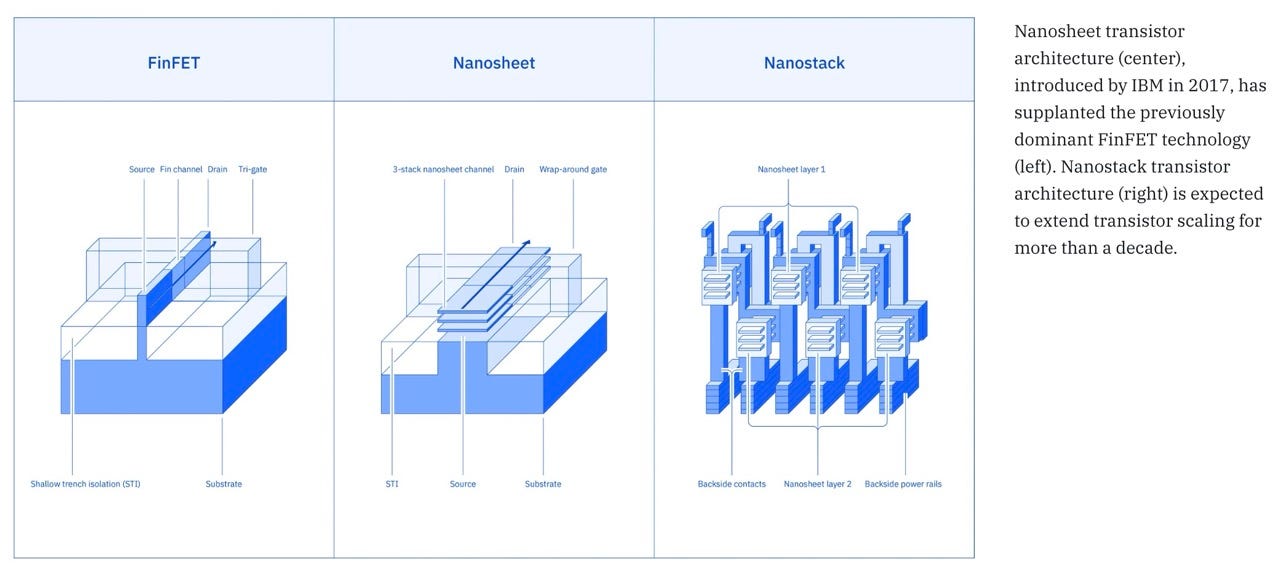
To produce this chip, IBM researchers developed an entirely new transistor architecture, called “nanostack,” the industry’s first known three-dimensional, nanosheet-based design /IBM Research/. Nanostack represents a major advance beyond nanosheet technology, the industry’s current leading-edge architecture, invented by IBM. The nanostack design vertically stacks and staggers transistors, taking advantage of 3D sequential integration to pack more transistors onto a chip. The design also unlocks the use of different material combinations within each stacked layer, optimizing performance and power efficiency of each transistor independent of the other.
Read more at IBM
Introducing Un-0: Generating Images with Coupled Oscillators
The best AI models today are conventional deep networks with transformer backbones. However, there is also a long history of alternatives that seek energy efficiency by leveraging the dynamics of a physical system, such as the noisy, time-varying behavior of analog circuits that compute with analog voltage and current instead of conventional digitized numbers.
To exploit these alternative computing methods, the AI task needs to be mapped efficiently to the dynamics of the physical system. Un-0 validates that modern AI workloads can run more efficiently on physical substrates than on today’s hardware.
Why oscillators? In the brain, rhythmic activity and synchronization are pervasive, and have long been hypothesized to do computational work like binding distributed features into coherent percepts, gating communication between regions, and organizing the timing of spikes (Gray et al., 1989; Buzsáki, 2006; Fries, 2015). Coupled oscillators are among the simplest mathematical models of that kind of behavior, which makes them a natural primitive to study for neuro-inspired models of computation (Winfree, 1967; Kuramoto, 1975; Ermentrout, 1996; Ermentrout et al., 2010).
Read more at Unconventional AI

Business Transactions
This week’s top funding events, acquisitions, and partnerships across industrial value chains.
Qualcomm to Acquire Modular
As AI scales, efficiency, not capability, becomes a constraint. Performance-per-watt drives the cost of inference, and cost determines what scales. Meeting this demand requires more than hardware. Developers need software that connects system-level optimization with heterogeneous, disaggregated compute, turning silicon performance into reliable and efficient AI services across accelerators, environments, and use cases.
Modular provides an open, AI-native software stack that enables AI to run efficiently across hardware architectures. Built by engineers who helped create much of today’s AI infrastructure, Modular’s unified platform runs models with industry-leading performance across CPU, GPU, NPU, and custom ASIC architectures without re-writes for each accelerator. For developers and enterprises, that means building once, deploying across any environment with lower total cost of ownership. Modular is supported by an open, industry-friendly, vendor-neutral developer community committed to improving the portability and efficiency of AI infrastructure.
Read more at Qualcomm
AMD Acquires MEXT to Advance Memory Optimization for Compute Infrastructure /AMD/. MEXT has developed innovative AI-powered predictive memory technology designed to make flash behave more like DRAM, helping expand usable memory capacity while maintaining performance and efficiency.
Nearfield Instruments Secures $380 Million Series D Funding in Largest Ever Deep-Tech Funding Round in The Netherlands
Nearfield Instruments, a leader in advanced semiconductor 3D metrology and process control, announced the successful closure of a $380 million Series D funding round. The transaction values the company at $1.6 billion, marking a major milestone in Nearfield’s development into a global leader in semiconductor metrology and inspection.
Nearfield’s innovative metrology and inspection solutions provide the accurate, reliable and high-throughput measurements needed to control advanced processes, improve yield and ensure manufacturability. By enabling critical measurements for High Numerical Aperture Extreme Ultraviolet (High-NA EUV), Gate-All-Around (GAA) and Complementary Field-Effect Transistor (CFET architectures), and hybrid-bonded 3D integration, Nearfield plays a central role in making the next generation of AI computing scalable, energy-efficient, manufacturable and reliable.
Read more at Business Wire
Agility Robotics to Go Public Through Merger with Churchill Capital Corp XI
Agility Robotics, Inc., a leading humanoid robotics and physical AI company, and Churchill Capital Corp XI (NASDAQ: CCXI) (“Churchill”), a publicly traded special purpose acquisition company, announced they have entered into a definitive business combination agreement. Upon closing of the Transaction, the combined company is expected to operate as Agility and be listed on a major North American exchange under the ticker symbol “AGLT.”
Agility’s mission is to build robot partners that augment the human workforce and lead the adoption of humanoids everywhere. Its flagship humanoid robot, Digit, is a general-purpose, human-centric robot Made for Work™ and currently operating in manufacturing, distribution, and logistics environments to fill chronic physical labor shortages. Through more than a decade of development, Agility has established itself as one of the only humanoid robotics companies with multiple years of operational experience in real customer environments. The Company is supported by leading strategic investors and partners across the AI, technology, VC, and industrial ecosystem, including DCVC, NVIDIA, Amazon, SoftBank Vision Fund 2, Schaeffler, Foxconn, Abico, and Playground Global.
Read more at Agility Robotics
Apptronik’s Robots Can Strut, But Its CEO Isn’t Bragging Yet /Bloomberg/
onsemi to Acquire Synaptics to Enable the Next Generation of Intelligent Systems for Physical AI /onsemi/
Looking for additional content? Paid subscribers get more stories delivered each week as part of Overcapacity!