


Shop Talk
Capturing this week’s zeitgeist
Following the rush of Hannover Messe /Interact Analysis/, I visited Munich for a different kind of immersion. Here, science and high-tech is part of the civic fabric. On a walk from the central station to the city's East Side, I crossed paths with the bronze monument of Joseph von Fraunhofer (celebrating 200 years on June 7), a silent prelude to the massive, historic halls of the Deutsches Museum. Wandering through those sprawling galleries, I was completely surrounded by centuries of every engineering discipline.


We are gifting a 1-year paid subscription to the first person to identify the content link AND cultural reference to the title/subject line of this week’s digest. Comment on this post with your guess before next week’s digest is released to be eligible!
Assembly Line
This week’s Industry 5.0 breakthroughs and frontier technologies of the built world.
🗣️🦾🤖🦿 The $10 Trillion Bet on Humanoid Robots with Figure Founder Brett Adcock
Brett shares why humanoid robots are already working today, how Figure plans to scale from thousands of units this year to 1 million per year, and why he believes this could become the biggest business in the world. Backed by nearly $2B across rounds — including investment from Jeff Bezos, Microsoft, Nvidia, and Amazon — Figure 15x’d its valuation to $39B in just 18 months. Also covered is Brett’s decision to part ways with OpenAI, the challenges of building physical intelligence, and what it takes to solve one of the hardest problems in engineering.
🗣️ Zane Hengsperger on Building Nox Metals and the Future of Manufacturing /YouTube/
🚘 Rotary Engine Shows Why Internal Combustion Still Matters
Despite the global trend toward electrification, internal combustion remains vital for consumers, defense, and aviation, sparking a renewed interest in reviving and reinventing technologies like the rotary engine. Innovators like LiquidPiston and Mazda are redesigning the century-old Wankel rotary engine to create smaller, more efficient power sources for everything from military drones to plug-in hybrid sports cars.
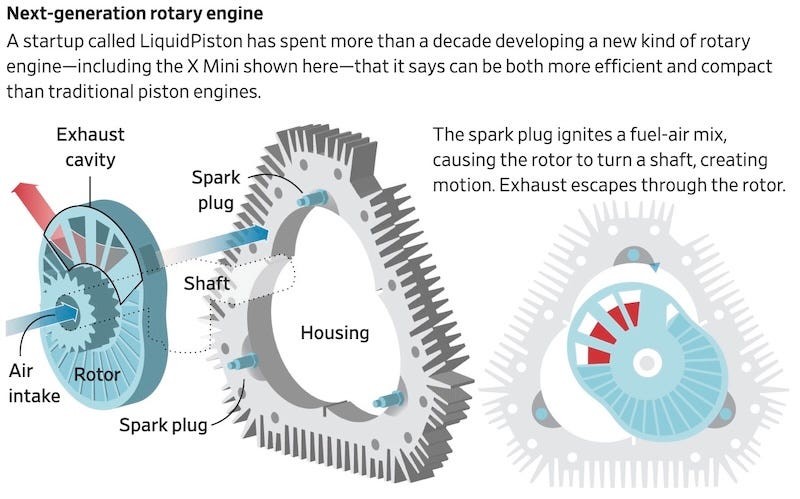
Ultimately, as the growth of electric vehicle sales slows, gas engines are serving as generators in extended-range electric vehicles (EREVs) to act as a practical bridge technology toward full electrification.
Read more at WSJ
easyJet and Rolls-Royce complete successful 100% hydrogen aero engine test, advancing sustainable flight technology /easyJet/
✈️⛓️ Boeing and the Supply Chain Cost of Industrial Complexity
✍️ Author: Jim Frazer
Boeing’s recent problems are often described as quality failures. That is accurate, but incomplete. The deeper issue is industrial complexity. Boeing operates one of the most demanding supply chains in the world: highly engineered products, long-cycle programs, strict certification requirements, specialized suppliers, and little room for error. In that environment, quality is not a department. It is an outcome of supply chain design.
Boeing is an extreme case, but the pattern applies broadly. As supply chains become more specialized and distributed, companies need stronger control mechanisms: more disciplined supplier quality systems, better sub-tier mapping, real-time production status visibility, earlier detection of process drift, clearer ownership of engineering and manufacturing interfaces, and stronger governance over outsourced critical work.
Read more at Logistics Viewpoint
✈️ Boeing will boost MAX production this summer, marking 2nd bump since the blowout /The Seattle Times/
✈️ Airbus Sticks to Plane Delivery Goal Despite Pratt & Whitney Engine Shortage /WSJ/
✈️⛓️ MA-APKG: A multi-agent LLM-based method for construction aviation product assembly process knowledge graph /Journal of Manufacturing Systems/
🚙⛓️ Inside Tesla’s hidden supply chain: how a Chinese town shapes the modern world /SCMP/
🎛️☁️ Cloud-Direct NC: A new generation of numerical control technology
✍️ Authors: Shivam Garg, Liang Tung Chen, Aryan Shroff, Ricardo Toro, Shiv G. Kapoor, Jorge E. Correa, and Placid M. Ferreira
Artificial Intelligence, Industrial Internet of Things (IIoT), and Cloud Manufacturing technologies, along with rapidly evolving computing infrastructure, require that the fifty-year-old CNC architecture be reexamined to better address the changing needs of manufacturing automation as it evolves from programmed to perceptual automation. This paper introduces Cloud-Direct Numerical Control (C-DNC), an architecture that recruits the services of different computing (cloud, edge, and embedded/real-time) resources, matched to different tasks in the NC workflow.
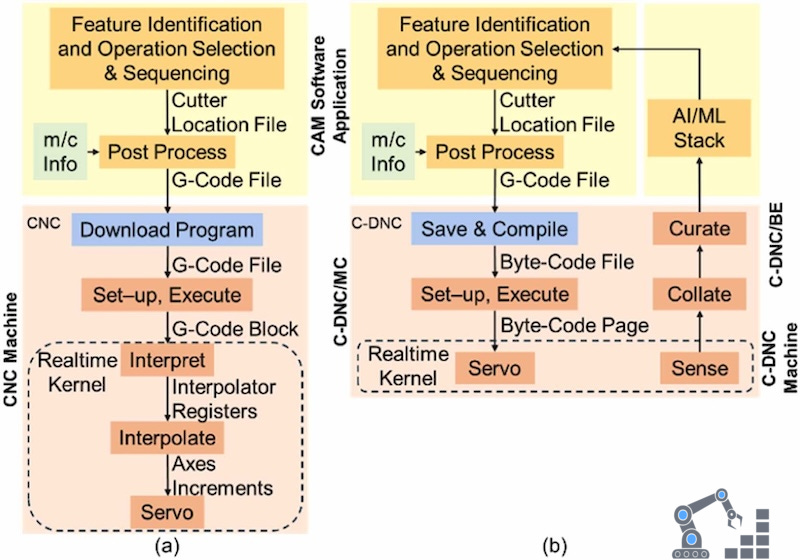
It introduces the concept of a ‘compiled motion program’ to reduce the workload on real-time computing resources by eliminating the repetitive tasks of interpreting G-codes and performing real-time trajectory interpolation. A portion of the freed-up real-time resource bandwidth is used to demonstrate NC-embedded monitoring and IIoT services that not only provide high-bandwidth data collection but also ensure tight temporal alignment of this data with machine instructions. The remaining bandwidth can be used for real-time inferencing and advanced controls to realize truly intelligent NC systems. Finally, this cloud-integrated version of Direct Numerical Control reduces investment costs through the efficient shared use of computing resources, enables new modes for the democratization of NC via subscription and pay-per-use models, and integrates with upstream design and planning software tools.
Read more at Journal of Manufacturing Systems

New Product Introduction
Highlighting new and innovative facilities, processes, products, and services
🇩🇪🚜 World First: Inside Liebherr’s New 100-Tonne Mining Excavator
From remote jungle mines to extreme tropical conditions, Indonesia is one of the toughest proving grounds in the world. With intense rainfall, challenging material, and nonstop operations, it’s the perfect place for Liebherr to push new machines to their limits; collecting real-world data and refining performance before launching them globally.
📐🧠 Bringing Autodesk Fusion onto Claude for Creative Work
AI makes it easier than ever to turn ideas into something real. But in design and engineering, moving from intent to an editable, manufacturable design still takes time and manual work.
With Fusion, that looks like two things:
Autodesk Assistant brings AI directly into Fusion, helping users understand context and take action in their workflows
Fusion Model Context Protocols (MCPs) lets third-party AI systems connect to Fusion, enabling them to access design context and perform actions securely.
Read more at Autodesk
🇩🇪☀️⚡ Colored films enable patterns on PV modules
Scientists at the Fraunhofer Institute for Solar Energy Systems ISE have succeeded in creating colored films with transparent cutouts, thereby producing realistic-looking designs on photovoltaic modules. In this way, roof tiles, for example, can be imitated. The film cutout patterns utilize MorphoColor® technology, an invention of Fraunhofer ISE that creates a color impression without significantly impairing the efficiency of a PV module.

The technology can be applied to all standard photovoltaic and solar thermal modules; the desired pattern is cut into the films with MorphoColor® coating using laser or CAD-controlled processes.
Read more at Fraunhofer ISE
The full story behind SolarSea® — from a violin in Vienna to 2.4 MW of solar panels floating at sea in the Maldives. /YouTube/
Business Transactions
This week’s top funding events, acquisitions, and partnerships across industrial value chains.
💰 Eclipse raises $1.3B to reshore manufacturing, strengthen supply chains /Manufacturing Dive/. The main Eclipse fund is dedicated to startups that go through the venture firm’s incubation program called Venture Equity. It is also focused on spinning out smaller firms from larger companies, such as Mind Robotics from Rivian, and traditional seed and series A funding, Reichow said.
🇩🇪💰 BMW i Ventures Announces $300 Million Fund to Back AI Startups Reshaping the Automotive Ecosystem /BMW/. Fund III will invest in physical AI, agentic AI, and software automating complex workflows across manufacturing, supply chains, and the broader automotive ecosystem
💰 KOMPAS VC closes €160M Fund II /Tech.eu/ aiming to support early-stage companies developing technologies that improve productivity, resilience, and decarbonisation across industrial sectors.
🇩🇪🦾🧠 Sereact Raises $110M Series B
Sereact has raised a $110 million Series B round led by Headline, with participation from Bullhound Capital, Daphni, and Felix Capital. Existing investors Air Street Capital, Creandum (lead of Sereact’s 2025 Series A), and Point Nine all returned for this round. The round funds two priorities: scaling Cortex 2.0, the next generation of Sereact’s robotic brain, and entering the United States. Sereact opens its first US office in Boston and hires commercial, application, and engineering staff locally.
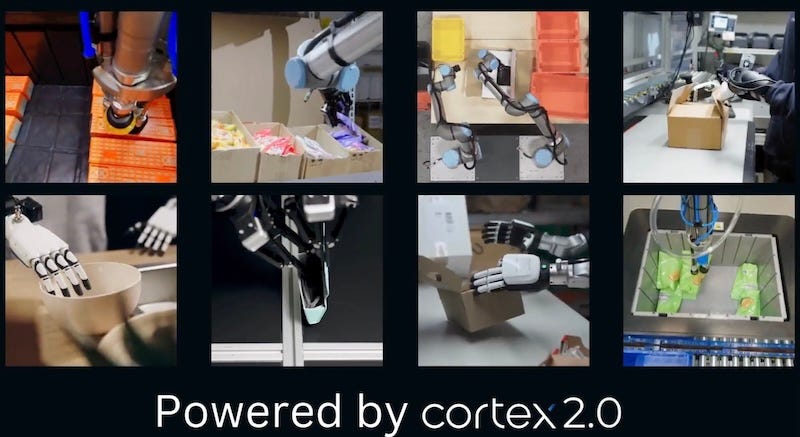
Cortex 2.0 augments a vision-language-action (VLA) model with a world model. From the current state, it generates a set of candidate future trajectories, runs them against a learned model of physics and object behavior, and scores each one for stability, risk, and efficiency. The robot commits only to the best-scored branch - and updates the rollout in real time as the scene changes. World models are the next frontier in AI, and most of that work is happening in research labs on synthetic data. Cortex 2.0 is the one trained on more than a billion picks of real production.
Read more at Sereact
🦾🧠 How to teach the same skill to different robots /EPFL/
🦾 ABB Robotics launches PoWa cobot family targeting industrial tasks /The Robot Report/
🏴💿 Cnuic secures $3M pre-seed to unlock next-generation photonic chip production
Cnuic has raised $3 million in pre-seed funding led by Tensor Ventures, together with the Silicon Valley-based Blank Space Ventures. The round also saw participation from Silicon Roundabout Ventures, Phasechange, SANDS, and Superlative.
The company based in Edinburgh has developed a working prototype of a completely new type of photolithography device, which makes use of the properties of light, enabling rapid, reconfigurable production of photonic chips with enhanced 3D control, something that was previously impossible. In practice, Cnuic asserts this could be the biggest innovation in this field since the invention of the transistor.
Read more at Tech.eu
💿 The Race to Make the World’s Most In-Demand Machine /WSJ/. ASML plans to make at least 60 extreme ultraviolet machines this year, 36% more than 2025, and expects $42 billion to $47 billion in annual sales.
💿 Lace Lithography raises $40 million for helium atom beam lithography that could print chips at atomic resolution — 0.1nm beam is 135 times narrower than ASML’s EUV light /Tom’s Hardware/
Looking for additional content? Paid subscribers get more stories delivered each week as part of Overcapacity!