


Shop Talk
Capturing this week’s zeitgeist
The industrial giants of the future are deploying industrial technology across decentralized, autonomous networks that prioritize resilience and agility over the outdated pursuit of sheer scale /c&en/. By integrating AI-driven analytics, modular manufacturing, and self-optimizing systems, these leaders will move away from concentrated megastructures toward flexible, regionalized facilities /New Electronics/, akin to the "minimills" that upended the steel industry, capable of pivoting in real-time to counter geopolitical shocks or supply shortages. This transition, fueled by a shift toward geographically dispersed renewable feedstocks like biomass and captured CO2, redefines competitiveness through ecosystem-based collaboration rather than simple cost-cutting. Ultimately, the next generation of titans will be those who treat autonomy as a strategic enabler to augment human decision-making, proving that in a volatile global market, being fast and adaptable beats being large and rigid every time.
🇺🇸 Magrathea raises $24M to build demo magnesium smelter /Axios/
🇺🇸 Trillium Raises $13M to Launch World’s First Demonstration Plant for Bio-based Acrylonitrile /GlobeNewswire/
Quote of the Week
The most damaging misconception in industrial AI today is a false binary: Either AI can solve everything now, or it isn’t ready for serious industrial use. Both claims miss the point. /EETimes/
HM26: Whitelabeled AI and the hope for the API /Industrial AI Podcast/
Assembly Line
This week’s Industry 5.0 breakthroughs and frontier technologies of the built world.
🦾🤖🦿 Humanoid Robots Are the Next Phase of the AI Hype Cycle
The humanoid industry remains stymied by the Three B’s: balance, battery, and brains alongside the immense difficulty of replicating human-like fine motor skills. Investors are betting billions on a Robots-as-a-Service (RaaS) model to address labor shortages and demographic shifts, aiming to turn human-shaped machines into a universal, adaptable platform for industrial and service work.
Read more at Bloomberg
According to Francesco Nobili /LinkedIn/ here’s what the math currently looks like against the alternatives:
→ Humanoid: 1,250 hrs / 11 months. 50% uptime. ~$150K per unit.
→ Industrial robot: 5,500+ hrs. 85-95% uptime. ~$50K.
→ Human worker: 1,830 hrs. ~$78K over 11 months. Shows up Monday. Then Tuesday.
Other notes in Humanoids:
🤏🤖🎤 Humanoid Touch And Voice Are Improving Rapidly /Semiconductor Engineering/
🤖 Figure taught two F.03 robots to clean a room and make a bed in under 2 minutes - fully autonomous /YouTube/
🇨🇳 ROBOTERA Raises Over USD 200 Million in New Round Led by SF Group, HSG and IDG Capital /PR Newswire/
🏭🤖 1X opens California factory targeting 10,000 home humanoid robots in year one /TNW/
Where we’ve seen this before: 🇯🇵 Japan /RSIS and MIT/
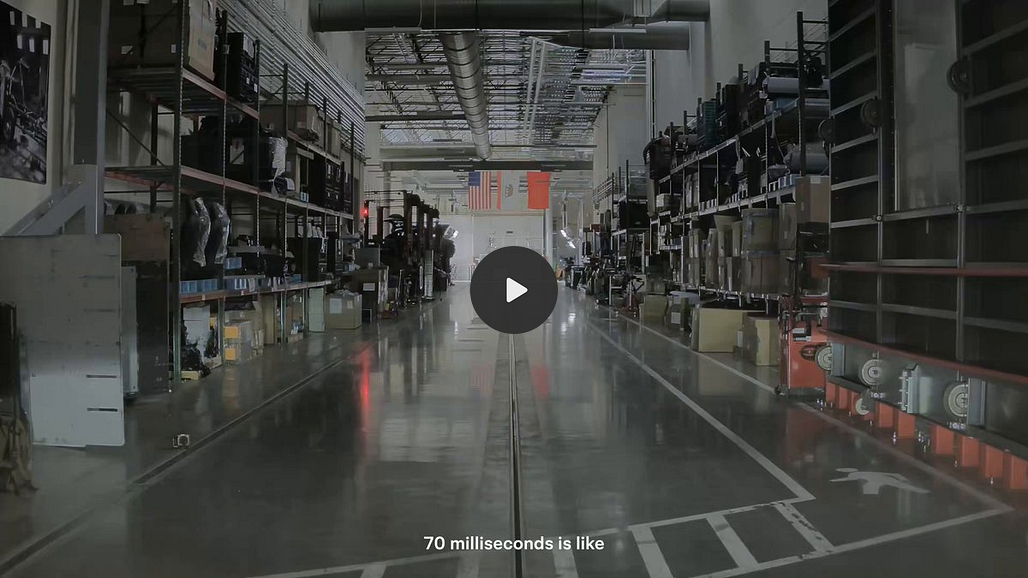
🚙 Tesla Vision can Deploy Airbags up to 70ms Earlier

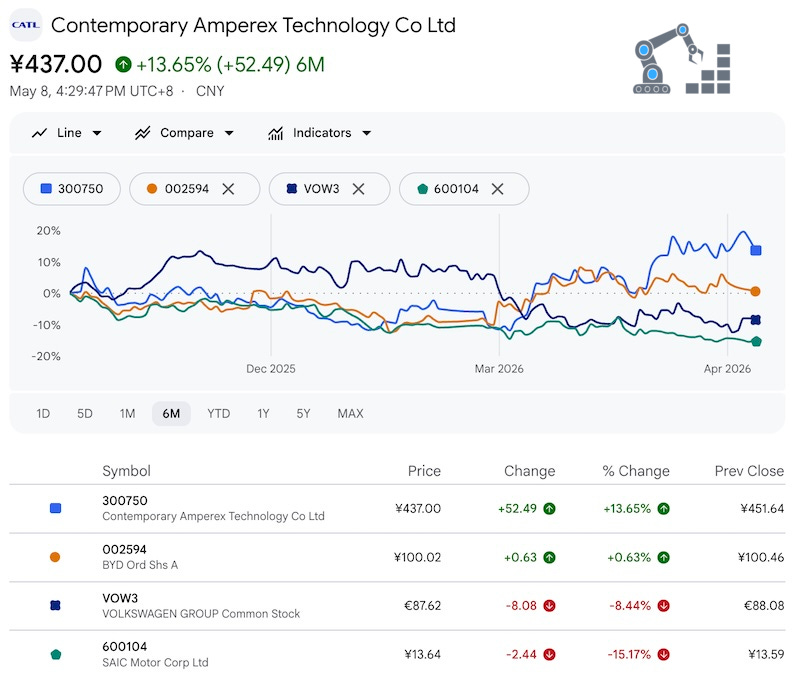
🔋 CATL Unveils Six Major Innovations: Multi-Chemistry Systems to Redefine New Energy Mobility Experience /CATL/. The Engineering Behind CATL’s 30-Second EV Charging Battery Breakthrough /Geeky Gadgets/
🚗 Inside Cadillac’s IQ Door Manufacturing Process /Munro Live/
🛻 Inside Ford’s efforts to build an affordable electric truck /Manufacturing Dive/
🛻 EV Startup Slate Hires Ford, Lucid Veteran Ahead of Production Start /EV/
🧠📐🚙 What an AI-designed car looks like /The Verge/
🧠📐 How Dassault Systèmes Is Building AI That Understands Physics
🗣️ AI Takeover: Qualcomm’s Big Bet on AI Agents, Robots and 6G /YouTube/
🗣️ How AI Agents Are Transforming Workflows on the Factory Floor with Apprentice CEO Angelo Stracquatanio /Manufacturing Happy Hour/
Agentic AI in Manufacturing: How Bosch Makes the Shop Floor Smarter /Bosch Global/
🗣️ Large Engineering Models: Reimagining Design, Simulation, and Manufacturing | EMMI AI | CDFAM BCN 26 /YouTube/
🧠📐 Zero-to-CAD: Agentic Synthesis of Interpretable CAD Programs at Million-Scale Without Real Data
Computer-Aided Design (CAD) models are defined by their construction history: a parametric recipe that encodes design intent. However, existing large-scale 3D datasets predominantly consist of boundary representations (B-Reps) or meshes, stripping away this critical procedural information. To address this scarcity, we introduce Zero-to-CAD, a scalable framework for synthesizing executable CAD construction sequences. We frame synthesis as an agentic search problem: by embedding a large language model (LLM) within a feedback-driven CAD environment, our system iteratively generates, executes, and validates code using tools and documentation lookup to promote geometric validity and operation diversity. This agentic approach enables the synthesis of approximately one million executable, readable, editable CAD sequences, covering a rich vocabulary of operations beyond sketch-and-extrude workflows. We also release a curated subset of 100,000 high-quality models selected for geometric diversity. To demonstrate the dataset’s utility, we fine-tune a vision-language model on our synthetic data to reconstruct editable CAD programs from multi-view images, outperforming strong baselines, including GPT-5.2, and effectively bootstrapping sequence generation capabilities without real construction-history training data. Zero-to-CAD bridges the gap between geometric scale and parametric interpretability, offering a vital resource for the next generation of CAD AI.
Read more at arXiv
🧠📐 The CAD AI Hype?! /The Industrial AI Podcast/
🧠📐 Why AI-Powered CAD File Management Starts With the Boring PDM Problem Engineers Have Always Hated /OpenBOM/
Where we’ve seen this before: neuralCAD-Edit: An Expert Benchmark for Multimodal-Instructed 3D CAD Model Editing /arXiv/

New Product Introduction
Highlighting new and innovative facilities, processes, products, and services
🧠 Introducing SubQ: The First Fully Subquadratic LLM
Transformers defined the last decade of AI — the “T” in ChatGPT. They unlocked modern language understanding, reasoning, and much of what we now think of as AI. Yet one fundamental limitation has shaped everything built on top of them: compute requirements scale quadratically with context length.
Subquadratic is an AI company building a new class of large language models. Our first model, SubQ 1M-Preview, is the first LLM built on a fully subquadratic architecture, one where compute grows linearly with context length. With a research result at 12 million tokens, SubQ’s architecture reduces attention compute by almost 1,000x compared to other frontier models.
Starting today, SubQ will be available for early access via:
API — The full-context API for developers and enterprise teams.
SubQ Code — A coding agent built on SubQ, available via command line interface (CLI). SubQ Code loads entire codebases into a single context window, enabling developers to plan, execute, and review across a full repository in a single pass — without the coordination overhead of multi-agent systems.
SubQ Search — A long-context search tool providing Deep Research capabilities with chatbot speed.
Read more at Subquadratic
💿 Lumai Productizes Lens-Based Optical Computer /EETimes/. This is the first time an optical computing system has successfully run billion-parameter models. Lumai said its technology can offer 50x the performance of today’s GPUs with a 90% reduction in power.
💿 New computer chip material inspired by the human brain could slash AI energy use /Cambridge University/
📥 Neurocad early access program is now open
Who we’re looking for: engineers who rebuild schematic symbols from datasheets, create PCB footprints from package drawings, generate mechanical models for placement, or work in Altium, SolidWorks, or similar tools. Our goal is to validate that the structured component model accurately reflects real-world manufacturing tolerances before scaling the platform.
This is not a beta launch. It’s a focused evaluation with a small group of engineers working on a specific problem. We review each application manually.
Apply at Neurocad
🤝 Nominal Acquires Fid Labs to Bring Domain-Expert AI to Hardware Engineering /Nominal/
📥📐 SimScale Opens Waitlist for Engineering AI Simulation Agents /Simscale/. Apply at Engineering AI Waitlist.
🇩🇰 Atech raises €681k with Lovable backing to make hardware prototyping more accessible /EU-Startups/. Atech introduces ‘vibe-engineering’ for hardware.
Business Transactions
This week’s top funding events, acquisitions, and partnerships across industrial value chains.
💰 EQT secures €3.1bn for European logistics fund /Private Equity Wire/
💰 Atlantic Packaging Launches New Earth Ventures to Accelerate Packaging Technology and Supply Chain Innovation /PR Newswire/
🇬🇧🔋 Nyobolt Closes Series C Round at $1B Valuation, to Power the Rise of Autonomous Machines, Physical AI Applications and AI Data Centres
Nyobolt, a pioneer in ultra-fast, high-power, energy technology, announced it has raised $60 million in funding to accelerate its development pipeline and bring its power performance solutions to the autonomous machines that need them most. The round was led by Symbotic (NASDAQ: SYM), a leader in AI-enabled robotics technology for the supply chain, with participation from IQ Capital, Latitude (Phoenix Court), Scania Invest and CBMM. The raise follows a period of rapid commercial momentum, with Nyobolt revenues growing five times year-on-year, reflecting accelerating demand surge across physical AI applications and AI data center infrastructure.
Nyobolt’s commercial traction spans some of the most advanced autonomous robotics deployments in the world. For Symbotic’s SymBot™ autonomous mobile robots, Nyobolt’s performance battery delivers six times more energy capacity than the ultracapacitors previously used, is 40% lighter, and achieves at least ten times the cycle life of traditional Lithium-Ion technology, enabling continuous, high-intensity 24/7 operations across Symbotic’s warehouse deployments.
Read more at Nyobolt
🇩🇪🔋 CMBlu Surpasses €1B+ Unicorn Threshold with €50M Initial Close of Series C, Defining Baseload Infrastructure for AI and Data Centers /GlobeNewswire/
🇪🇺🔋Europe’s second chance: The rise of a new battery ecosystem /Tech.eu/
🇳🇱⚛️ QuantWare Raises $178 Million to Build World’s Most Powerful Quantum Processors at an Industrial Scale
QuantWare, the leading industrial quantum processor company, announced a $178 million (€152 million) Series B equity funding round following the announcement of VIO-40K™, a quantum processor architecture for 10,000 qubits, 100x larger than the state of the art today. The company is building KiloFab, the world’s largest dedicated quantum open architecture fab, increasing the company’s production capacity by 20x to meet strong global customer demand.
QuantWare is the only company that designs, fabricates, and integrates modular quantum processors on an open architecture at an industrial scale. Its proprietary VIO™ technology — a modular Quantum Processor Architecture — allows the creation of the world’s most powerful quantum processors that provide the most compute per Watt.
Read more at Business Wire
🇬🇧⚛️ Quantum Motion Raises $160 Million Series C to Deliver Quantum Computing’s “Transistor Moment” /Business Wire/. Quantum Motion’s silicon transistor-based approach enables delivering utility-scale systems with 100-fold reduction in cost and space requirements, and 1,000-fold reduction in energy consumption compared to alternatives. Its systems are designed for deployment into standard data-centre racks, avoiding the need for bespoke facilities and the heavy energy overhead associated with alternative architectures.
🇳🇱⚛️ Delft-based FrostByte secures a cool €1.3 million to scale cryogenic electronics for quantum computing /EU-Startups/
⚛️📐 Why Quantum Hardware Will Be Designed in Simulation First /Dassault/
Where we’ve seen this before: Microsoft’s Majorana 1 /Microsoft/
🇺🇸⚡ Panthalassa Raises $140 Million to Power AI at Sea
Panthalassa, a renewable energy and ocean technology company, announced $140 million in Series B financing led by Peter Thiel, with participation from new investors John Doerr, Marc Benioff’s TIME Ventures, Max Levchin’s SciFi Ventures, Susquehanna Sustainable Investments, Hanwha Asset Management (USA)’s venture fund, Anthony Pratt, Fortescue Ventures, Future Positive, WTI, Nimble Partners, Super Micro Computer, Sozo Ventures, Dylan Field, Planetary VC, Leblon Capital, Resilience Reserve, Portland Seed Fund, and the Intrepid Oregon Fund. They are joined by returning investors Founders Fund, Gigascale Capital, Lowercarbon Capital, Unless, and WovenEarth.
The funding will complete the company’s pilot manufacturing facility near Portland, Oregon, and accelerate deployment of its Ocean-3 series of nodes, which will perform AI inference computing at sea using power generated from ocean waves.
Read more at Business Wire
Looking for additional content? Paid subscribers get more stories delivered each week as part of Overcapacity!