


We open with the two pivotal July events that roiled equity prices across the AI Buildout Supply Chain: Kimi K3 release and the Situational Awareness LP distress.
The Kimi K3 Frontier
First on July 16th Moonshot AI released Kimi K3, introducing a novel architecture and training recipe that delivers roughly 2.5 times the intelligence per unit of compute compared to its predecessor, Kimi K2 /Kimi/. The release triggered market volatility reminiscent of DeepSeek’s R1 launch in January 2025, which erased nearly $590 billion from Nvidia’s market cap in a single day.
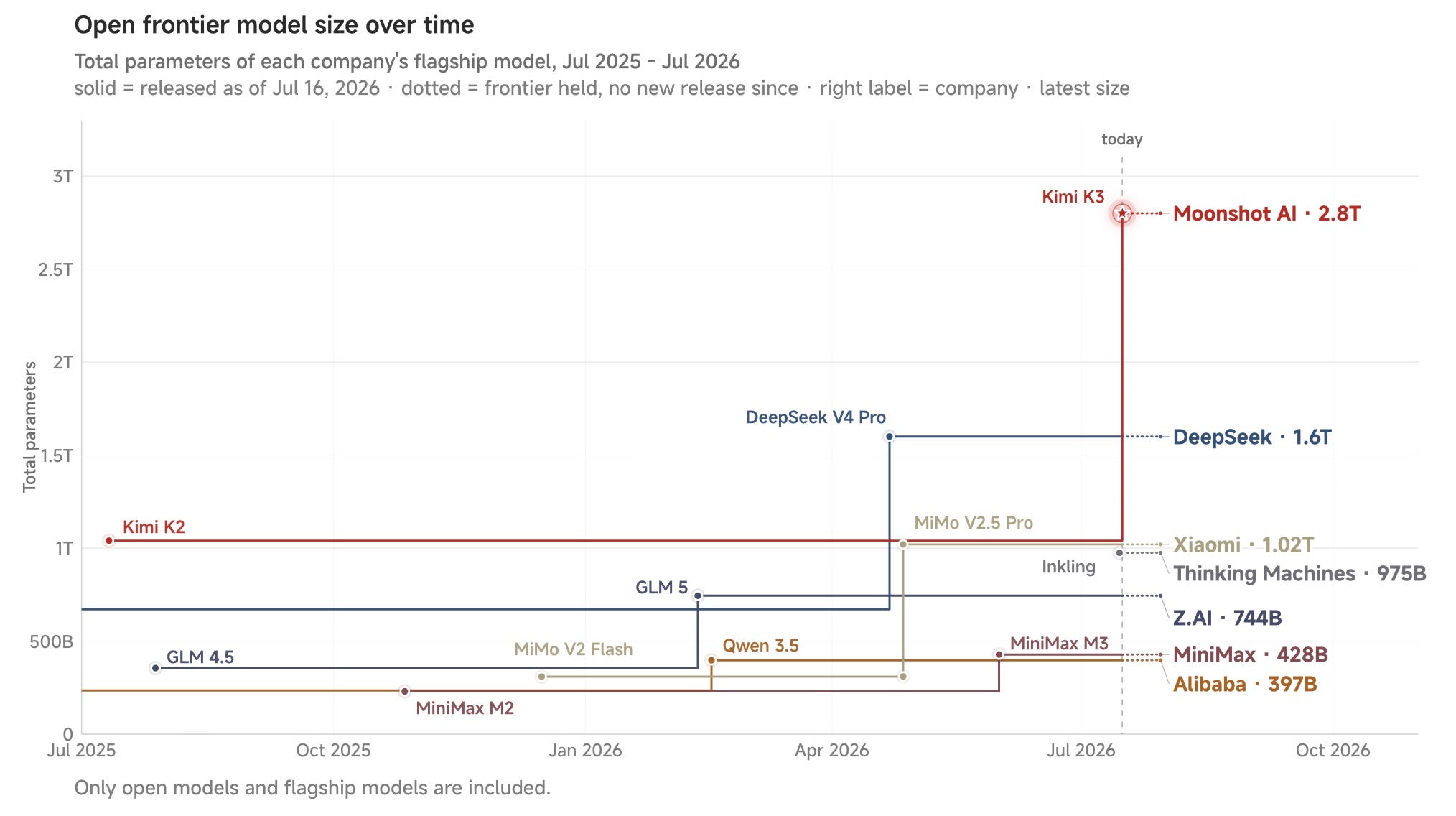
Beyond raw model performance, Moonshot demonstrated Kimi K3 autonomously generating a functional 4 mm² semiconductor design in just 48 hours using the open-source Nangate 45nm cell library /Si2/. Every semiconductor design step from RTL synthesis down through placement, routing, and simulation was executed entirely within open-source flows, marking a significant milestone for AI agents tackling complex, long-horizon engineering tasks. Moonshot similarly showcased automated workflows across GPU compiler development, kernel optimization, digital asset creation, and scientific research.
Wall Street reacted swiftly as shares of EDA giants Cadence and Synopsys each fell approximately 9% in the following trading session as investors digested the implications for proprietary chip-design software /Yahoo! Finance/.
All content published on this newsletter is based on public information and independent research. Opinions are authors own and have been sanitized through AI engines which can make mistakes. This newsletter is not financial advice, and readers should always do their own research before investing in any security.
Situational Awareness
Concurrently, Leopold Aschenbrenner’s Situational Awareness LP (SALP) fund entered July with heavy, highly leveraged exposure to the AI infrastructure complex. As the market spooked following the Kimi K3 announcement, SALP’s portfolio value plummeted 67%, triggering severe margin calls amid thinning liquidity across its core positions as first reported July 30th /FT/.
To satisfy those demands, the fund liquidated the bulk of its public equity book to Citadel and unwound its remaining leverage /WSJ/. While year-to-date performance remains positive at roughly +80%, the drawdown brought the fund dangerously close to permanent capital loss, an episode Aschenbrenner candidly characterized as “unacceptable” in a recent letter to partners /BI/. The forced transfer of these concentrated positions onto Citadel’s balance sheet effectively absorbed a major source of sell pressure, coinciding with a partial rebound across the impacted equities.
Aschenbrenner assumed that because a technology is transformative, the capital that builds it will earn its cost.
There is no relationship between those two things. In fact, it’s more likely not to be true.
The July sequence illustrates how rapidly a perceived shift in model efficiency can reprice both enabling hardware and the leveraged funds positioned around it. But while financial markets reacted aggressively to Kimi K3’s compute efficiency, has any constraint really changed?
Let’s dive in starting from the top of stack...