


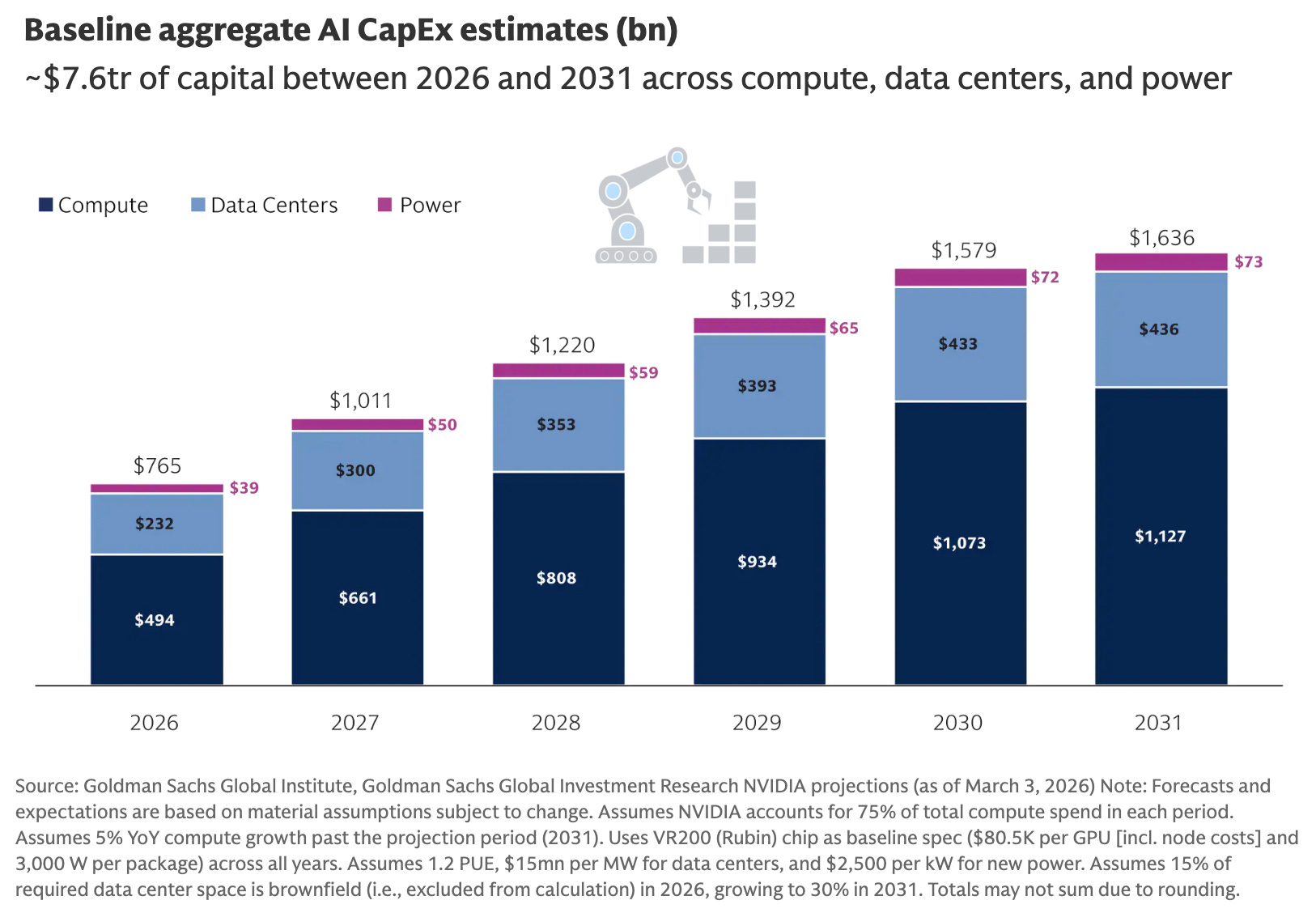
According to Goldman Sachs, the required ~$7.6 TRILLION of capital between 2026 and 2031 across compute, data centers, and power of the global AI build-out hinges on four supply-side assumptions /Goldman Sachs/. First, the economic useful life of silicon dictates the frequency and cost of massive replacement cycles /WSJ/. Then comes data center complexity. To support specialized hardware, operators must pay top dollar for advanced liquid cooling and dense power infrastructure /DCD/. Furthermore, compute elasticity determines whether chip efficiencies actually reduce hardware needs or simply trigger more demand /CIO/. Finally, severe physical bottlenecks in the power grid and labor market can dangerously elongate construction timelines /National Academies/. Just a few delays can stall monetization entirely.
Companies offering solutions to these physical bottlenecks and infrastructure constraints are moving swiftly to capitalize on the AI boom. By unlocking these critical supply-side challenges, they are aggressively tapping the capital markets to secure the massive funding needed for the next phase of growth. Those that are well positioned for scale may be investable, others may be just cashing in. Within the last month the following firms related to these bottlenecks have announced:
AI Factories
Cerebras Systems (AI inference chips/supercomputers for data centers): Filed S-1 for IPO on April 17, 2026 (Nasdaq: CBRS planned). Expected raise ~$2 billion at a valuation over $35 billion. Directly supports AI workloads in data centers as a Nvidia alternative. /Cerebras and SEC/
Forge Nano (advanced materials/Atomic Layer Deposition tech for AI-era semiconductor chips and batteries): Announced definitive SPAC merger on April 21, 2026, with Archimedes Tech SPAC Partners II (to trade as Nasdaq: NANO). ~$1.6 billion total equity value (pre-money ~$1.2 billion + PIPE). Enhances chip manufacturing and energy storage relevant to data centers. /GlobeNewswire/
Sivers Semiconductors AB evaluates a potential dual listing of its shares on the Nasdaq New York /Sivers/. Sivers develops photonics and wireless components (lasers, optical transceivers, etc.) used in high-speed data transmission for AI datacenters, HPC, and telecom infrastructure.
Energy Systems
Fervo Energy (next-generation geothermal energy developer): Filed S-1 for IPO on April 17, 2026 (Nasdaq: FRVO planned). Estimated raise ~$250 million. Unicorn status (valuation crossed $1 billion pre-IPO via prior funding); focuses on clean, reliable power for high-demand AI data centers. /Fervo Energy/
X-energy (advanced nuclear small modular reactors): IPO priced April 23 and began trading April 24, 2026 (Nasdaq: XE). Raised ~$1.02 billion (upsized) at ~$9.1 billion market cap initially (now higher, around $11–12+ billion post-debut). Targets clean baseload power for AI data center energy needs (e.g., backed by Amazon). /X-energy/
Mineral Frontier
The Elmet Group Co. (precision-engineered critical materials/components like tungsten/molybdenum, plus high-energy/microwave systems for semiconductors, energy, aerospace/defense): IPO priced April 22 and began trading April 23, 2026 (Nasdaq: ELMT). Raised ~$125.5 million (upsized) at ~$411–438 million market cap. U.S.-based producer of critical materials used in semiconductor/electronics and energy applications. /VoxelMatters/
Copper and Silver Miner Lumina’s Toronto IPO Raises $297 Million /Bloomberg/. The pricing gives Lumina Metals a market value of as much as roughly C$1.3 billion based on the outstanding shares listed in its filing. Accounting for employee stock options and restricted stock units, the company would have a fully diluted value of up to about C$1.4 billion.
All content published on this newsletter is based on public information and independent research. Opinions are authors own and have been sanitized through AI engines which can make mistakes. This newsletter is not financial advice, and readers should always do their own research before investing in any security.
Which brings us to the “The Great Data Center Delay” which we will break down in the rest of this article…