


Shop Talk
Capturing this week’s zeitgeist
The Texas triangle of Houston, Austin, and Dallas have secured a manufacturing renaissance by doubling down on the gritty “substrate” of the physical world /SightBringer on X/. These cities have positioned themselves as the masters of hard power, offering the energy /Manufacturing Dive/, logistics, and buildable land necessary to turn AI abstractions into physical output. By prioritizing functional scale and industrial competence over aesthetic vibes, Texas has built a resilient machine capable of powering, cooling, and housing the future of global industry.
Key Drivers of Texas Expansion
Texas CHIPS Act: Governor Abbott signed legislation in 2023 to establish the Texas Semiconductor Innovation Fund /Texas Gov/ to attract and support these massive investments.
Workforce Development: Projects like Texas A&M’s $200M semiconductor project are being developed to support the expanding talent needs through 2028. /YouTube/
AI Demand: The surge in AI and data center needs is the primary driver, with companies aiming for vertical integration and increased localized production. /Manufacturing Dive/
Up Next: Hannover Messe 2026, April 20 - 24
Hannover Messe coming up next week and it’s a great place to see the entire exponential ecosystem!
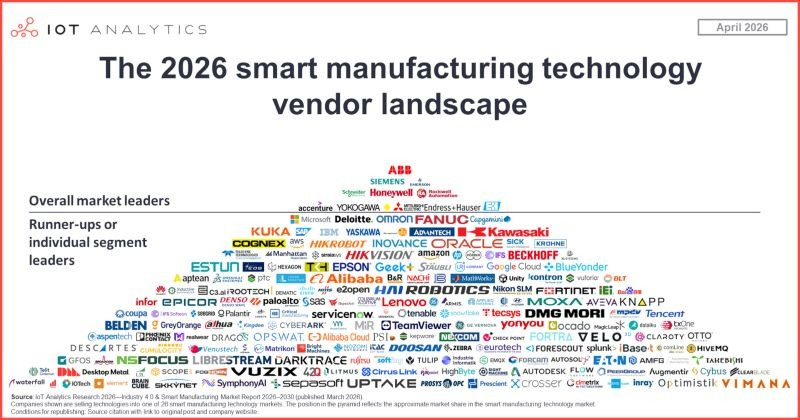
I will be focusing on the leaders and startups of scalable Data, AI, and Intelligence:
Databricks at Hannover Messe /Databricks/
Litmus at Hannover Messe 2026: The Industrial Data Foundation for Enterprise AI /Litmus/
HighByte at Hannover Messe 2026: Ecosystem in Action /HighByte/
AVEVA at Hannover Messe 2026: Harness your industrial intelligence /AVEVA/
Meet Zeta Alpha at Hannover Messe 2026 /Zeta Alpha/. See how Agentic AI is transforming how engineers and R&D teams discover, organize, and act on technical knowledge.
Connect With Azumuta at Hannover Messe 2026 /Azumuta/
Reply to this email if you would like to catch up in Hanover!
New in 2026: We are gifting a 1-year paid subscription to the first person to identify the content link AND cultural reference to the title/subject line of this week’s digest. Comment on this post with your guess before next week’s digest is released to be eligible!
Last week’s answer: From Industrial Versailles to Man on the Moon: Earthset From the Lunar Far Side /NASA/
Assembly Line
This week’s Industry 5.0 breakthroughs and frontier technologies of the built world.
This Is How AI Will Automate Every Industry
Sorcery got rare access inside Applied Intuition’s commercial garage with Co-Founders CEO Qasar Younis and CTO Peter Ludwig, where they’re building AI systems that power cars, trucks, mining equipment, defense systems, and more. In a never-before-seen tour to the public, Applied Intuition showcases where/how real machines across industries are being rebuilt with AI.
Qasar and Peter break down how one platform can run everything from a car to a boat to a mining site, and why the future of AI is no longer just software, but systems that move the real world.
A New Chapter for Pronto: We Have Officially Been Acquired by Atoms /Pronto/. As of today, Pronto is proud to become the core technology engine of Atoms Mining, one of three divisions within the company dedicated to digitizing the physical world through purpose-built, intelligent machines.
Inside a Warehouse Automation Project: How Sumitomo Drive Technologies Is Transforming Logistics and Reshoring Operations
Ocado to launch AI-powered Ocado IQ software at MODEX /AutomatedWarehouse/
Auditors for Dexory have issued a rare warning over gaps in its financial records after the British robotics firm Dexory reported surging revenues alongside deepening losses /City AM/. The accounts come just days after Dexory secured £8.5m from the British Business Bank as part of a wider Series C round, with backing from investors including Eurazeo, Atomico and Lakestar.
NOTE: MODEX 2026 is on display April 13th-16th in Atlanta, GA as the largest manufacturing and supply chain event in 2026.
X-Force Threat Intelligence Index 2026
For the fifth consecutive year, the manufacturing sector remained the most attacked industry, representing 27.7% of all incidents within the top industries. This ongoing targeting reflects its critical role in global supply chains and the high value of operational and intellectual property data.
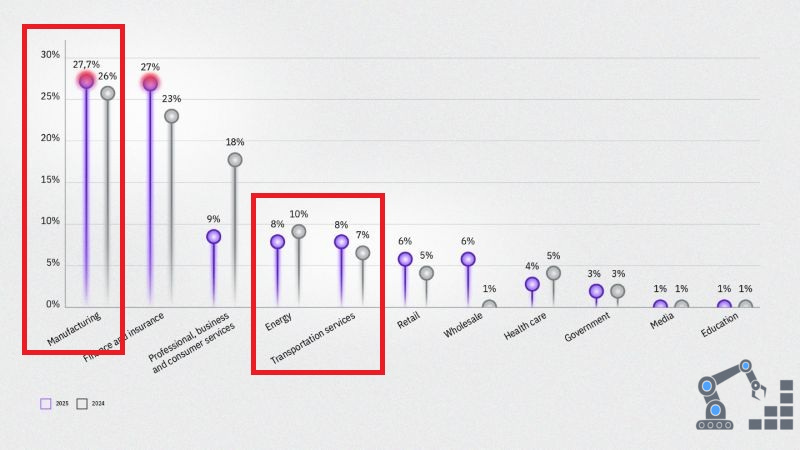
Attackers leveraged several methods to breach manufacturing systems, with exploitation of public-facing applications (32%) emerging as the most common vector. Valid accounts (domain) (16%) and external remote services (11%) were also prominent, reflecting attackers’ reliance on exploiting misconfigured or insufficiently secured access points.
Read more at IBM
Project Glasswing: Securing critical software for the AI era /Anthropic/. Claude Mythos Preview is a general-purpose, unreleased frontier model that reveals a stark fact: AI models have reached a level of coding capability where they can surpass all but the most skilled humans at finding and exploiting software vulnerabilities.
Why Anthropic won’t release its new Claude Mythos AI model to the public /NBC/
Information to Atoms
Below are simulations and printed-on-silicon images from a scanning electron microscope (SEM) of a complex metal one (M1) layer printed in a single exposure with Substrate’s X-ray lithography tool, enabled by AlphaEvolve-optimized simulations. The printed patterns are equivalent in resolution to “high numerical aperture” (High-NA) lithography, which is equivalent to the requirements of the 2 nm semiconductor node.
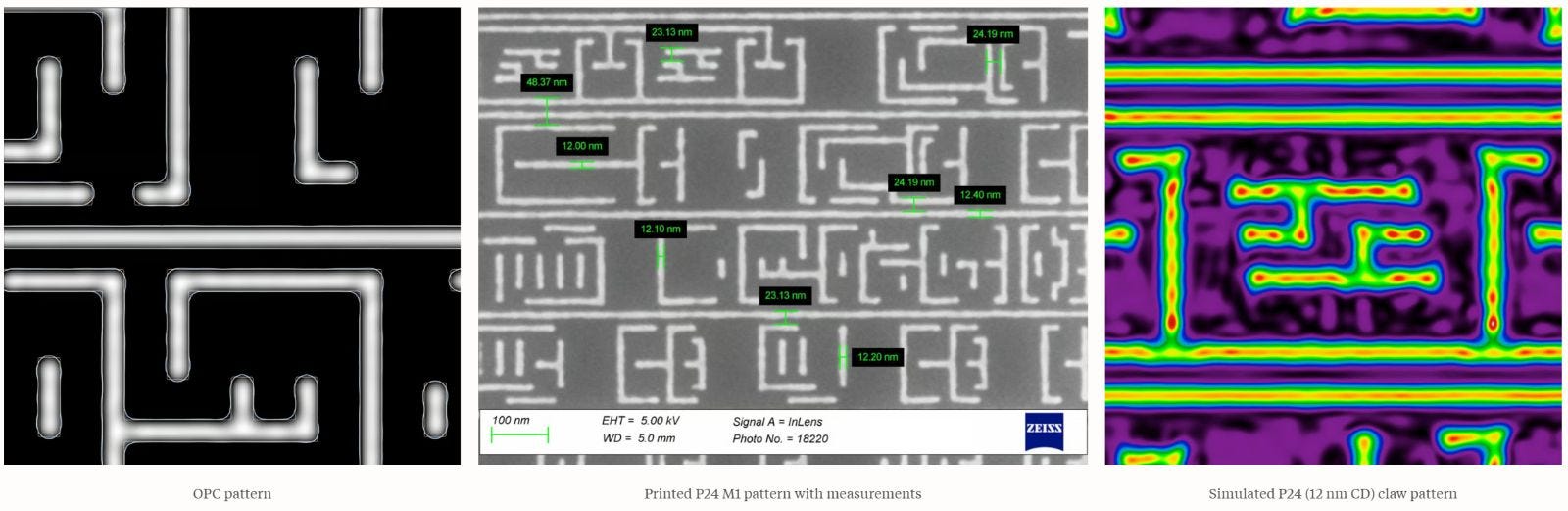
Beyond optimizing for success, the real power of this framework is its ability to predict not just that something will fail, but why. When we understand where and why printing fidelity breaks down, we can compensate by adjusting other parameters, simulate, and then validate with real-world printing.
We are now using AlphaEvolve in other areas, from material discovery to automated circuit layouts. We are also exploring ways to combine AlphaEvolve with other models and techniques to speed up research. One promising area is integrating AlphaEvolve with models focused on scientific knowledge, such as Gemini 3 Deep Think, in a semi-autonomous research loop.
Read more at Substrate
Siemens accelerates AI chip verification to trillion‑cycle scale with NVIDIA technology /Siemens/
Nobody (yet) builds AI manufacturing for PCBs, coil winding, wire harnessing, and battery assembly at scale in Europe, despite how essential these are to defense and aerospace. The most exciting to me is AI native factory operators are... /Oleg Malenkov on LinkedIn/
Constraint Capital #4 - Apr 2026

In the history of industrial revolutions, we didn’t just invent the engine; we built the factory. March 2026 has officially marked that same transition for the digital age. We have moved past the era of singular crafted AI models and entered the era of the
New Product Introduction
Highlighting new and innovative facilities, processes, products, and services
Intel Foundry Achieves Breakthrough with World’s Thinnest GaN Chiplet Technology
✍️ Author: Han Wui Then
Researchers at Intel Foundry have demonstrated a first-of-its-kind GaN chiplet technology built on 300 mm GaN-on-silicon wafers, marking a significant leap forward in semiconductor design. Presented at the 2025 IEEE International Electron Devices Meeting (IEDM), this work tackles one of the most pressing challenges in modern computing: how to deliver more power, speed, and efficiency in an increasingly compact space. To meet the demand of graphics processors, servers, and wireless networks for ever-greater performance, the Intel Foundry team developed an ultra-thin GaN chiplet — its base silicon measuring just 19 μm thick, roughly one-fifth the width of a human hair — along with the industry’s first fully monolithic on-die digital control circuits, all built using a single integrated manufacturing process.

Thinning a semiconductor wafer sounds straightforward, but doing it on a fully processed 300 mm GaN-on-silicon wafer — one that already contains all the transistors and metal wiring layers — without damaging those structures is a formidable engineering challenge. The Intel Foundry team accomplished this using a technique called stealth dicing before grinding (SDBG) /DISCO/, which uses a precisely controlled laser to create microscopic fracture lines inside the wafer before a mechanical grinding step reduces its thickness. The result is a GaN chiplet with an underlying silicon base of just 19 μm.
Read more at Intel Community Blog
From Defect Images to Die Prediction: How Intel Is Scaling AI in Advanced Manufacturing /EETimes/
Intel joins Musk’s Terafab AI chip project to power humanoid, data center goals /Reuters/
Real-Time Injection Molding Simulation, Powered by AI
Introducing Cadmould AI Solver, the world’s first neural physics engine for plastic injection molding. This technology is set to revolutionize design for manufacturing by combining the accuracy of physics engines with the speed of neural networks to deliver simulation results in seconds.
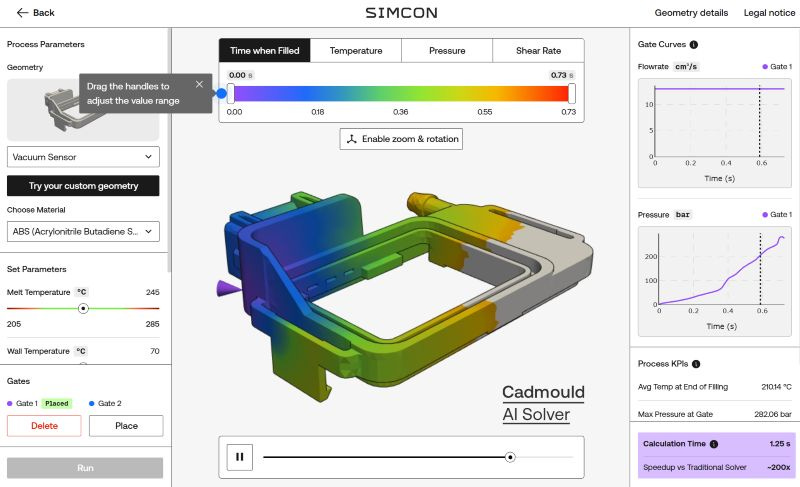
This interactive research preview allows you to test-drive our AI model live. Instead of waiting for results, you receive instant feedback on filling pattern, pressure, and temperature in seconds. It is capable of modeling complex physical interactions, including multi-gate scenarios, with accuracy that rivals traditional solvers. Please note that this preview is a focused showcase of the filling phase only.
Read more at Simcon

Business Transactions
This week’s top funding events, acquisitions, and partnerships across industrial value chains.
🚀🕴️ Inside the SpaceX founder factory—and the race to solve the next generation of impossible problems /Fast Company/. Fast Company built a database of 400+ ex-SpaceX employees turned company builders, the largest ever. What they learned, how they’re applying it, and the future they’re building.
🇺🇸💿 SiFive Raises $400 Million to Accelerate High-Performance RISC-V Data Center Solutions; Company Valuation Now Stands at $3.65 Billion
SiFive, the gold standard for RISC-V processor IP, announced it has raised $400 million in an oversubscribed Series G financing to accelerate its high-performance data center roadmap. This equity funding round was led by Atreides Management with Apollo Global Management, NVIDIA, Point72 Turion, and T. Rowe Price Investment Management, Inc., alongside repeat investors Prosperity7 Ventures, and Sutter Hill Ventures. The financing values the company at $3.65 billion and will accelerate SiFive’s RISC-V CPU and AI IP solutions for the data center.
CPUs are critical in agentic AI systems because they excel at orchestrating complex system level coordination tasks that GPUs and accelerators aren’t designed to handle efficiently. As AI evolves toward more complex agentic models, efficient CPU performance is critical to expanding compute capacity within existing power envelopes. SiFive enables this transition by replacing complex, power-hungry legacy architectures with modern RISC-V CPUs that are inherently lower power. RISC-V integrates scalar, vector, and matrix compute into a single, standards-based interface that helps customers scale rapidly, significantly accelerating hardware development to match the speed of AI innovation.
Read more at Business Wire
🇺🇸⚗️ Membrane Technology & Research Secures $27 Million Investment to Accelerate Global Deployment of Membrane-Based Solutions
Membrane Technology & Research, Inc. (MTR), a global leader in membrane-based separation technologies, today announced it has secured a $27 million equity investment led by Climate Investment, with participation from Hartree Partners. Combined with MTR’s commercially-proven and scalable technology platform, this investment strengthens the company’s position to accelerate global deployment in industrial separations and carbon capture applications.
Read more at Business Wire