


Shop Talk
Capturing this week’s zeitgeist
AI coding tools let industrial engineers build custom software and connect messy plant data in hours rather than months. Instead of waiting on IT, teams can quickly spin up tailored dashboards to monitor live machinery or draft code for tricky shop-floor workflows that usually take forever to configure.
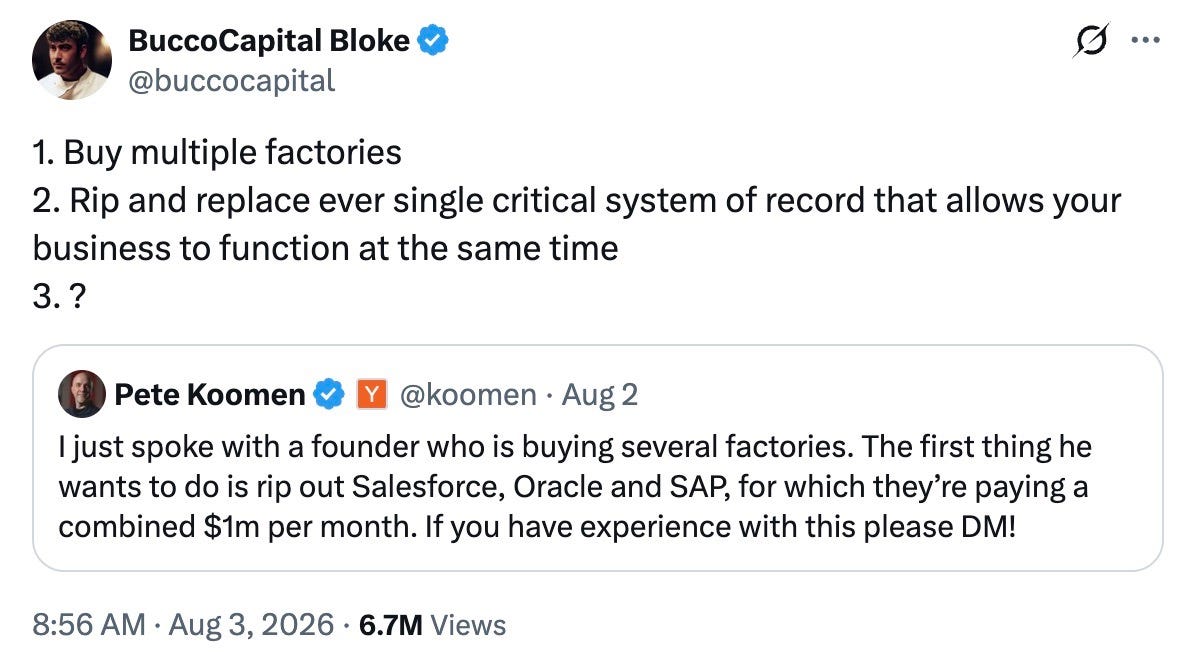
Replacing core systems of record like your ERP or MES is another story /X/. These platforms hold decades of fragile business rules, custom logic, and historical data. When AI-generated code makes even a tiny mistake, it can freeze a production line or mess up account balances across the entire company. For now, AI is fantastic for building quick tools around your existing systems but probably keep them away from pulling the plug on your core foundation unless you’ve mastered them like a process technology.
Assembly Line
This week’s industrial breakthroughs and frontier technologies of the built world.
We Made a Knob for SmarterEveryDay to Print Millions
Slant 3D counters SmarterEveryDay’s claim /YouTube/ by arguing that while individual 3D printers take longer per part than injection molding, mass-production “print farms” achieve equal or higher overall throughput through massive parallelization. By converting the high capital cost of a single molding machine into hundreds of lower-cost printers running concurrently, manufacturers eliminate expensive tooling, avoid single-point failure risks, and gain the flexibility to iterate part designs instantly via software.
Loading Hondas in the Heartland: How Honda’s Indiana Auto Plant Ships its vehicles
Automotive finished-goods logistics relies on highly synchronized multi-modal transport, where factory workers precision-park new vehicles, shuttle crews, and use specialized connecting ramps inside enclosed rail auto-racks to rapidly roll vehicles across entire multi-car trains. While relocating assembly, such as Honda keeping the Civic in Greensburg, Indiana, rather than Mexico/Reuters/, allows automakers to bypass heavy import tariffs, it concentrates immense pressure on domestic rail infrastructure and local carrier yards to manage high outbound volume efficiently.
Shipping Ford Trucks Across the Country: A Look at How Autoracks are Loaded /YouTube/
Several major automakers implement autonomous end-of-line logistics, utilizing two distinct architectural approaches:
On-Vehicle Autonomous Driving (Tesla BYD, NIO, XPeng)
Tesla: Employs its onboard Full Self-Driving (FSD) software to have newly built vehicles drive themselves straight off the assembly line at the Fremont Factory /X/ and navigate over a mile to their assigned staging lanes and loading docks without human drivers.
Infrastructure-Guided Automation (BMW, Mercedes-Benz, General Motors)
BMW deploys an “Automated Driving In-Plant” (AFW) system across plants like Dingolfing and Leipzig /BMW/. Instead of relying on the car’s built-in sensors, the factory uses a stationary off-vehicle LiDAR infrastructure and cloud movement planners (developed with Seoul Robotics and Embotech) to remotely pilot 5 Series, 7 Series, and MINI Countryman models over 1 km through test tracks directly into logistics yards.
Mercedes-Benz & Audi use automated valet parking (AVP) and infrastructure-driven plant routing systems in plants like Factory 56 (Sindelfingen) /Audi/. External cameras and LiDAR networks track vehicle location and issue remote steering, braking, and throttle commands over local networks to move vehicles between production steps and staging bays.
BYD & Chinese EV makers leverage integrated smart-factory architecture to autonomously route EV units off assembly lines into yard staging. Utilizing factory-wide digital twin tracking alongside onboard camera/radar suites, vehicles self-navigate to charging pads, quality inspection lines, and shipping bays.
Inside a high-tech lab designing food for a hotter world
The video highlights high-throughput plant phenotyping using automated greenhouses equipped with 3D scanners, thermal sensors, and AI computer vision to continuously analyze crop performance under simulated climate stress. By mapping non-destructive traits like photosynthetic efficiency, root growth, and water retention to their specific plant genomes, researchers can dramatically accelerate traditional cross-breeding without resorting to genetic modification. The overall trajectory points toward creating climate-resilient, disease-resistant crops capable of maintaining food yields in a warmer, more volatile global environment.
Have you tried the Exponential Industry Arcade yet? Safety comes first in Hazard Sweep…

New Product Introduction
Highlighting new and innovative facilities, processes, products, and services
Terraform Industries Hydrogen Electrolyzer Breakthrough
Last week the c team at Terraform Industries pulled off yet another first, the sustained production of >99.9% pure H2 from our vertically integrated, California-manufactured electrolyzer stack while it was coupled directly to a solar array at our Muroc desert test site.
Most commercial electrolyzers need carefully conditioned power from expensive battery-meditated backup systems. Ours runs directly off the sun. Clouds pass, the day turns to night, and we maintain purity from a stack whose Bill of Materials cost is well below $100/kW.
Terraform’s single-minded focus on capex reduction has allowed us to convert sunlight to hydrogen in an unprecedented demo at a cost below $2/kg. If that wasn’t enough, we have a crystal clear plan of steady execution to push that cost below $1/kg in the coming years.
Read more from Founder Casey Handmer on X
Oklo’s Groves Reactor Achieves First Criticality in Under a Year
Oklo Inc., an advanced nuclear technology company, announced that its Groves Isotope Test Reactor reached first criticality after achieving a controlled, self-sustaining nuclear chain reaction at low power. The milestone comes less than a year after groundbreaking and follows U.S. Department of Energy (DOE) authorization through the DOE Reactor Pilot Program (RPP).
The DOE’s RPP created a pathway that allowed engineering, construction, commissioning, and operational preparation to advance alongside DOE’s safety review and authorization. Groves demonstrates that the domestic nuclear industry can once again move from design through construction, authorization, and startup on timelines that are measured in months rather than years when developers, suppliers, and regulators work together on an integrated deployment approach.
Read more at Oklo
Business Transactions
This week’s top funding events, acquisitions, and partnerships across industrial value chains.
Hadrian Raises $1.37B Series D to Build Highly Automated Factories to Accelerate America’s Industrial Renewal
Hadrian, the advanced manufacturing company building highly automated factories for America, announced $1.37 billion in new equity financing to accelerate the buildout of the domestic manufacturing capacity needed to deliver America’s most critical defense, aerospace, and industrial systems.
The financing will support new factories, expanded R&D, and additional production capabilities as Hadrian builds the industrial infrastructure required to deliver complete mission-critical systems at speed and scale. At a time when demand for trusted U.S. manufacturing capacity continues to outpace supply, Hadrian is expanding the AI-powered production network needed to strengthen deterrence, accelerate delivery, and restore America’s ability to build.
Read more at PR Newswire
Valor Atomics Announces a $1B Series B Led By Sequoia
Valar Atomics is excited to announce the closing of a $1 billion Series B financing led by Sequoia Capital. As part of this new partnership, Valar welcomes Sequoia partner Shaun Maguire to Valar’s board of directors. Sequoia was joined in this round by Apandion, Atreides Management, Conviction, Dream Ventures, HOF Capital, Point72, Riot Ventures, Snowpoint Ventures, Valor Equity Partners, and other both new and longtime investors. Finally, in addition to the $1B of equity, Valar is excited to announce the closing of a $200 million credit facility led by Erebor Bank, as administrative agent, and J.P. Morgan, alongside Crescent Cove and Hercules Capital.
The preliminary stage of Valar’s mission has been a success. Ward 250’s operability has been proven. More importantly, the speed and efficiency of a vertically integrated, hardware focused approach stands for all to see. So, what does the new Series B financing mean for Valar? It allows us to make the next mission critical evolution: Valar will transition from demonstrating the operability of an integrated reactor system to producing fleets of them en masse. This has been Valar’s mission since its inception. A project can build one reactor, but a fleet requires manufacturing. This series B financing is the fuel for this mission. It will allow us to fully execute a vertically integrated, hardware first approach; one that encompasses everything from reactor deployment and long-term operations to fuel production. Valar will not rely on outside suppliers for the fuel needed to deploy and operate. We will construct it ourselves in labs placed alongside the very reactors that same fuel will run. These reactors will bring unprecedented energy abundance that matches the scale of their production.
Read more at Valar Atomics
Base Power Announces $1B Series D and Launches Base Core, First-of-its-Kind Home Battery Built in the United States /Business Wire/. Go inside the factory with Sourcery /YouTube/.
Ore Energy Raises $43 Million /Newswire/ to scale its iron-air battery technology. Ore’s batteries, designed to store renewable electricity for up to 100 hours, can solve one of the biggest barriers to the energy transition: affordable, long-duration energy storage.
Mariana Minerals Raises $310 Million Series B Led by Khosla Ventures to Accelerate Critical Minerals Production
Mariana Minerals, a software-first, vertically integrated critical minerals company, today announced it has raised $310 million in Series B financing. The round was led by Khosla Ventures, with continued support from Andreessen Horowitz (a16z) and Breakthrough Energy Ventures, and new participation from Greenoaks, Halo Fund, Pax Ventures, StepStone Group, BHP Ventures, Washington Harbour Partners, Greycroft, General Innovation Capital Partners, Mitsubishi Corporation, In-Q-Tel (IQT), and Earthshot Ventures, with a number of additional strategic capital partners joining the round. This round brings the company’s total parent and project capital raised to date to approximately $400 million.
Mariana engineers, builds, and operates mines and refineries using its proprietary MarianaOS platform, which integrates capital project execution (CapitalProjectOS), refinery operations (PlantOS), and mine management (MineOS) into a single AI and machine learning stack. MarianaOS compresses traditional 5-to-10 year project execution timelines by roughly half and reduces commissioning timelines well below industry benchmarks.
Mariana’s Series B financing unlocks continued buildout of the company’s active project portfolio, including its flagship sites Copper One in Southeastern Utah and Lithium One in East Texas. Copper One, acquired by Mariana in late 2025, restarted mining operations under autonomous orchestration within 4 months and is ramping toward a production target of 50,000 metric tons of refined copper per year. Lithium One, which broke ground in Q4 2025, is the world’s first GWh-scale facility for producing lithium from oil & gas produced water, with commercial production targeted for the first half of 2027.
Read more at PR Newswire
LoopX Innovation Inc., a Physical AI company building machine intelligence for uncontrolled mining environments, announced it has closed a $4.05M Seed financing led by BDC Seed Venture Fund and Orion Industrial Ventures /Business Wire/
Shelfmark Raises $3.5 Million to Automate Manufacturing’s Most Underserved Production Lines and Make them Smarter Every Run
Shelfmark, a Physical AI company providing production intelligence for continuous-flow manufacturing, announced a $3.5 million seed round to bring greater autonomy to one of manufacturing’s most overlooked environments: the fast-moving lines that produce materials on reels, rolls and continuous webs. Led by Armory Square Ventures, with participation from Grand Ventures, Hyde Park Angels, Argon Ventures and Cultivation Capital, the round brings Shelfmark’s total capital raised to approximately $5 million.
At the heart of Shelfmark’s Physical AI engine is a perception system combining in-line industrial cameras, spatial sensing and proprietary deep-learning vision models that inspect and interpret high-speed continuous materials in real time under dynamic plant conditions. Shelfmark reports 99.5% defect-detection accuracy in customer deployments that have halved inspection labor costs and generated returns of up to 7x compared with manual inspection.
Read more at GlobeNewswire
NavVis Raises USD 85M Series D Round to Supply the Data Foundation for Physical AI /Business Wire/. NavVis combines survey-grade reality capture 10x faster than traditional methods with NavVis IVION, a collaborative enterprise cloud platform that turns spatial data into shared, trusted, always-current spatial twins.