


Shop Talk
Capturing this week’s zeitgeist
In the story of America, the drive to build complex machinery with one’s own hands and to seek true independence from constraints, whether of empire, circumstance, or limited resources, has always formed the living core of the national mythos we call the American Dream. It began with the ragtag forces who, bankrupt and outmatched, refused to accept defeat and instead improvised the decisive victory at Yorktown through raw determination, borrowed ingenuity, and unbreakable will, proving that a people without pedigree or treasury could still forge their own future. That same spirit echoes today in every garage, workshop, and dorm room where individuals turn scrap, code, and sheer grit into advanced industrial systems from high-speed aerospace prototypes to computer systems, reminding us that the Dream was never about inherited advantage but about the radical belief that anyone, through relentless effort and inventive resolve, can create the machinery of their own freedom and prosperity.
Assembly Line
This week’s industrial breakthroughs and frontier technologies of the built world.
🇬🇧🪙 How a New Steel Alloy Is Invented!
The Warwick Manufacturing Group (WMG) is a world-leading research and education group, creating knowledge to deliver impact - for industry, people, and the environment.
🇺🇸🚗🏭 Ford’s AI Hiccups Lead Carmaker to Rehire ‘Gray Beard’ Engineers
Ford initially assumed its AI systems could completely take over vehicle quality control and engineering tasks. However, because experienced engineers left the company before their institutional knowledge could be properly captured, the AI lacked the deep “judgment data” it needed to succeed. Instead of catching design flaws, the automated tools actually amplified weak inputs.
To fix the technical gap, Ford brought back the 350 engineers to:
Rebuild the data pipelines feeding the AI to ensure it was learning from proper veteran engineering judgment.
Refine the automated tools and mentor junior staff.
Overhaul software QA by creating a dedicated 40-person software quality assurance team and introducing more than 100,000 AI-powered automated tests to catch edge cases late in development.
For the first time in 16 years, Ford secured the #1 spot among mainstream brands in J.D. Power’s Initial Quality Study (IQS), scoring 152 problems per 100 vehicles. Specific segments like the F-150, Mustang, and Super Duty won best-in-segment for the second consecutive year.
Read more at Bloomberg
🇨🇳🚙🏭 Inside NIO’s AI factory, where cars build themselves /The Korea Herald/. In this 100 percent automated process, where 941 robots orchestrate every movement, NIO EVs roll off the line at a rate of “one car every minute.” To boost production efficiency, NIO adopts the “Island production method,” replacing conveyor belts with a fleet of autonomous rovers that transport vehicles and components between workstations.
🇩🇪 SAP Gives AI Product Oversight to CEO and COO in Reshuffle /Bloomberg/
🦾 Automate Show 2026 Recap
The conversation traces the industry’s shift away from early-stage humanoid hype toward the practical, real-world deployment of Physical AI and edge computing. It then transitions into how software orchestration, digital twins, and advanced kinematics are solving labor shortages and preserving vital manufacturing knowledge.
Vention collaborates with FANUC and Universal Robots on software-defined automation /Robot Report/
🇺🇸🖨️3️⃣ Advanced 3D printing creates origami-inspired structures
Researchers at the U.S. Department of Energy’s Manufacturing Demonstration Facility at Oak Ridge National Laboratory have introduced an innovation in additive manufacturing by integrating origami-inspired 3D printing techniques with hybrid composites — materials made from mixed reinforcing components. By eliminating the need for molds to fabricate a part, this process produces lightweight, cost-efficient structures with faster build times and greater adaptability.
The method enables the production of complex geometries that traditional mold-based methods cannot economically achieve. It also allows the fabrication of objects larger than the printing machine itself, reducing capital costs and boosting production efficiency. In a test print, researchers found that eliminating molds reduced fabrication time by 95 percent and costs by 90 percent for printing a unique design compared to conventional mold-based composite manufacturing. ORNL has filed a patent, and the team is in the process of preparing the innovation for future licensing.
Read more at ORNL
🇮🇹🇺🇸 Data-driven smart wire arc additive manufacturing: a qualification-oriented cyber-physical system framework /The International Journal of Advanced Manufacturing Technology/
🇨🇳 An executable machine-tool-level digital twin for closed-loop CNC milling /Robotics and Computer-Integrated Manufacturing/
🇮🇹 Event-Driven Reinforcement Learning Enables Long-Horizon Control in Semiconductor Fabrication /arXiv/

New Product Introduction
Highlighting new and innovative facilities, processes, products, and services
🇺🇸☢️ Nuclear Reactor Powers Nvidia AI Chip in US First
Valar Atomics, a California-based nuclear startup, generated power from an advanced reactor to run an Nvidia AI chip. While just a trickle of electricity was produced, it’s the first time a next-gen reactor has done so in the US. On the heels of a demonstration of Valar’s Ward 250 reactor connecting to the Nvidia Blackwell chip at the company’s site in Utah, Valar Atomics CEO Isaiah Taylor joins Ed Ludlow on “Bloomberg Tech.”
🇨🇳💿 Hangzhou Garen claims world’s first 6-/8-inch gallium oxide wafer production line
Chinese semiconductor firm Hangzhou Garen Semiconductor has established the world’s first mass-production line compatible with both 6-inch and 8-inch homoepitaxial gallium oxide wafers. Most commercially available gallium oxide wafers are limited to 2 to 4 inches due to severe manufacturing and quality-scaling challenges.
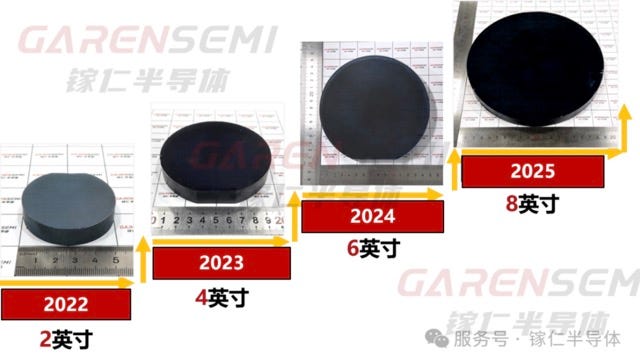
Garen overcame these hurdles using two core technical innovations:
Proprietary Cast-Growth Single-Crystal Technology: Produces ultra-thick gallium oxide crystals while drastically cutting the consumption of iridium, a costly precious metal. Alongside an ultra-thin substrate process, this increases substrate output by three to four times and slashes substrate costs by more than 80% per wafer.
Optimized MOCVD Epitaxy Process: Delivers epitaxial layers thicker than 10 micrometers with a thickness variation below 1%. This high level of uniformity significantly improves manufacturing yields.
Read more at Interesting Engineering
Gallium: The Inelastic Byproduct Powering AI Semiconductors (GaN, GaAs & InP) /ei/
Business Transactions
This week’s top funding events, acquisitions, and partnerships across industrial value chains.
🇫🇷🇺🇸🤝 Schneider Electric announces agreement to acquire Cognite, unlocking a new level of strategic intelligence for Industrial AI
Schneider Electric, a global leader in energy management and automation, announces that it has entered into a definitive agreement to acquire 100% of Cognite Holding B.V. (“Cognite”), a leading provider of industrial data and AI software, in an all cash transaction valued at $3.1 billion.
Cognite’s scalable, open architecture combined with the capabilities of AVEVA CONNECT means that analytics and industrial AI can ingest industrial data across the asset lifecycle and throughout customers’ existing data ecosystems and investments. The combination extends CONNECT with enterprise-wide data contextualization capabilities and leading-edge agentic AI.
Read more at Cognite
🇨🇦 Stathera Announces US$55 Million Series B to Scale Silicon Timing and Accelerate Next-Generation AI Data Center Solutions
Stathera Inc., a fabless semiconductor company pioneering silicon timing solutions, announced the close of an oversubscribed US$55 million Series B financing. As the market consolidates around a dominant incumbent, the round positions Stathera to become the leading independent alternative for AI data center and hyperscale customers. The round was led by new investor Maverick Silicon with continued backing from existing investors Celesta Capital, BDC Capital, MediaTek Innovation Fund, TXC Corporation, and Ultratech Capital Partners. The financing brings total funding to US$75 million.
Stathera will use the proceeds to fund mass production of its GEN2 silicon timing portfolio while accelerating development of its next-generation platform for AI data centers and growing the company’s engineering and commercial teams. With this expansion, Stathera will establish a Silicon Valley office to engage leading AI, data center, and hyperscale customers.
Read more at PR Newswire
🇺🇸 Omen AI Raises $31M Series A to Bring Continuous Fluid Intelligence to the Machines Powering the AI Economy /PR Newswire/
🇫🇷 VSORA strengthens its funding to launch the commercial roll-out of Jotunn8, its AI inference processor, and execute its ambitious technology roadmap /GlobeNewswire/.
🇰🇷 CarbonSix Secures $40M Series A to Deploy Physical AI Across Global Manufacturing
CarbonSix, a pioneer in Physical AI for the manufacturing sector, announced today that it has raised $40 million (approx. KRW 60 billion) in a Series A funding round from a syndicate of premier U.S. and South Korean venture capital firms. The round was co-led by DSC Investment and LB Investment. New investors joining the round include IMM Investment, Korea Development Bank (KDB), SV Investment, Cortentia (U.S.), and ASQ (A Squared, U.S.). Demonstrating strong continued confidence in CarbonSix’s technology and scalability, all existing seed-round investors—Foothill Ventures, Storm Ventures, Zeitgeist Capital, Xquared and CarbonBlack Fund—fully participated with follow-on investments.
At the core of CarbonSix’s competitive edge is its proprietary “data flywheel” business model. Instead of dumping massive, generalized datasets into abstract foundation models, CarbonSix provides practical automation tools that factories can use immediately. As clients operate these tools, high-quality, task-specific data is naturally captured and fed back into the system. This creates a powerful compounding loop: tool usage drives data accumulation, which refines the AI models, ultimately delivering even smarter automation tools back to the factory floor.
Read more at PR Newswire
🇺🇸 Robot hand company, Proception, settles Tesla trade secret suit and announces $11M raise /TechCrunch/
🇺🇸 Luxonis Raises $14 Million Series A to Power the Perception Layer Behind Physical AI /Business Wire/
🇺🇸 Arcturus Emerges from Stealth with $8M in Seed Funding to ‘Rewire the World’ with Metals Infused with Carbon Nanomaterials
Arcturus, an advanced materials company that infuses carbon nanomaterials into metals to unlock step-change improvements in electrical, thermal, and mechanical performance, emerged from stealth with an $8 million seed round led by Initialized Capital, with participation from 1517, Breakthrough Energy Discovery, Toyota Ventures, and Wireframe Ventures.
Arcturus is developing a proprietary process to infuse carbon nanomaterials into metals, creating a new class of high-performance materials designed to improve electrical, thermal, and mechanical performance. The company is building these materials as a drop-in solution for critical components across electrical systems, with target applications including motor windings, bus bars, heat sinks, and, over time, transmission lines and broader grid infrastructure.
Read more at GlobeNewswire
🇺🇸 Altillion Secures $5 Million Seed Round to Extract Iodine and Critical Minerals from Oilfield Wastewater and Industrial Brines /GlobeNewswire/
Looking for additional content? Paid subscribers get more stories delivered each week as part of Overcapacity!