


Shop Talk
Capturing this week’s zeitgeist
The magic of the Automate Show is the feeling that you are stepping directly into the future, where the cutting edge of industrial tech becomes a tangible, hands-on reality. As thousands of engineers, founders, and industry leaders gather this week at McCormick Place, the show floor transforms into a high-energy hub of live demonstrations, breakthrough AI, and game-changing humanoid robotics. Whether you are watching groundbreaking ideas pitch live at the Startup Challenge or trading insights with peers between sessions, it is a unique space where the next big technology and the right connection come together to reshape your business.
A few interesting exhibitors I’ve had the pleasure of first connecting with at previous Automate shows:
Copia Raises $26M in Funding to Unify OT Code Management, Backup, and Recovery /PR Newswire/ used to accelerate Copia’s mission to bring modern code management and recovery capabilities to the operational technology (OT) teams who are the first responders in the event of an industrial cyberattack or downtime incident.
Podium Automation Raises $18M Series A to Modernize the Backbone of Industrial Automation /PR Newswire/
CESMII Releases i3X™ 1.0: A Complete, Implementation-Ready Open API Specification for Manufacturing Interoperability /CESMII/
Assembly Line
This week’s industrial breakthroughs and frontier technologies of the built world.
🇪🇺🏭🧠 AI for Industry Is Europe’s Hope to Salvage Manufacturing Edge
While Europe may have lost the consumer chatbot wars to the US and China, a critical new battleground is emerging on the factory floor. European manufacturers are racing to integrate industrial AI using real-time sensors, predictive maintenance software, and automated quality control to create highly efficient, autonomous “smart factories.” This transition is a matter of survival, with over $1 trillion in manufacturing value at risk of leaving Western Europe due to high costs and labor shortages. However, the clock is ticking: industry experts warn that Europe has a narrow two-to-three-year window to successfully deploy these advanced systems before falling irreversibly behind Asian competitors, who are moving rapidly to combine robotics and AI.
Read more at Bloomberg
🤝🏭📊 Siemens partners with Databricks and FFT to turn production data into scalable AI-driven insights /Siemens/. Siemens Industrial Edge and FFT DataBridge connect shopfloor and plant data directly to the Databricks Platform – no IoT middleware required
☁️📊💨 Ingesting the Milky Way: Petabyte-Scale with Zerobus Ingest /Databricks/. By ingesting 1PB within 24 hours, Databricks demonstrates Zerobus’s ability to maintain continuous throughput of 12 GB/s to a single table.
🇪🇺📑 Europe’s golden age is over. Here’s the playbook for the next one. /Azumuta/ Eight imperatives, six of the sharpest voices in European manufacturing, distilled into one document designed to be read in one sitting.
📑 MIT’s Initiative for New Manufacturing builds momentum /MIT News/
🖨️🔋 The Secret Revolution in Battery Technology: 3-D Printing
The core uniqueness of 3D-printed battery technology lies in its ability to transform energy storage from a rigid, predetermined component into a fluid structural element that can fill any arbitrary geometry or empty space within a device. Unlike traditional manufacturing, which relies on chemical innovations and standard cylindrical or pouch shapes, this additive manufacturing approach is entirely chemistry-agnostic—boosting existing lithium-ion, sodium-ion, and solid-state designs alike. Furthermore, it revolutionizes the production process itself by enabling a solvent-free dry manufacturing method that eliminates massive, energy-intensive drying ovens, drastically reducing production footprints while making complex, high-capacity material designs physically viable.
Read more at WSJ
🚙🔋 GM may ditch LFP batteries for future EVs /Reuters/ and instead is focused on developing a different battery chemistry, lithium manganese-rich, or LMR, which the company has said costs about the same as LFP to make in the U.S., but can store more energy for the same weight and size.
🤝🚙🔋 QuantumScape Announces Agreement with Honda on Solid-State Battery Technology /QuantumScape/
🦾🧠 An Overview of Modern AI Robotics from First Principles
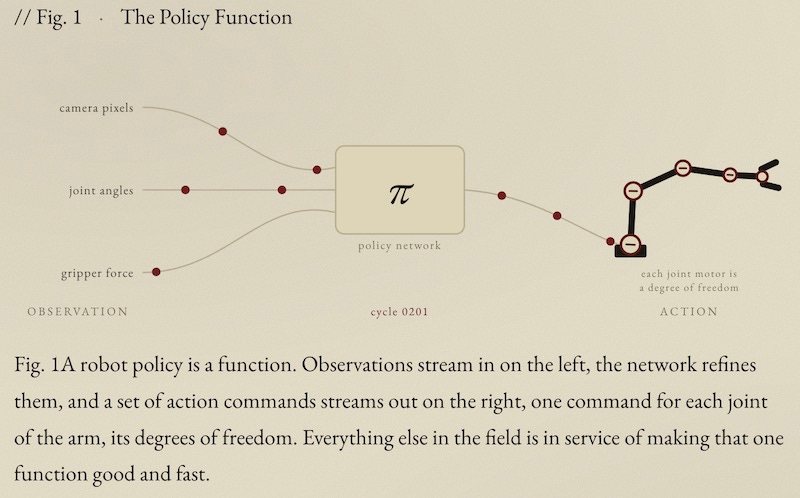
There is a deceptively simple way to describe what physical AI is all about, a way in which anyone with a STEM background will intuitively understand. Like all other AI models, a model which controls a robot is also a function. It takes in observations (camera pixels, joint angles, the felt resistance of a gripper, etc) and it outputs actions, the next set of positions and torques for its motors. Everything else, all the complicated algorithms, training methodologies, and data scaling theories are in service of producing a good version of that function and embedding it into the weights of a neural network.
The way out is the way humans learn: practice, against a critic. This is reinforcement learning: letting the robot try, scoring the outcome, and reinforcing what worked. The catch is that you can’t supervise a robot at every moment or hand it an example for every possible situation, and in the real world (unlike a simulator) attempts are serial, slow, and require a human to reset the scene. RL in the physical world proves very difficult as a result. Self-improvement algorithms hence fix major bottlenecks in performance for robotics, especially with regards to generalization.
Read more at Interlatent

New Product Introduction
Highlighting new and innovative facilities, processes, products, and services
🧫 Launching Midjourney Medical & The Midjourney Scanner
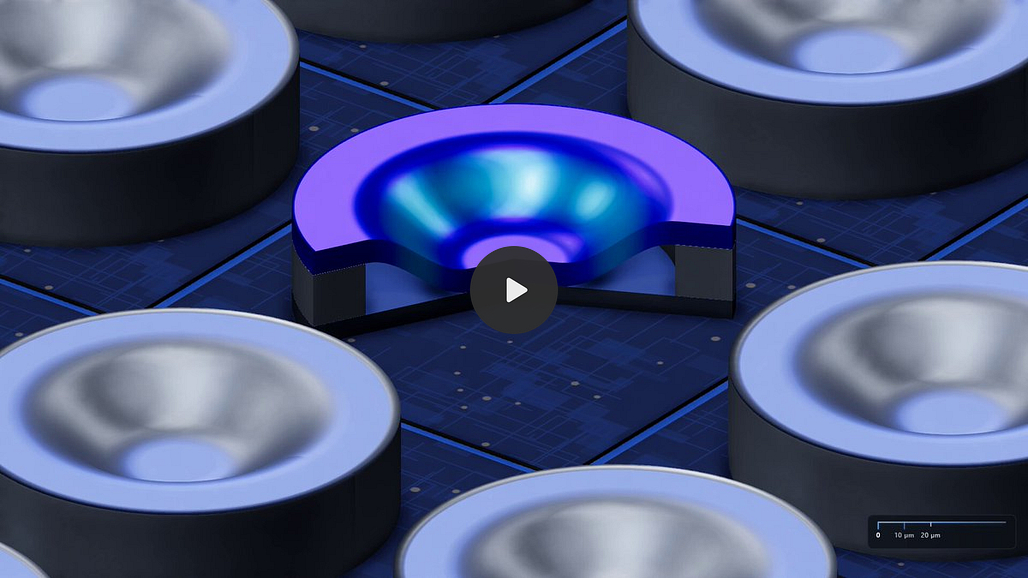
The major computational task is figuring out how to change waves into images. Basically - as waves travel through the water and your body they change shape. The shape of these waves changes whenever there is a change in density or stiffness (i.e., going from water to skin to fat to muscle to bone). By looking at how the shapes of all the waves change, we reconstruct a detailed map or ‘image’ which basically lets us figure out what’s in there. All of these images come together to cover a 3D map of your body, down to a fraction of a millimeter, that looks a lot like today’s MRIs but at nearly a hundred times the speed.

The next 12 months are about refining our algorithms and hardware on a daily basis. We’ll be doing research trials to show off the raw capabilities of our system, moving towards a 2nd generation hardware design, and we’ll do build-out for our first “research spa” which will become the promethean site that enables mass-scale health scanning.
Read more at Midjourney
📏 Lumafield Introduces Neptune Performance and Triton Performance Connecting Metrology-Grade Measurement to Production-Line Inspection /Lumafield/
🧪 Energy-efficient codon optimization on thermodynamic hardware /arXiv and THRML/. The first concrete pharmaceutical application mapped to thermodynamic hardware with energy estimates grounded in prototype measurements. All code is released under an open-source license.
🦾🧠 Qwen-Robot Suite: A Foundation Model Suite for Physical World Intelligence
The Qwen family of foundation models already gives strong perception and reasoning about the physical world. But seeing is not acting: the gap between vision and language understanding and physical control remains the central bottleneck for embodied intelligence. The Qwen-Robot Suite bridges this gap with three foundation models — Qwen-RobotNav, Qwen-RobotManip, and Qwen-RobotWorld. Nav unifies five navigation task families through a controllable observation protocol. Manip turns heterogeneous robot data into a coherent canonical space, enabling cross-embodiment training at scale. World co-trains 20+ embodiments via a natural-language action interface under one world model. Together, they enable an agentic system where general intelligence translates directly into physical action.
Read more at Qwen
🦾🧠 SC3-Eval: Evaluating Robot Foundation Models via Self-Consistent Video Generation /arXiv/. Joint work between Physical Intelligence and the NVIDIA Cosmos team /X/.
🦾📊 XDOF Raises $70 Million To Build Infrastructure For Robot Foundation Models /Pulse 2.0/. XDOF has open-sourced ABC-130K, which it describes as the largest open-source teleoperation dataset /Hugging Face/.
Business Transactions
This week’s top funding events, acquisitions, and partnerships across industrial value chains.
🇨🇭♻️ GR3N raises €15.5M to build the world’s first microwave-powered PET recycling plant / TNW/. GR3N’s technology, called MADE (Microwave Assisted DEpolymerisation), can process all PET.
🇪🇸🦾 THEKER raises €73M to deploy AI-native factory robots that learn on the job
THEKER, the Barcelona-based AI robotics company, has raised €73 million ($85 million) in a Series A to scale its generalist factory robots across industrial production environments. The round was led by CRV, with participation from Samsung, LVMH, Cathay Innovation, 20VC, Henkel Ventures, Korelya, and Bright Pixel Capital. It marks Samsung’s first-ever investment in a Spanish company, LVMH’s first bet on the Spanish startup ecosystem, and CRV’s first investment in Spain.
The round comes less than a year after THEKER closed Spain’s largest-ever seed round at €18 million. The speed from seed to Series A reflects what the company calls real commercial deployment momentum, not just lab demos.
THEKER’s pitch is a new category of industrial robot: AI-native, generalist machines that adapt in real time to changing environments, mixed SKUs, irregular shapes, and operational variability without manual reprogramming. Unlike traditional industrial robots that are rigid and costly to reconfigure, THEKER says its systems deploy in days and continuously learn in production.
Read more at TNW
🇭🇰🦾 Humanoid robot maker EngineAI files for a Hong Kong IPO /TNW/
🇬🇧🦾 Fuse: We’re building robots /Alan Chang on X/. Energy is the bottleneck for AI; our goal is to unleash it, and robots are how we make sure it never becomes one again.
🇺🇸🪙 Foundation Alloy Industrializes New Metals Platform with $22M Series A
Foundation Alloy, the 21st-century metals company building a new way to engineer alloys, today announced $22 million in Series A financing to scale production on its MetalsFIRST™ platform—a fully integrated, solid-state metallurgy technology—to industrial volumes. The round was led by Voyager Ventures, with participation from Trust Ventures, Yamaha Motor Ventures, America’s Frontier Fund, Overlap Holdings, Material Impact, Engine Ventures, and El Cap.
Foundation Alloy’s MetalsFIRST approach is a fully integrated, solid-state platform encompassing composition design, mechanical alloying, shape forming, and sintering, that produces engineered alloys without ever entering the molten state. This process enables faster, simpler manufacturing cycles, capital-efficient industrial scale up, and access to alloy compositions and properties impossible to achieve with legacy melt processes. Foundation Alloy’s specialty and stainless steels are engineered for the most demanding applications while requiring 80%–90% fewer production steps, while its Molyclast® product line includes MC1200, a molybdenum alloy that delivers more than 3x the strength of commercial alternatives. This combination of superior performance and manufacturability unlocks new capabilities for demanding applications across the industrial space.
The funding transitions Foundation Alloy into an industrial supplier. This summer, the company is opening a new 36,000 sqft facility in Massachusetts, standing up an additional modular production cell with Re:Build Manufacturing in southern New Hampshire, and doubling headcount across production, engineering, and commercial operations.
Read more at PR Newswire
🇺🇸🪙 Cuprum Metals raises $19.4M Series A to accelerate Copper Extraction Technology /Cuprum/ using a water-based chemical leach, with the flexibility to operate using sea water, to achieve high recovery rates at significantly faster processing times.
🇺🇸🪙 NOX METALS Raises an $11.5M Seed Round to Reindustrialize America /NOX/
🇬🇧⚙️ Doncasters seeks to raise up to $747M in U.S. IPO /Yahoo/ which manufactures high-precision alloy components for demanding conditions.
🇺🇸♨️ Critical Energy Raises $22M to Mass-produce Modular Geothermal Turbines
Based in Los Angeles and founded in 2024 by Spencer Jackson, Critical Energy just closed a seed round led by Susa Ventures and Upfront Ventures. Other investors include MaC Venture Capital, Susquehanna Sustainable Investments, Humba Ventures, Scribble Ventures, Underground Ventures, and Silicon Valley Bank, which provided venture debt.
Critical Energy designs modular geothermal turbines. These are container-sized units built in-house that turn heat into electricity using a closed-loop fluid system and custom machinery. The company says it can reduce deployment times from years to weeks by building most of the system off-site. It has already built a pilot facility in Los Angeles and is moving toward larger commercial projects.
Read more at TFN
🇺🇸♨️ Mantle Energy, Inc (Mantle), has successfully closed a $5 million seed round led by 17Shoals /PR Newswire/ leveraging techniques to create heat in oil and gas formations in a way that facilitates both Enhanced Oil Recovery and Geothermal Energy to provide energy security and a lower carbon baseload power.
Looking for additional content? Paid subscribers get more stories delivered each week as part of Overcapacity!