


Shop Talk
Capturing this week’s zeitgeist
Happy belated Thanksgiving. While we typically focus on the feast, the holiday is, at its core, a story about successful technology transfer. The Pilgrims didn’t survive New England by stubbornly sticking to European farming methods; they survived because they admitted what they didn’t know and accepted mentorship from the Wampanoag people on how to work the land.
I was reminded of this distinct form of “survival through humility” while reading about China’s CATL breaking ground on a massive new battery plant in Spain this week.
Despite Europe’s deep automotive history, the shift to electric vehicles has changed the playing field. Faced with a knowledge gap, Spanish industry leaders are prioritizing transparency over pretense. As David Romeral of the CAAR automotive network bluntly admitted: “We don’t know this technology, these components—we’ve never made them before... All we can do is watch and learn.”
Whether planting corn in 1621 or manufacturing lithium-ion cells in 2025, the lesson remains the same: the fastest path to industrial mastery isn’t solitary invention, but the willingness to learn from those already years ahead. A case in point is Skeleton Technologies, which partnered with Siemens to de-risk its €220M Leipzig SuperFactory buildout. As reported by Tech.eu, CEO Taavi Madiberk believes that capital alone cannot solve the complexities of building a factory.
I keep this weekly digest free because I am thrilled with the continued community growth of industrial technologists and venture capitalists. Give the gift of Exponential Industry this holiday season to support the industrial technology ecosystem:
Assembly Line
This week’s Industry 5.0 breakthroughs and frontier technologies of the built world.
🦾 Kristian Kasson: A Pioneer in the Cobot Industry
In this episode, Kristian Kassow, co-founder of Universal Robots and managing director of Kassow Robots, discusses the evolution of collaborative robots. He shares insights on the development of seven-axis cobots, the advantages of built-in torque sensors, and the integration of cobots with mobile robots.
Assembly line operations at Stellantis uses Octopus-like system with cobots /Universal Robots/
Cobots are out, collaborative applications are in after safety standard change /Manufacturing Dive/
🧠 How Manufacturers Should Prepare for an AI Implementation featuring Aaron Lober of CADDi
Newcastle Systems studies how people plus automation can increase warehouse agility /AutomatedWarehouse/
Solving Hard Industrial Problems with Fast AI Deployment - with Kriti Sharma of IFS Nexus Black /AI in Business Podcast/
♨️ Can We Decarbonize Industrial Steam?
By electrifying steam production, this technology gives industries a practical path to cut carbon emissions, reduce energy costs, and transition toward clean, sustainable thermal energy. Using advanced thermodynamics and heat-recovery systems, it can deliver reliable, high-temperature steam that integrates easily into existing operations with minimal retrofit requirements. For companies working toward cost-effective decarbonization and net-zero goals, this could be one of the most promising breakthroughs in industrial heat — and AtmosZero is leading the charge.
🚚🧠 Tactical decision making for autonomous trucks by deep reinforcement learning with total cost of operation based reward
✍️ Author: Deepthi Pathare, Leo Laine & Morteza Haghir Chehreghani
We develop a deep reinforcement learning framework for tactical decision making in an autonomous truck, specifically for Adaptive Cruise Control (ACC) and lane change maneuvers in a highway scenario. Our results demonstrate that it is beneficial to separate high-level decision-making processes and low-level control actions between the reinforcement learning agent and the low-level controllers based on physical models. In the following, we study optimizing the performance with a realistic and multi-objective reward function based on Total Cost of Operation (TCOP) of the truck using different approaches; by adding weights to reward components, by normalizing the reward components and by using curriculum learning techniques.
Read more at Artificial Intelligence Review
Pony.ai Announces Gen-4 Autonomous Truck Lineup, Set for Mass Production and Deployment in 2026 /PR Newswire/ reducing the bill-of-materials (BOM) cost per vehicle by approximately 70% compared to the previous generation. By leveraging the majority of components from the latest-generation Robotaxi solution, the system is designed for a service life of 20,000 hours, supporting up to 1 million kilometers of freight operation.
How Rotate Turns Flightradar24 Flight Data into Cargo Intelligence /flightradar24/
🎉 Congrats on Issue 100, Aditya Raghupathy!

New Product Introduction
Highlighting new and innovative facilities, processes, products, and services
🖨️🪙 ValCUN’s Molten Metal Deposition Aims to Democratize Aluminium 3D Printing
✍️ Author: Rodolfo Hernández
ValCUN’s process targets long-standing limitations that have restricted the adoption of aluminium additive manufacturing. Despite aluminium’s ubiquity, it is the most-used industrial metal after steel, manufacturers remain reliant on extrusion and casting. These routes are well-established but face geometric constraints and higher costs at low volumes.
Established metal AM processes such as LPBF, DED, and WAAM also struggle with aluminium. Their use of non-standard feedstock, the safety requirements associated with explosive powders, and high thermal input contribute to cracking and limit compatibility with industrial alloys such as the 6xxx and 7xxx series.

ValCUN’s MMD process addresses these barriers by melting aluminium wire inside the printhead before deposition. The company states that this approach uses three to eight times less energy than laser-based systems and enables the use of low-cost, free-market wire, positioning MMD as a simpler and more cost-effective alternative.
Read more at 3DPI
🦾🤖🦿 Robots didn’t survive the factory work on BMW plant — worked 10 hours a day, Monday through Friday.
Their arms started falling apart. Entire bodies & palms were horribly scratched, too. Finally, developers took pity on them and retired after 10 months of work, replacing with new ones.
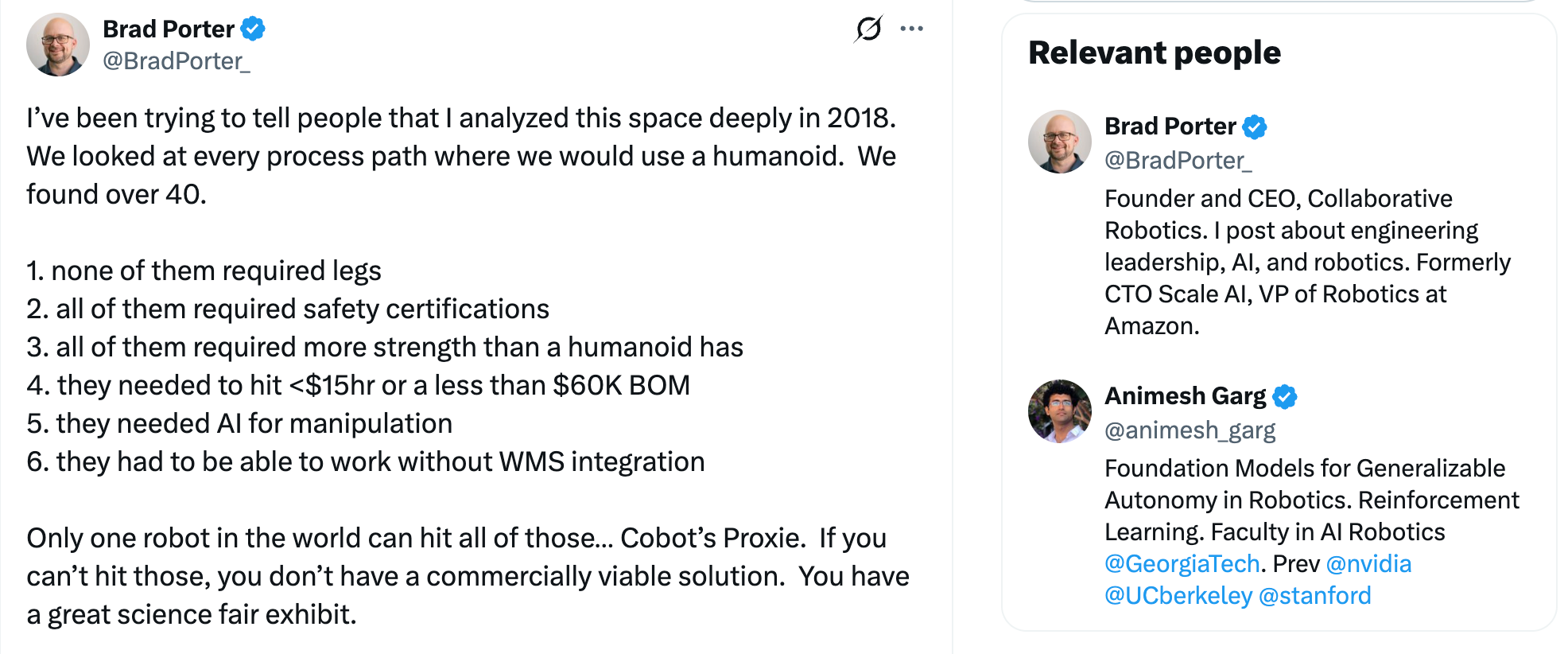
See the discussion on hardware survival and humanoid use cases on X
RUMOR: Tesla could be collaborating with Sumitomo Drive Technologies in Langley, British Columbia on gearbox and reducer prototypes for Optimus actuators. /Tesla Yoda on X/
Business Transactions
This week’s top funding events, acquisitions, and partnerships across industrial value chains.
🇺🇸⚡ X-energy Closes Oversubscribed $700 Million Series D Financing Round to Continue Expansion to Meet Global Energy Demand
X-Energy Reactor Company, LLC, a leader in advanced nuclear reactor and fuel technology, announced it has closed an oversubscribed Series D financing round of approximately $700 million led by Jane Street, from new investors including ARK Invest, Galvanize, Hood River Capital Management, Point72, Reaves Asset Management, XTX Ventures and various others, as well as existing investors including Ares Management funds, Corner Capital, Emerson Collective, NGP, Segra Capital Management and others.
X-energy expects to utilize proceeds from the round to help continue the expansion of its supply chain and commercial pipeline, supporting an industry-leading orderbook of more than 11 GW, representing approximately 144 advanced small modular reactors.
Read more at Business Wire
🇺🇸⚡ Export-Import Bank to spend $100bn to achieve US energy dominance /FT/
🇬🇧📐🧠 PhysicsX Announces Series B Round Extension
PhysicsX, the physical AI company redefining the future of engineering and manufacturing, announced an extension to its Series B funding round, with a new investment from NVentures, NVIDIA’s venture capital arm. This brings PhysicsX’s total Series B funding to more than USD 155M, valuing the company at nearly USD 1B. The round was led by Atomico in June 2025, with participation from Temasek, Siemens, Applied Materials, and July Fund, as well as continued support from existing investors including General Catalyst, NGP, Radius Capital, Standard Investments, and Allen & Co.
Read more at PhysicsX
🇩🇪📐🧠 Numerical Machine Learning: Where Physics Meets AI /Industrial AI Podcast/
🇨🇭🚜🧠 Gravis Robotics raises $23M to scale autonomous earthmoving tech
Gravis Robotics has secured $23 million in fresh funding, co-led by IQ Capital and Zacua Ventures, with participation from Pear VC, Imad (CVC of Nesma & Partners), Sunna Ventures, Armada Investment and Holcim. Alongside the funding, the company has announced a series of new industry partnerships that further strengthen its position in the effort to transform global construction.
Founded in late 2022 as a spinout from ETH Zurich, Gravis addresses key structural challenges in the construction sector (rising demand, declining productivity and an ageing workforce) by focusing on improving output rather than overhauling existing processes. Leveraging the team’s expertise in AI and autonomy, its retrofit system goes beyond basic command-based operation, adapting to real ground conditions via a learning-based control system that “feels the soil” using data from hydraulics, LiDAR, cameras and GNSS.
Read more at Tech.eu
🇨🇭📹🧠 Cerrion raises $18M to reduce factory downtime with AI video agents
Cerrion, the Swiss-founded AI video agent platform that detects and resolves production line issues in real time, has raised $18 million in Series A funding to further expand and scale operations in the US and Europe. The round was led by Creandum, with participation from existing investors Y Combinator, Goat Capital, 10x Founders and Session VC, alongside prominent angels including Harry Stebbings (20VC), Oskar Hjertonsson, Thomas Wolf (Hugging Face) and Garret Langley (Flock Safety).
Cerrion addresses downtime issues with AI video agents that monitor factory operations beyond what workers can directly observe. These agents help operators detect and respond to process deviations, quality issues and safety risks in real time, triggering alerts, slowing or stopping machines and notifying relevant personnel as needed. This combination of automated intervention and human oversight enables manufacturers to resolve problems up to 50 per cent faster, reducing downtime and scrap losses by up to half.
Read more at Tech.eu
How Machine-to-Machine Communication Will Power Physical AI /EETimes/ with RealSense the defacto-standard 3D stereo camera for robotics /GitHub/
🇺🇸🚢 Y Combinator-backed Maritime Fusion Raises $4.5M From Trucks VC, Paul Graham
Maritime Fusion, a fusion energy company developing first-of-a-kind (FOAK) reactors for maritime and off-grid applications, announced the closing of a $4.5 million seed round led by Trucks VC, with participation from Silicon Valley legend Paul Graham, Alumni Ventures, Aera VC, Y Combinator, and several strategic angel investors. The capital accelerates the company’s mission to develop its HTS cable technology and bring fusion power to the commercial shipping industry before grid-scale adoption.
Read more at PR Newswire
🚢 Report shows how SMR-powered ships could transform trade /The Engineer/ with a 15,000 TEU nuclear-powered containership cruising at 25 knots, approximately 40 per cent faster than conventional vessels, which operate at lower speeds to reduce fuel consumption.
🛥️ ExploMar Closes Over USD 10 Million Financing to Accelerate Global Expansion /PR Newswire/ of its high-performance electric propulsion systems for boats
🛥️ Flux Marine’s $15M Infusion Fuels Production Ramp to Meet Expanding Order Book /Access Newswire/ of its fully commercialized its 115HP electric outboard and modular battery pack
Want more? Check out the bonus reads below 👇