


Shop Talk
Capturing this week’s zeitgeist
I am excited to continue my collaboration with Allie Systems with a virtual round table on "Fact vs. Fiction: What It Really Takes to Build a Factory That Thinks”, this Tuesday, March 31 at 11 AM CST. The session is designed to get past the hype cycle and share what's working on the floor. We will dig into the data foundation problem, change management, use case mapping, and what "autonomous operations" actually looks like in practice.
Connect with Allie Systems on LinkedIn for an invite
Quote of the Week
Build samples. Test them. Analyze deeply why things fail. Build tests that catch those failures. Correlate your module-level tests with system-level FATP tests. Go back to the process, tune it. Build more samples. Repeat.
This is how you observe the “reinforcement learning” of manufacturing. Not by reading about it — by running the loop yourself, staring at failure pareto charts, arguing with the process engineer about whether the epoxy dispense volume is drifting, and watching the yield numbers tick up over weeks as you close the gaps.
Read more at “The Dark Matter of Hardware Engineering” /Dark Matter/
🧪📊🧠 53 Years of Trade Secrets, Locked in Software That Will Never See an AI /Dan Thompson on X/
New in 2026: We are gifting a 1-year paid subscription to the first person to identify the content link AND cultural reference to the title/subject line of this week’s digest. Comment on this post with your guess before next week’s digest is released to be eligible!
Last week’s answer: The Automation High Point Story ends as a new era takes over.
Assembly Line
This week’s Industry 5.0 breakthroughs and frontier technologies of the built world.
👕♻️ How Renasens Cracked Textile Recycling And Raised $11.5 Million
✍️ Author: Brooke Roberts-Islam
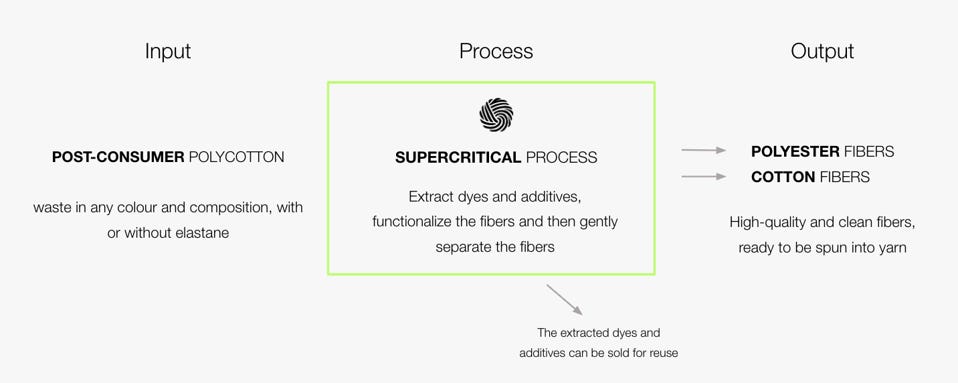
The engineer’s technology uses supercritical carbon dioxide (a fluid) as the solvent (dissolving solution) rather than water or harsh chemicals, thereby reducing water and energy use and the overall footprint of the recycling process. While the use of supercritical CO₂ is not novel, the application for textile recycling is.
Read more at Forbes
🪫 Why this battery company is pivoting to AI /MIT Technology Review/. SES AI is hoping for a new life after more than a decade in the battery manufacturing business.
🎛️🖥️ What Happens When Manufacturers Build Their Own MES Applications in Two Days
✍️ Author: Jenna Gabriel
Production Lab is a two-day, hands-on building event where MachineMetrics customers work side by side with our engineering team to design and build custom applications on the MachineMetrics platform. The tools they used: Max AI for data exploration and prompt development, Lovable and Cursor for AI-assisted application building, and Carbide, MachineMetrics’ custom application builder, for deploying production-grade applications directly into the platform. Every team shipped a working solution tied to real, live machine data by the end of day two.
The execution gap is real. It lives between what your ERP plans and what your shop floor actually does, and it costs manufacturers margin, capacity, and hours every single shift. Closing it requires software that fits how your operation actually runs, not a generic template you adapt yourself.
Read more at MachineMetrics
🖥️🎛️ The software-defined factory hinges on ROI /AutomotiveWorld/
📐🧠 Engineering intent to compiled into engineering artifacts
In our setup, a textual description of a production environment and the objects to be placed is enough to generate USDA files, the native scene description format used by NVIDIA Omniverse to describe 3D scenes, assets, transformations, materials, hierarchies and layouts.
The workflow looks like this:
An engineer describes what they want to visualize.
Claude (Opus 4.6) compiles this description into machine-readable USDA files.
Omniverse loads the scene and the factory layout appears.
What sounds simple is actually a big shift. In the future, engineers will no longer interact directly with engineering tools.
Read more at Dr. Dirk Alexander Molitor on LinkedIn
📐🧠 Continuous Design Reviews with AI, in addition to manual human reviews is the future. /Dalus on X/
📐 The Myth of CAD as Code /emm0sh on X/
📐🧠 Synopsys Brings Agentic Engineering Into Focus as AI-Driven Design Tests Productivity Limits /EETimes/

New Product Introduction
Highlighting new and innovative facilities, processes, products, and services
🏆 The most innovative manufacturing companies for 2026
The most consequential changes are unfolding across materials and components that form the foundation of industrial supply. Hertha Metals and Electra are disrupting the carbon-intensive economic model of steel and iron production with electrified, cost-effective methods that can be integrated into existing infrastructure. Abstrax is stabilizing climate-volatile agricultural inputs with precision-engineered flavor systems that enable beverage makers to maintain product consistency despite climate variability. Likewise, TerraSlate is disrupting coated and laminated materials with a recyclable waterproof paper that can withstand industrial use, without relying on plastic.
At the factory level, Acerta AI and Sight Machine are embedding diagnostics and analysis directly into live operations so defects can be traced and corrected in minutes instead of days. Freeform’s high-throughput metal printing architecture and Cellares’s automated cell therapy facilities showcase that machine learning and robotics can maintain tight tolerances while dramatically increasing throughput.
Read more at Fast Company
🤝🧑🔧 Augury and MaintainX Partner to Deliver Closed-Loop Maintenance Execution for Frontline Teams /PR Newswire/
🤝 Apple adds new partners, Bosch, Cirrus Logic, TDK, and Qnity Electronics to its American Manufacturing Program /Apple/
💿 Arm expands compute platform to silicon products in historic company first
Arm Holdings plc (NASDAQ: ARM) today announced the next evolution of the Arm compute platform, extending into production silicon products for the first time in the company’s history. This begins with the launch of the Arm AGI CPU, an Arm-designed CPU for AI data centers, built to address a rising class of agentic AI workloads.
For more than three decades, the industry has innovated on the Arm compute platform to deliver scalable, power-efficient computing across hundreds of billions of devices. As AI transforms global computing infrastructure, partners across the ecosystem are asking for ways to deploy Arm technology at scale. In response, Arm is expanding its platform strategy beyond IP and Compute Subsystems (CSS) to include Arm-designed silicon products – giving partners the broadest set of options to build on Arm and enabling faster innovation across the AI ecosystem.
Read more at Arm
💱 Scaling Token Factory Revenue and AI Efficiency by Maximizing Performance per Watt /NVIDIA/
💿 ASML accelerates advanced semiconductor lithography with Mistral AI /YouTube/
💿 Microsoft-backed startup, Lace, raises $40 million for advanced chipmaking equipment tech /Reuters/
🛢️🧠 Aker BP, Armada to deploy offshore modular data center for AI-driven drilling operations
Aker BP and Armada have entered into an agreement to deploy Armada’s Galleon modular data center for use in an offshore drilling environment on the Norwegian Continental Shelf. Under the agreement, Armada will deliver a Galleon designed to operate in offshore conditions, enabling local processing and analysis of drilling and operational data directly on the rig.
By deploying compute infrastructure directly offshore, the Galleon strengthens operational resilience and standardizes adoption and use of critical vendor applications. Running AI models locally allows energy companies to predict and prevent equipment failures before they occur, reduce unplanned downtime, and maintain continuity during connectivity disruptions. Local compute infrastructure also enhances cybersecurity by minimizing reliance on external networks.
Read more at PR Newswire
🛢️🧠 Onshore Well Exploration & Intervention Demo /Cognite/
🛢️🧠 Cognite and NVIDIA Operationalize NV-Tesseract to Transform Industrial Forecasting /Business Wire/
Business Transactions
This week’s top funding events, acquisitions, and partnerships across industrial value chains.
🇺🇸🦾🧠 Physical Intelligence in Talks to Raise $1 Billion at $11 Billion Valuation
✍️ Authors: Natasha Mascarenhas, Rebecca Torrence, and Shirin Ghaffary
Physical Intelligence, a two-year-old robotics startup founded by AI academics and former Google DeepMind researchers, is discussing a new funding round of about $1 billion that would bring the company’s valuation to more than $11 billion including dollars raised, according to people familiar with the matter.
The ultimate goal, the company has said, is building models that enable robots to perform any function requested by the user through “vision-language models,” in the same way that large-language models complete digital tasks on command. In recent weeks, the company has released new research about improving memory in robotic software models as well as performance on precise tasks that require careful and detailed manipulation of objects.
Read more at Bloomberg
🇬🇧🦾🧠 Stateful Robotics has raised $4.8 million in pre-seed funding /TFN/
🤝🦾🧠 Agile Robots and Google DeepMind partner to bring intelligence to robotics /Agile Robots/
🇯🇵🧠 Mitsubishi Electric Invests in AI Startup Sakana AI /Business Wire/
🇺🇸🖥️🎛️ DOSS raises $55M to Build the Operations Cloud for the Real World
DOSS raised a $55M Series B, co-led by Madrona and Premji Invest, with Greyhound, Commerce Ventures, and Intuit Ventures as new investors, and continued investment from Theory, General Catalyst, Contrary Capital, Mintaka, and Pathlight VC, and 47th Street Partners.
This raise enables them to: invest deeply in core platform and unified data model, so companies can go live faster with intelligent systems that adapt as fast as their business grows, develop agentic systems that remove the human bottleneck from configuring operations, further define a new category around adaptable operations, not static systems
Read more at DOSS
The logistics industry used to outsource to what are known as BPOs (it stands for business process outsourcers), now, AI is doing 80% of the texts and calls. /Aaron Rubin on X/
🏴⚗️ Biomanufacturing Pioneer Cauldron Raises $13.25M
Cauldron Ferm, a leader in advanced biomanufacturing, announced a $13.25 million Series A2 priced round. The round was led by Main Sequence Ventures, with participation from Horizons Ventures, SOSV, and NGS Super, bringing Cauldron’s total funding to $26 million.
Cauldron’s develops a continuous “hyper-fermentation” platform – a proprietary technology designed to deliver step-change improvements in bioprocess efficiency. Biomanufacturing uses living cells as programmable factories, where bio-engineered microbes convert simple inputs like sugars into valuable products. Cauldron’s key advantage is keeping these microbes in a highly productive steady state and running processes continuously for long periods. This increases output while significantly lowering production costs, helping bioproducts compete with conventional industrial alternatives.
Read more at Business Wire
🇺🇸 Helix Earth Secures $12 Million in Oversubscribed Seed 2 Funding to Revolutionize Energy Efficiency and Humidity Management in Commercial HVAC Systems
Helix Earth, a Houston-based hardware company built on proprietary liquid-gas chemistry with roots in NASA aerospace technology, announced today the successful close of its $12 million oversubscribed Seed 2 funding. The oversubscribed financing round was led by Veriten, an energy research, strategy, and investing firm, with participation from Rua Ventures, Carnrite Ventures, Skywriter LLC, Textbook Ventures, and others.
Helix Earth is developing a one-of-a-kind, cost-effective commercial air conditioner add-on that bifurcates the energy required for temperature management from moisture control. The result is healthier indoor air, lower energy bills, reduced building maintenance, and more comfortable spaces for building owners and occupants.
Read more at Business Wire
Looking for additional content? Paid subscribers get more stories delivered each week as part of Overcapacity!