


Shop Talk
Capturing this week’s zeitgeist
At Exponential Industry, our goal is to cover technology breakthroughs, business adoption, and heritage across the heavy industrial world. Moving forward, I will reduce the amount of AI-centric material /Reuters/ (you can find that on plenty of other publications) in this weekly digest with more cars, ‘dozers, and rockets! Enjoy!
Heard on the Floor
one of the most important bottlenecks for diffusion of learning-based robots — that there is a material cost of verification for physical actions.
Please spread the word of Exponential Industry by sharing the publication
Assembly Line
This week’s industrial breakthroughs and frontier technologies of the built world.
Deploying Megapack At Scale
At Tesla, we think about the full project as our product. Executing Megapack projects at scale is extremely complex. Our products are designed for fast and simple installation ensuring projects are deployed and connected to the grid on time and as fast as possible.
Drew Baglino, Heron Power, Elon’s Former Battery Chief on Making Transformers 100x Smaller /YouTube/
Unitree G1 Knee Actuator Teardown
The Unitree G1 knee actuator integrates a permanent magnet synchronous motor (PMSM), a two-stage planetary reduction, dual magnetic encoders, and a motor driver into an 80 mm OD by 64mm profile weighing approximately 1000g. Rated at a peak torque of 120 N·m (derived peak torque density of roughly 120 N·m/kg), the design emphasizes axial compactness and high structural integration for dynamic legged robotics.
Read more from Grant on X
Actuate 2026 Recap /Foxglove on X/
Where Does Value Accrue in Robotics? /Joanna Lichter on X/
Zetta ζ: An Efficient Closed-Loop Embodied Harness for Self-Evolving Physical Intelligence
✍️ Authors: Xin Ding, Liang Mi, Mingzhe Huang, et. al.
Embodied agents are increasingly used to close the gap left by end-to-end policy models. Yet the agentic path has not realized closed-loop learning in physical execution: existing harnesses remain largely open-loop, following fixed skills during rollout and reflecting only after an episode completes. Such post-hoc reflection cannot govern execution as it unfolds, because physical interaction requires decisions to track rapidly changing robot-environment states at a frequency beyond today’s large agentic models.
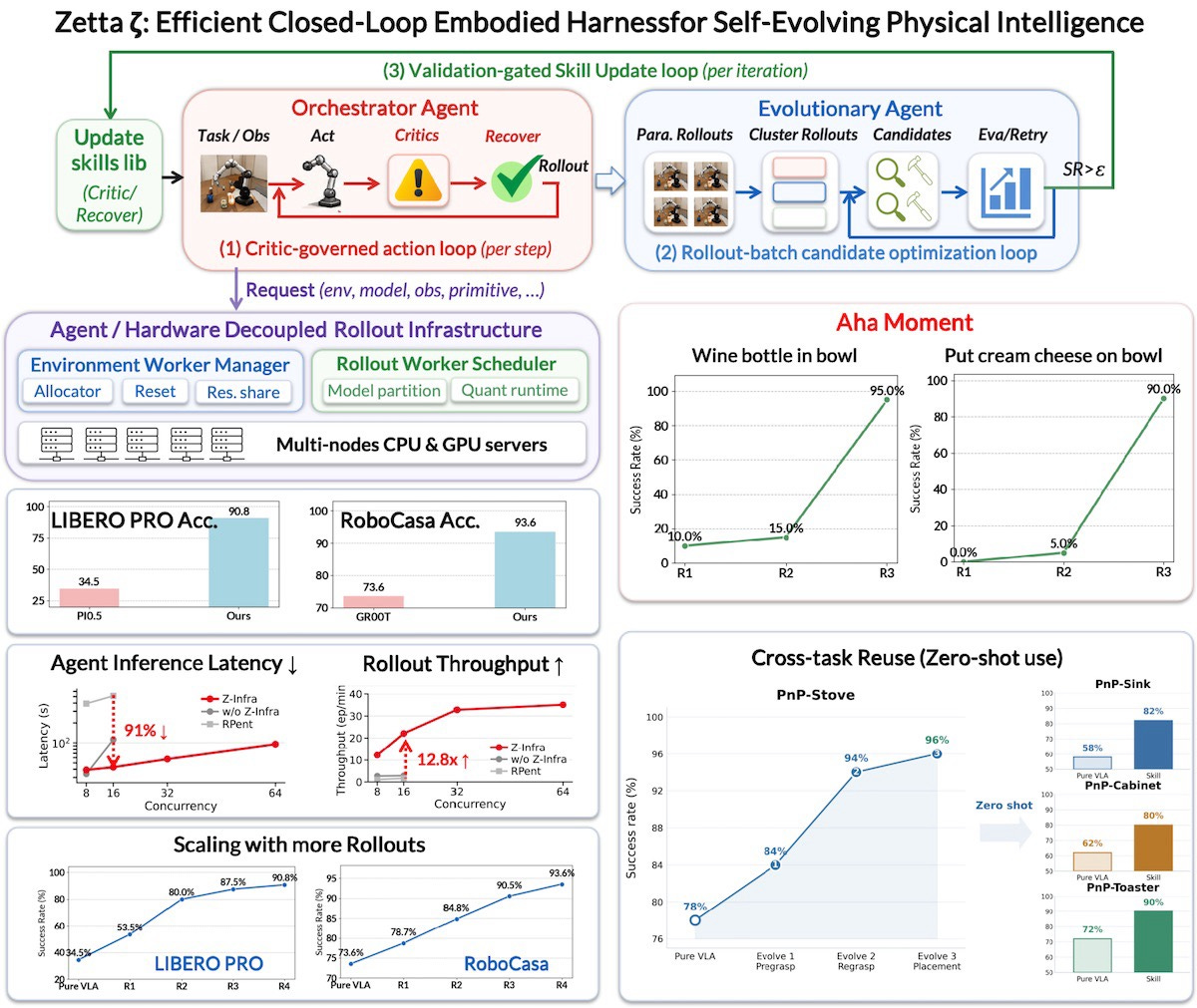
We present Zetta, a closed-loop embodied harness that evolves code-based runtime critics and recovery skills online while keeping the base policy frozen. Through three timescale-separated loops, Zetta provides action-frequency governance, rollout-level critic-recovery proposal, and validation-gated skill updates. Together with Z-Infra, a rollout infrastructure decoupling agent logic from heterogeneous execution resources, Zetta achieves state-of-the-art success on LIBERO-Pro and RoboCasa under our current rollout budget, reaching 90.8% and 93.6%, with an 11.1x inference speedup; success continues to scale with self-exploration experience; learned skills transfer zero-shot, and clear robotic “Aha Moments” emerge. These results show that closed-loop harness self-evolution opens a scaling path for reliable physical intelligence.
Ludi₀.₁: An Agentic System for Socially Intelligent Robots /Ludo Robotics/. Ludi₀.₁ is our first system designed to integrate robot perception, navigation, and manipulation with interactive speech, dialogue, memory, and social reasoning in a functioning robot. We deliberately chose an agentic architecture rather than relying on a single end-to-end model.

New Product Introduction
Highlighting new and innovative facilities, processes, products, and services
Previewing the Model Hardware Standard
We’re opening a research preview of the Model Hardware Standard (MHS), a shared specification for AI agents to safely operate physical devices, to a first group of scientific research labs and advanced manufacturers. MHS enables AI agents to operate multiple lab and manufacturing instruments, such as microscopes, liquid handlers, and robotic arms, in parallel, and perform intricate tasks ranging from routine drug discovery experiments to laser calibration on a quantum computer.
MHS addresses these challenges by introducing a standardized driver: software that translates between a computer’s operating system and a hardware device. The MHS driver uses a simple set of primitives—commands like “read” (for example, “get temperature”) or “write” (for example, “set temperature”)—that any hardware device can understand and act on. And it makes each device discoverable in a standard format, so that devices and agents can find each other and communicate across networks without needing a bespoke “translator” program in between.
Early adopters include Hugging Face, who are adding MHS support in LeRobot, their robotics library, and Raspberry Pi, who are enabling MHS integration across a number of their products following successful tests using their Camera MHS Driver.
Read more at Anthropic
GeoField — verified generative engineering for shelf brackets
Introducing GeoField - a set of models that encode geometry, physics (FEA, Stress) and DFM into the same latent space, and reproduces (assisted with an additional design agent) geometries to meet the stated cases. Today, it’s just for L shaped brackets.
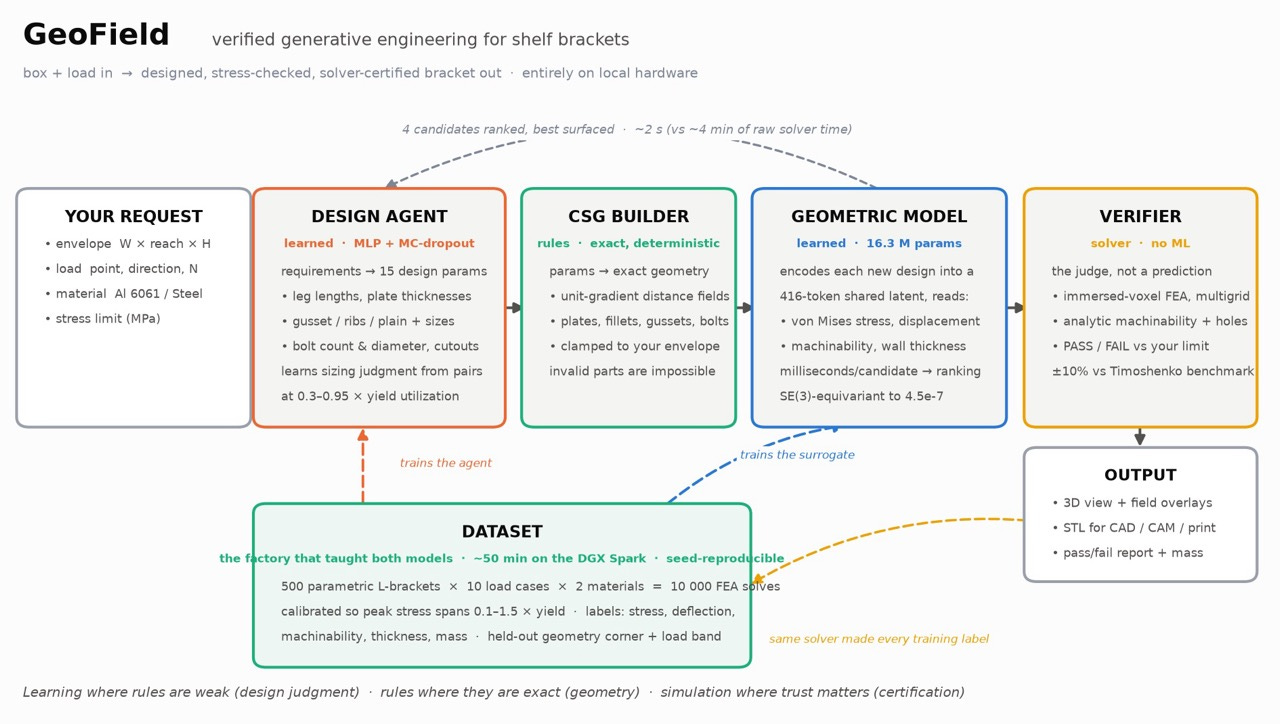
Give it a box and a load. It designs a bracket that fits and holds, predicts the stress in milliseconds, and certifies the winner with a real finite-element solve. Everything runs on local hardware; no cloud services, no CAD kernel, no meshes inside the model.
Read more from Connor Kapoor on X and GitHub
Hidden Factory
Unseen patterns in emerging industrial technology
Business Transactions
This week’s top funding events, acquisitions, and partnerships across industrial value chains.
Starcloud Raises $250 Million at $2.3 Billion Valuation to Scale AI with Orbital Data Centers
Starcloud, the company pioneering data centers in space, announced a $250 million Series A extension funding round at a $2.3 billion post-money valuation. The round was led by Manhattan West, with participation from existing investors Benchmark, EQT, Soma, NFX, 776, and others, alongside new investors NVIDIA, Cisco Investments, Cedar Capital, Goanna Capital, Standard Capital, and others. The funding brings Starcloud’s total capital raised to $450 million since its founding in 2024.
Starcloud’s collaboration with NVIDIA began when the company flew the first NVIDIA H100 GPU to orbit aboard its Starcloud-1 satellite in November 2025. As announced in March 2026, the two companies are now working together on NVIDIA’s Space-1 Vera Rubin Module /NVIDIA/.
Since launching Starcloud-1, the company has delivered a string of orbital computing firsts. It trained the first AI model in space. It ran the first version of Google’s Gemini in orbit. It demonstrated high-powered inference and fine-tuning on flight hardware. It also evolved operations and general procedures for running high-performance GPUs on orbit.
Read more at Business Wire
Voya Energy Unveils Metal Fuels Energy System, Closes $35 Million Series A
Voya Energy unveiled a new energy system pairing proprietary aluminum-based metal fuel with a purpose-built electrochemical generator that produces electricity without combustion or air emissions at the point of use. The company also announced a $35 million Series A to advance commercial deployment. The round was led by Energy Impact Partners (EIP), with participation from John Doerr, Mantis VC, StepStone, Founders Fund, Overmatch, Seven Stars and other institutional investors. The financing will support technology development, initial deployments in 2027 and manufacturing scale-up in 2028.
Voya is developing the system for data centers, industrial operators and other large energy users constrained by grid access, permitting or fuel logistics. Its fuel is produced from low-grade scrap aluminum and converted directly into electricity through a low-temperature electrochemical process. Voya’s industrial-scale design is expected to deliver up to two megawatts from a standard 20-foot container. At scale, the system is designed to provide approximately 100 megawatts of generation capacity and 10 gigawatt-hours of stored energy per acre—about four times more compact than diesel generator fleets and 100 times more compact than grid-scale battery installations.
Read more at Business Wire and Bloomberg
ALUMINIUM Global Exhibition 2026: What You Need to Know /SnerpaPower/
Teragen Energy Raises Oversubscribed $6M Pre-Seed Round to Power Today’s Frontier Industries /PR Newswire/ through a novel solid oxide fuel cell architecture, co-invented by CEO Dr. Ruofan Wang at Berkeley Lab “Scaleup and manufacturability of symmetric-structured metal-supported solid oxide fuel cells” /Journal of Power Systems/.
Motion raises $2M to bring humanoid robots to European factories
Motion is Europe’s first Humanoids-as-a-Service platform. Customers pay one monthly fee with no upfront capital, covering everything adoption requires: data collection, robot selection, task training, IT integration, fleet management, financing, insurance, compliance and maintenance. Two things set the model apart:
OEM-agnostic. We select whichever humanoid fits the task best, wheeled or legged, gripper or hand, so customers never bet on a single vendor or a single form factor in a fast-moving hardware market.
Every deployment makes the next one better, and your data stays yours. Each customer benefits from Motion’s deployment experience across the entire network, while each customer’s data remains its own on Motion’s secure European software layer, with cyber security built into every deployment.
The $2M pre-seed is led by Extantia Capital, with Norrsken Evolve, taking Motion’s five live pilots into full production and scales its Humanoids-as-a-Service model across the Benelux.
Read more at Motion